
The MiniMax Code CLI is open source. That does not mean it replaces Claude Code.
MiniMax published the terminal harness on 18 September 2026. MIT on first-party code. One curl line. A GitHub repo you can actually read — MiniMax-AI/minimax-code. The announcement leaned on FrontierHarness Eval: 23 of 30 tasks passed, median success time 4 minutes 33 seconds, second-lowest token use in that candidate set. Those numbers are real enough to notice. They are also not a swap-in for the tool you already have open.
MiniMax Code CLI vs Claude Code is a harness comparison, not a model comparison. That is the sentence people keep skipping. You can already point Claude Code at MiniMax models through MiniMax’s own Anthropic-compatible endpoint. You can also install mcode and leave Claude Code alone. Those are different jobs. Mixing them is how you waste a Saturday.
I cloned the public repo, installed the published npm CLI, ran their official fixture tests, and walked the command surface. I did not pretend I ran a paid all-day coding session. You will get the commands I ran, the version that landed, the two failing tests, and a rule for when the new harness is worth the context switch.
Why MiniMax Code CLI vs Claude Code showed up this week
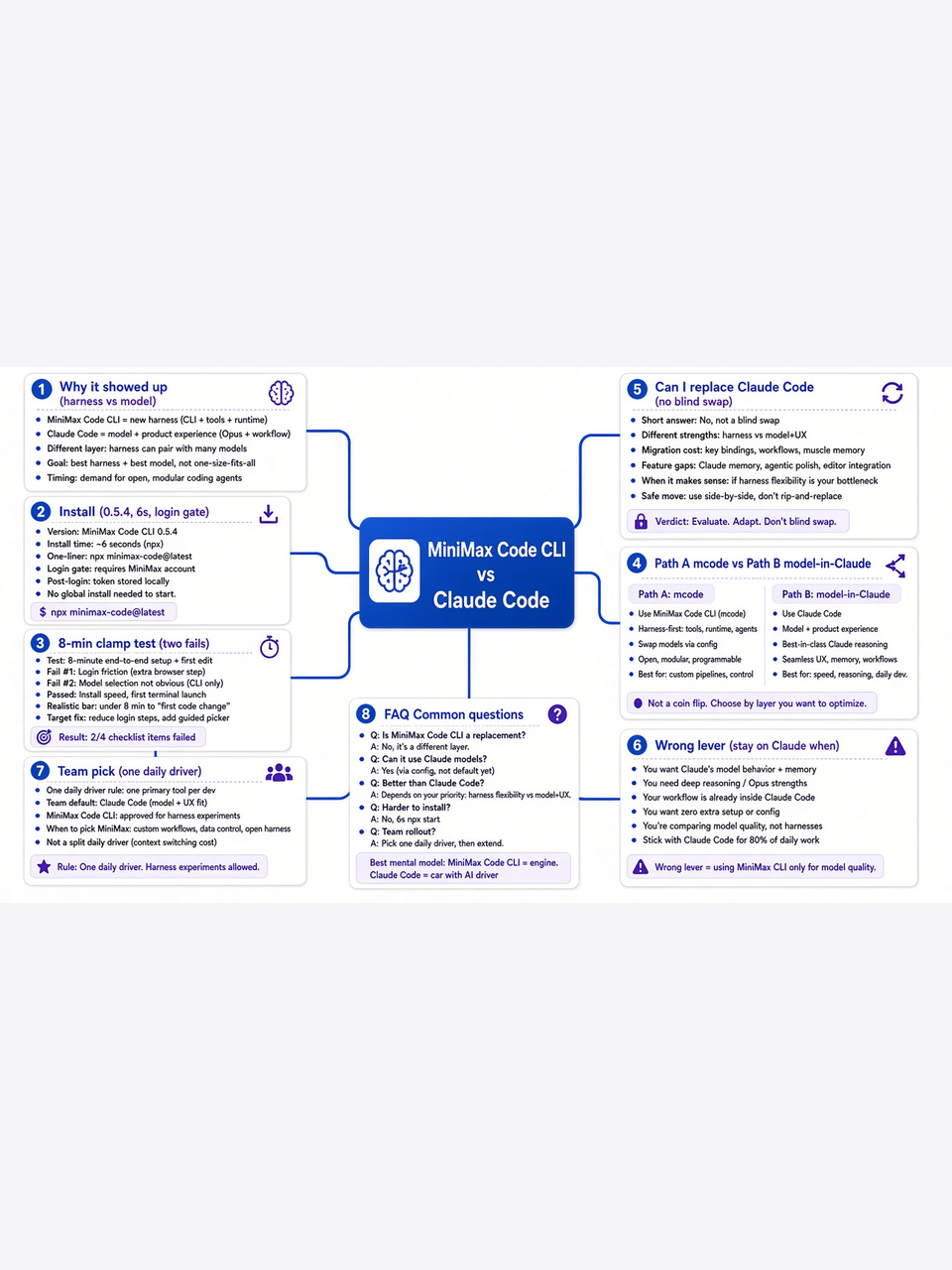
Before we talk about a harness, one idea has to be clear: the model writes tokens, the harness decides which files it may touch, which commands it may run, and how a session survives overnight. That wrapper is the harness (the loop, tools, permissions, and session file around the model). Claude Code is Anthropic’s harness. MiniMax Code is MiniMax’s harness. The model inside either one can change without the wrapper changing.
The early window is the wrapper. MiniMax opened MiniMax-AI/minimax-code under MIT for first-party code on 18 September. AIShareNet carried the drop within two days. r/LocalLLaMA and r/MiniMax_AI both treated it as a harness story, not another weight dump. The README is blunt about scope: terminal TUI, headless CLI, and ACP. The desktop app stays closed.
That last line matters more than the star count. You are not getting MiniMax Code the product. You are getting the inspectable agent loop they run in the terminal. If you wanted a cheaper model inside the habits you already have, MiniMax already documents the Claude Code path: write ANTHROPIC_BASE_URL and ANTHROPIC_AUTH_TOKEN into ~/.claude/settings.json and keep /status honest. The new repo is for people who want to read permissions, plugin loading, and mcode exec the way they already read learn-claude-code.
If you want the mental model for how a coding agent even loops, the learn-claude-code teardown is still the cleanest map. This post is the counterpart question: when do you keep that loop and change the model, and when do you change the loop.
What I actually installed (version, seconds, refusal)
I did this on a Linux box with Node v24.15.0. The public checkout on 24 September printed minimax-code 0.5.4 in the root package.json. That is newer than the 0.4.12 line in the open-source announcement. The published npm package matched the checkout.
Six seconds. Forty-three packages. mcode resolved to /usr/bin/mcode. Version string: 0.5.4.
mcode --help is a small surface: a prompt argument, --model, --session, --continue, then eight commands. init writes project guidance. exec runs one prompt without the TUI. acp speaks Agent Client Protocol (the stdio protocol editors use to drive an agent) over standard input and output. login / logout handle the MiniMax account. update patches the CLI. provider and plugin manage keys and extras.
Then I asked the headless path to do something tiny, with no account and no key:
The process did not hallucinate an answer. It exited with a single line: mcode exec failed: Sign in to MiniMax to use Agent features. Run mcode login, then retry. That is the right failure. The installer did not quietly phone home and invent a session. BYOK is documented as a separate path (mcode provider add plus MCODE_PROVIDER_API_KEY). I did not burn a key in this environment, so I stopped at the gate the product itself draws.
The checkout is not a toy folder either. Fifteen first-party packages under packages/: agent-core, agent-runtime, agent-tools, tui, oauth-core, local-runtime, local-runtime-v2, and the rest of the loop. Two vendored trees under third_party/: pi-mono and sandbox-runtime. AGENTS.md at the repo root says the quiet part out loud. This GitHub tree is a reviewed public projection of an internal monorepo. File moves have a merge cost the next sync will charge you for. That is why the desktop binary is missing and why LICENSE-STATUS.md refuses to pretend every bundled file is MIT.
The 8-minute MiniMax Code CLI vs Claude Code test
You can finish this without a billing argument. Copy their fixture, watch the tests fail the way they claim, then decide whether you are testing a harness or a model.
Minute 0 to 2. Install and pin the version.
If mcode is missing, use the official installer or the npm command above. Reopen the shell if PATH did not pick up ~/.minimax-code/bin.
Minute 2 to 4. Copy the official fixture. Do not edit it in the clone if you plan to pull later. The files live at examples/clamp/ in the repo.
I ran that exact suite. Three tests. One pass. Two fails. Duration 71 milliseconds. clamp(5, 0, 10) returned 0 instead of 5. clamp(14, 0, 10) returned 0 instead of 10. The implementation is four lines and the bug is the classic swapped min / max:
The README in that folder tells the agent not to rewrite the tests. That is the whole point of the demo recording they shipped. A harness that cannot read a four-line file, run node --test, and invert two arguments is not ready to replace your daily driver.
Minute 4 to 6. Pick the path you are actually testing.
Path A is MiniMax Code CLI as a harness. mcode login --region global (or mcode login for the CN account), then:
Path B is MiniMax as a model inside Claude Code. That is the setup MiniMax documents for people who already live in claude. You keep the CLAUDE.md, the skills, the prompt-audit habit. You change the endpoint.
Path B is not MiniMax Code CLI vs Claude Code. It is Claude Code with a different bill. Say that out loud before you tweet a winner.
Minute 6 to 8. Write three numbers from the same job: turns, whether tests passed without the agent editing the test file, and whether you had to babysit permissions. mcode exec exposes --permission smart|full|off, --effort, --max-steps, --timeout, and --output-format text|json|stream-json. Claude Code users already think in /usage and /effort. Compare like with like. One fixture. One definition of done. No vibes.
If you already cleaned house after the Opus 5.5 drop, run Path B against the same repo you used in the Opus 5.5 prompt audit. A dirty CLAUDE.md will punish both harnesses. It will punish the one you know how to audit first.
Can I use MiniMax Code CLI instead of Claude Code
Short answer: for a greenfield terminal agent, or for CI via mcode exec, yes you can start there. For a repo that already has a short CLAUDE.md, a prompt-audit habit, and a set of skills you trust, no. Keep Claude Code and change the model first.
The overlap is real. Both wrap a model in a terminal. Both have a plan mode. Both have permission modes. Both talk MCP (Model Context Protocol, the plug that lets the agent call a tool or a data source). Both can grow plugins. MiniMax Code adds three entry points MiniMax wants you to treat as first-class: the TUI, mcode exec for scripts, and mcode acp for editors that speak ACP. Claude Code’s gravity is the opposite direction. The ecosystem, the skills market, the audit skill, and the muscle memory already sit there.
Where MiniMax Code is honestly ahead on paper is inspectability. You can open packages/agent-tools and SECURITY.md and argue with the permission story. SECURITY.md is not marketing. It tells you the data directory holds login state and API keys in config.yaml, that sandboxing does not replace review of untrusted plugins, and that automatic permission classification should fall back to asking you rather than allowing by default. Claude Code’s loop is documented by the community and by Anthropic in pieces. MiniMax handed you a monorepo projection and a license file that admits the sandbox runtime is still Apache-2.0.
Where Claude Code is still the default is everything around the loop. Account recovery. Team habits. The prompt-audit command. The fact that your existing CLAUDE.md already loads. Switching harnesses means re-teaching the house rules. mcode init . writes AGENTS.md, not CLAUDE.md. That is a fine format. It is also a second briefing file to keep in sync if you keep both tools.
Cost talk needs the same split. MiniMax models are cheaper per million tokens than Opus-class Claude on the public price lists people have been circulating all year. That savings shows up whether the harness is mcode or claude. Reddit already has the scar tissue: people who bought a cheap MiniMax token pool and then watched a compatibility layer ignore prompt cache, or watched OpenCode and Claude Code report very different cache-read mixes on the same model. If your complaint is the invoice, change the model inside the harness you can already audit. If your complaint is that you cannot read the permission code, clone minimax-code.
One more limit I will not sand off. FrontierHarness Eval in the launch note used MiniMax Code 0.3.2 with Kimi K3 on 30 tasks. 23 passed, 4 failed, 3 timed out and counted against the pass rate. Time limits and providers were not identical to every published baseline they sat next to. Treat 76.7 percent as a candidate number, not a court verdict. Repo-level tests on your tree will move the number more than another screenshot of that table.
When the new harness is the wrong lever
Stay on Claude Code when the job is a long agent loop in a repo you already instrumented. The 65-line CLAUDE.md pattern exists because agents over-edit. The Opus 5.5 audit exists because agents over-think. Those files do not port by magic. You can copy them into AGENTS.md. You will still spend a week finding the sentences that only Claude Code ever honored.
Stay on Claude Code when you need the rest of the Anthropic surface in the same week: Cowork-style handoff, Marketplace connectors, the prompt-audit skill, the effort dial you just learned not to slam to xhigh. MiniMax Code will grow a marketplace of its own (mcode plugin marketplace). It is not the same catalog on day six of the source drop.
Use MiniMax Code CLI when you want a second opinion that cannot see your CLAUDE.md, when you want mcode exec --output-format json --max-steps 20 in CI, or when a compliance person asked you to show the permission code. Use it when you are comparing harnesses on purpose, with the clamp fixture first and your own failing test second.
Use MiniMax-the-model inside Claude Code when the invoice is the problem and the workflow is not. That is the boring answer and the one that ships Friday.
If you are already orchestrating more than one runtime, the Google AX hands-on is the other fork in the road: a declarative orchestrator is not a terminal coding agent. Do not flatten all three into one “agent” bookmark folder.
What this means if you pick tools for a team
The last year trained a sloppy reflex. A lab open-sources a terminal agent and the timeline treats it as a Claude Code funeral. It is not. It is a second readable loop, with a fixture that fails on purpose, and a login wall that does not fake success.
Keep one daily driver. Measure the other on a copied fixture and on one real ticket. If MiniMax Code fixes clamp, then fails your flaky integration test by rewriting the assertion, you learned more than FrontierHarness Eval will teach you this month. If it passes both and the bill drops because the model is cheaper, attribute the win to the model, not the logo on the spinner.
If you try only one thing from this page, make it the split.
Then pick Path A or Path B on purpose. Do not run both in the same folder until you know which file the agent is allowed to edit.
Common questions about MiniMax Code CLI vs Claude Code
Can I use MiniMax Code CLI instead of Claude Code?
Not as a blind swap. Use MiniMax Code CLI when you want an inspectable MIT harness, headless mcode exec, or ACP in an editor. Keep Claude Code when the repo already has skills, a short CLAUDE.md, and a prompt-audit habit. Try the cheaper MiniMax model inside Claude Code before you throw away the loop.
Is MiniMax Code CLI worth it if I already pay for Claude Code?
Worth installing. Worth running on the clamp fixture and one real ticket. Not worth making it the only tool on Monday morning. The install I ran took six seconds. The expensive part is re-teaching house rules to a second briefing file.
Does MiniMax Code CLI replace Claude Code now that it is open source?
No. Open source covers the terminal TUI, headless CLI, and ACP. It does not cover the desktop app. It does not move your CLAUDE.md, your Marketplace, or your team’s muscle memory. Source access also does not grant model credits.
How do I run MiniMax models in Claude Code without switching harnesses?
Follow MiniMax’s Claude Code doc. Set ANTHROPIC_BASE_URL and ANTHROPIC_AUTH_TOKEN in ~/.claude/settings.json, pick MiniMax-M3[1m] (or the current documented ID), then confirm with /status and /model. That path tests the model. It does not test mcode.
Why did mcode exec fail with a login error on a fresh install?
Because Agent features need a MiniMax sign-in or a configured provider key. I hit the exact line after a clean npm install: Sign in to MiniMax to use Agent features. BYOK is the other door: mcode provider add with MCODE_PROVIDER_API_KEY. The CLI refused to invent an answer. Keep it that way.
2 comments