
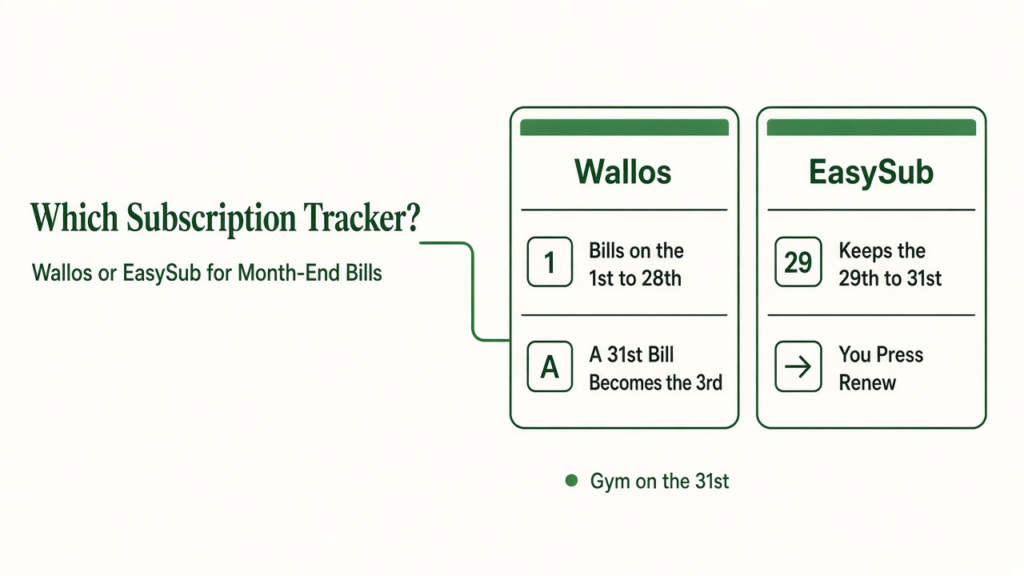

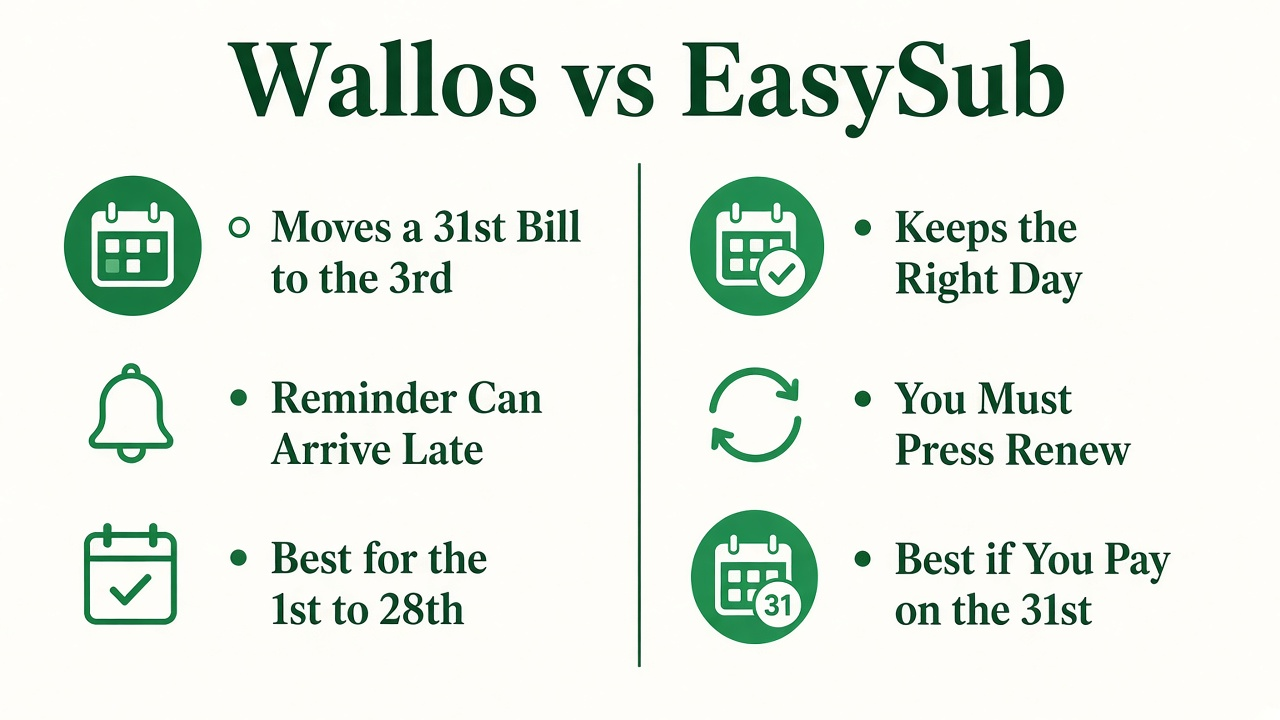
I added a gym bill that charges on the 31st to Wallos, let the nightly update run, and Wallos said the next charge was December 3. The real charge would hit on November 30. That is the case this post is about. Wallos is easiest if every bill lands between the 1st and the 28th. EasySub keeps the right day for the 29th, 30th or 31st, but you have to press Renew after each payment.
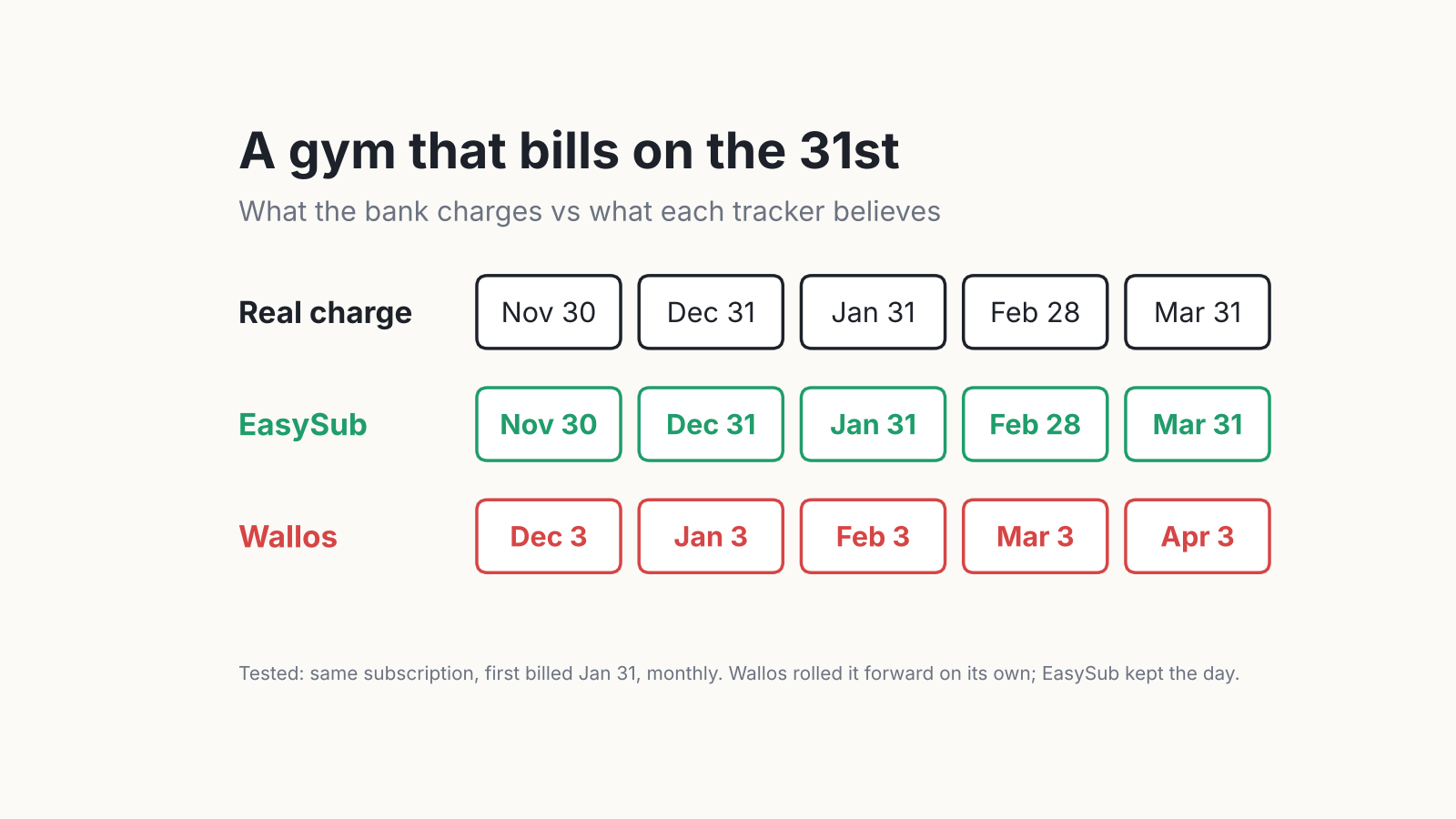
Say your gym charges you on the 31st. I added exactly that bill to Wallos, let the nightly update run, and Wallos said the next charge was December 3. The real charge would hit on November 30.
Why does a three-day gap matter? That gap is the whole post. A subscription tracker is only as good as the date it believes, because every reminder it sends is counted back from that date. Get the date wrong and the warning shows up after the money is gone.
So I put two self-hosted trackers on the same machine, gave them the same subscriptions, and watched what each one did with month-end dates, renewals and reminders.
What a Self Hosted Subscription Tracker Does
It is a small web app on your own server that lists what you pay for and warns you before each charge.
You type in each subscription once: name, price, how often it bills, and the next payment date. The app adds up your monthly and yearly cost and sends a message a few days before each charge. Self-hosted means it runs on your own computer, home server or a cheap VPS (a rented virtual server), so your list of bills never sits on someone else’s service.
Wallos is the one most people already know. EasySub is a newer one that shows up as a Wallos alternative, with a Chinese, English and Russian interface. Both are open source, both start with one Docker command, and both store everything in SQLite (a database that lives in a single file). Wallos is GPL-3.0 licensed. EasySub is MIT.
How I Tested Them
Same server, same bills, then I let each app do its own date math.
I started both containers and made an account in each. Then I added the same bills: a gym first billed on January 31, a VPS on the 30th, a domain renewed every February 29, and Netflix on the 15th.
Next I let each app roll its dates forward the way it does on its own and pressed the renew buttons. Finally, I pointed both apps’ reminders at a webhook (a URL that receives a message when something happens) on the same machine.
Idle, Wallos used under 50 MB of memory. EasySub used under 100 MB. Both are light enough for a small home server.
Wallos Moves a 31st Bill to the 3rd
Wallos adds “one month” by counting days past the end of a short month, so January 31 becomes March 3 and the 3rd sticks forever.
Start with how month math works. “January 31 plus one month” has no clean answer, because February has no 31st. Most billing systems pick the last day of the shorter month: February 28. Wallos runs on PHP, and PHP’s default month adding does something else. It treats February 31 as “three days after February 28” and lands on March 3.
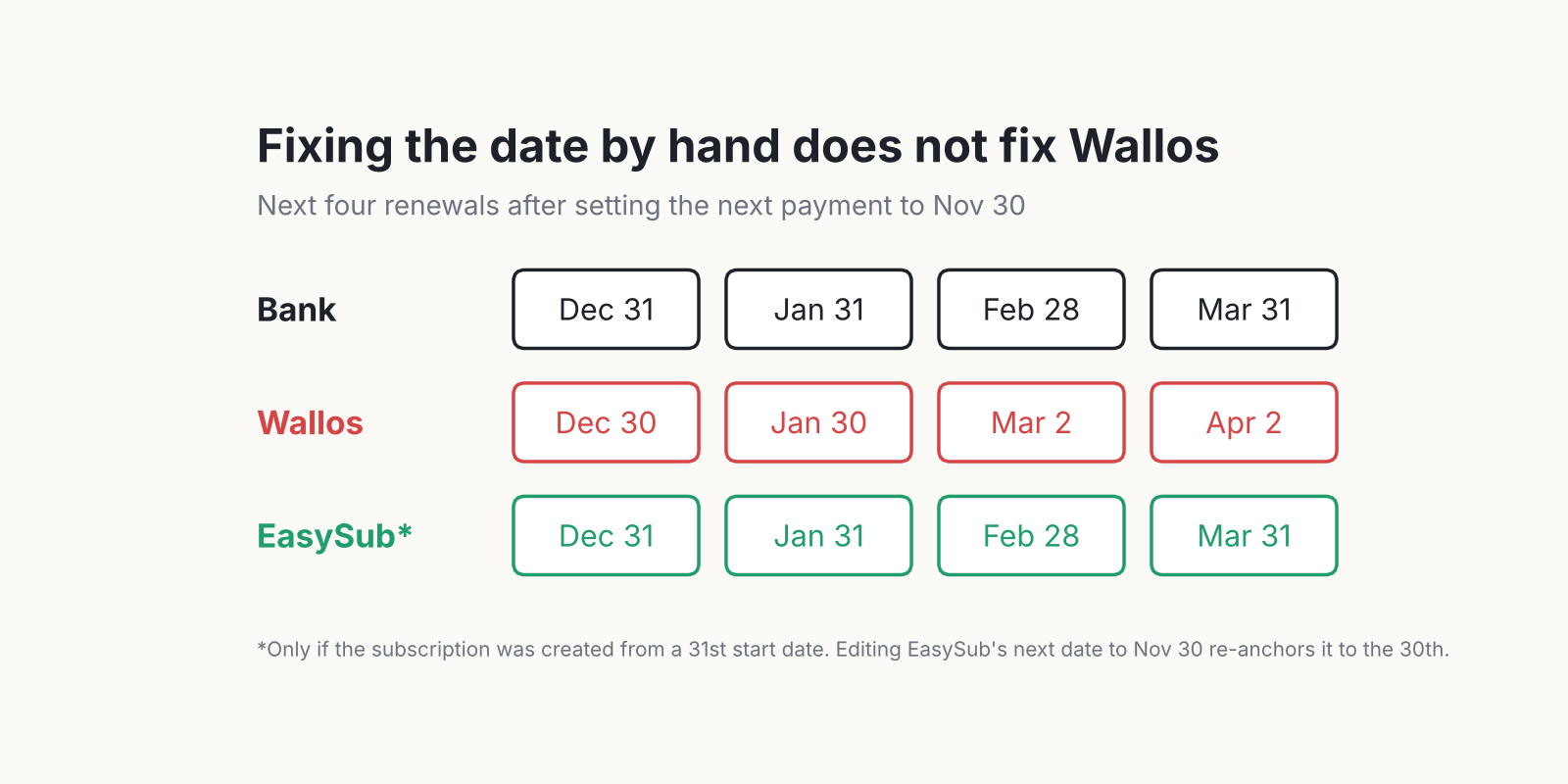
Wallos rolls dates forward with a cron job (a task the server runs on a schedule, here every night). Each night it checks for dates in the past and adds one billing cycle until the date is in the future. The gym went January 31, March 3, April 3, and on until it landed on December 3.
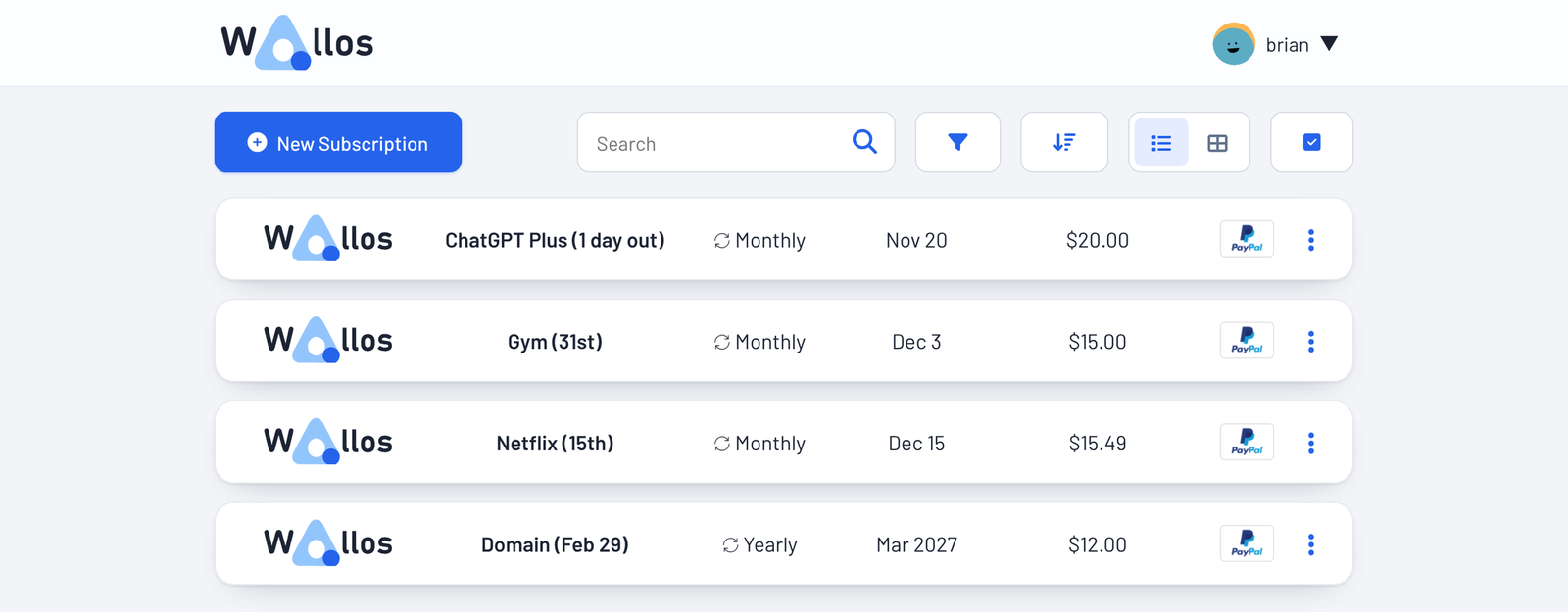
The Netflix bill on the 15th was perfect. The domain was not. A yearly bill on February 29 jumped to March 1 the next year and stays on the 1st after that. Any bill on the 29th or 30th drifts too, once a year, the first time it crosses February.
Can you fix it by hand? I tried that too. Setting the gym’s next payment to November 30 made Wallos step to December 30, January 30, then March 2. Wallos never keeps the original day. It only remembers the last date it saved.
A Wrong Date Can Miss the Reminder
Yes, because Wallos sends one reminder on one day, counted back from its own date.
Wallos checks once a day and sends a reminder when the next payment is a set number of days away. You pick the number. With it set to one day, the gym reminder goes out on December 2, which is two days after the card was charged.
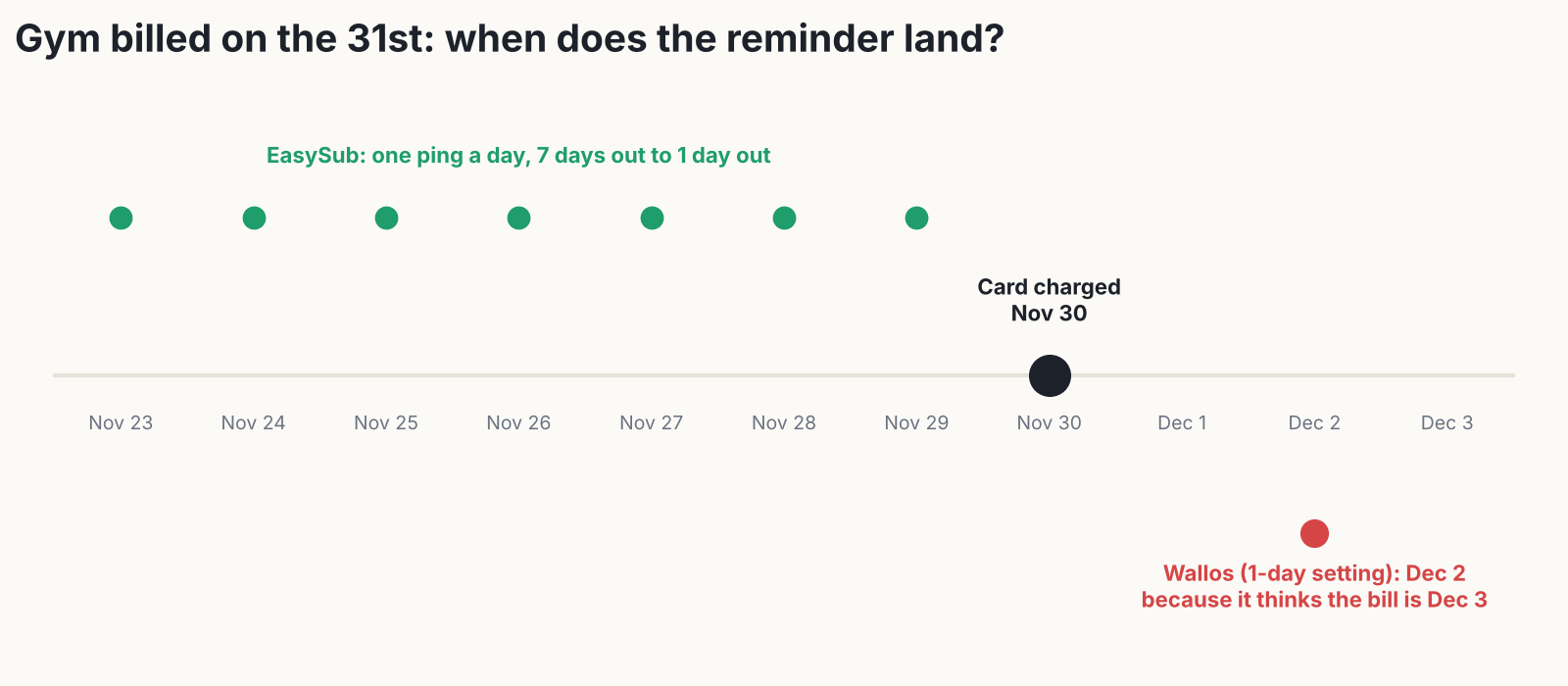
What if you set it to five days? Then it arrives November 28, so you are fine this time. But the gap grows to three days at the worst, and you have to know about the bug to choose a number big enough. Most people pick one or two days and forget about it.
How EasySub Handles Month-End Bills
EasySub saves the original billing day separately, so a bill on the 31st stays on the last day of every month.
EasySub stores an anchor day (the day of the month a bill should land on) next to each subscription. When it moves a date forward, it aims for the anchor and drops to the last day only when the month is too short.
The gym went November 30, December 31, January 31, February 28, March 31. Exactly what the bank does. The February 29 domain went to February 28 in a normal year.
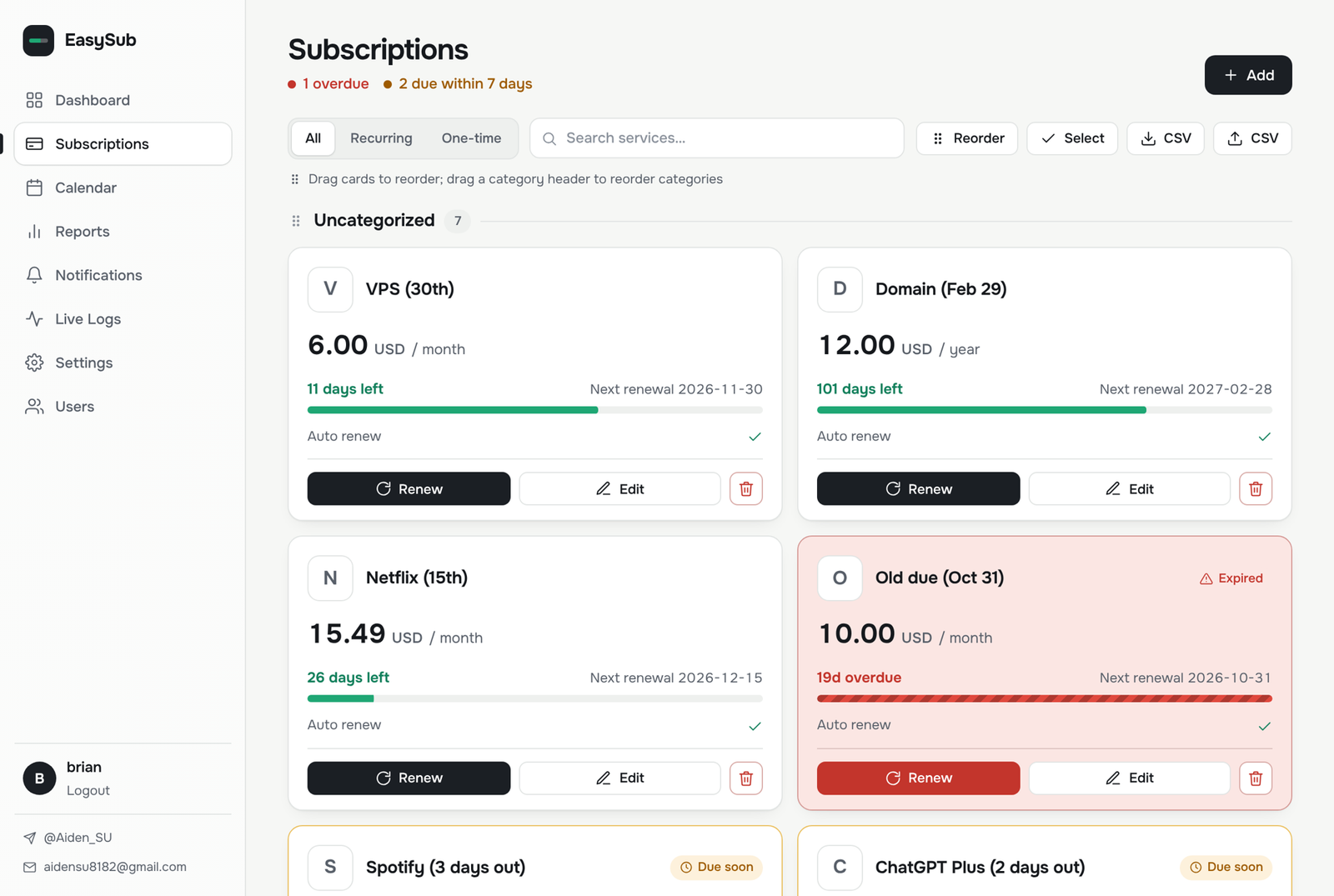
Reminders are also harder to miss. By default EasySub pings you every day from seven days out to one day out. My webhook listener received the message the moment I ran the reminder check. Wallos delivered too, once I let it reach my local address.
The Catch With EasySub
It does not move a date forward by itself. After each payment you press Renew, or the bill turns Expired and the reminders stop.
The “auto renew” switch on each card is only a label. I added one bill with a due date that had already passed, and it sat there marked Expired, with no next date and no more reminders, until I renewed it. Wallos would have rolled it forward that night.
That gives you the real trade-off. Wallos is automatic but wrong on month-end dates. EasySub is right on month-end dates but manual.
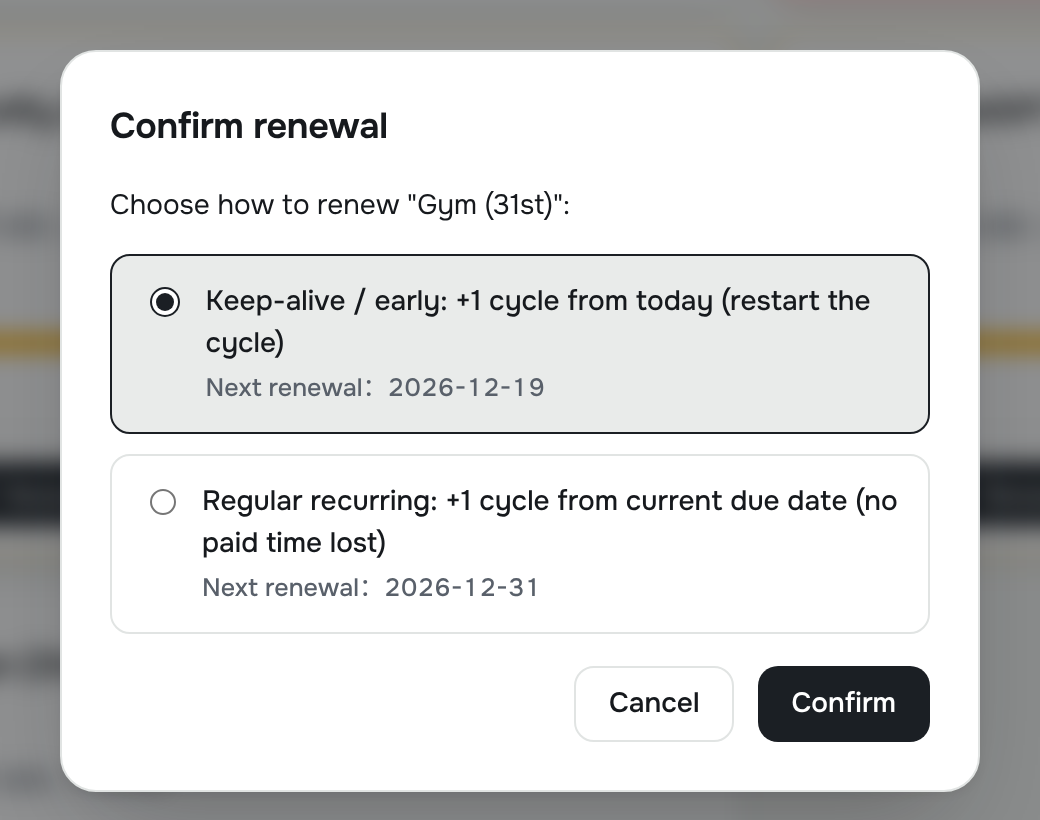
The Renew button has one more trap. It opens a dialog with two choices, and the selected one is “+1 cycle from today”. Pick that for the gym on November 19 and the next charge becomes December 19, a date the gym never uses. For a normal bill you want the second option, “+1 cycle from current due date”.
Editing a date has a similar side effect. When you change a subscription’s next renewal date, EasySub resets the anchor to that new day. Change the gym to November 30 and it will bill on the 30th from then on. The clean way to add a 31st bill is to put a past 31st in the start date and leave the next renewal date empty. EasySub works out the rest.
Three smaller things you will hit on day one:
- New accounts use Chinese yuan as the main currency. Change it in Settings, or every total converts to CNY.
- The reminder text arrived in Chinese even with the English interface switched on.
- Both apps block reminders to addresses on your home network by default, so a self-hosted ntfy or Gotify server will fail until you allow it.
That last one is the easiest to miss. In Wallos you add the address to an allowlist (a list of addresses it is allowed to call) in the admin page. In EasySub you set OUTBOUND_PRIVATE_ALLOWLIST in the container, like 192.168.1.10:8080. If you have not picked a push server yet, the ntfy vs Gotify comparison shows how to set one up.
How to Install Them
One Docker command each, then you register in the browser.
Run this for Wallos. The two volumes keep your data and logos safe across updates:
docker run -d --name wallos -p 8282:80 \
 -v wallos_db:/var/www/html/db \
 -v wallos_logos:/var/www/html/images/uploads/logos \
--restart unless-stopped bellamy/wallos:latestThen this for EasySub. Everything lives in one data volume:
docker run -d --name easysub -p 8842:8000 -e EASYSUB_DB=sqlite \
 -v easysub_data:/app/data --restart unless-stopped \
suyijun8182/easysub:latestOpen the port in your browser and register. In both apps the first account becomes the admin. Set the TZ variable to your own time zone on both, so the nightly jobs and reminders run on your clock and not the server’s.
Wallos vs EasySub at a Glance
Wallos wins on automatic dates and English polish. EasySub wins on correct month-end dates and reminder coverage.
| Wallos | EasySub | |
|---|---|---|
| Bill on the 31st | Drifts to the 3rd | Last day of each month |
| Moves past dates forward | Yes, every night | No, you press Renew |
| Reminders | One, on a day you choose | Daily, 7 days to 1 day before |
| Reminder language | Your interface language | Chinese |
| Home network push targets | Admin page allowlist | Environment variable |
| Idle memory | Under 50 MB | Under 100 MB |
| License | GPL-3.0 | MIT |
There is a fair case for Wallos even with the bug. It needs nothing from you after setup, and most bills never touch the 29th to 31st. If yours don’t, the drift never shows up and Wallos is the calmer choice.
Which One You Should Pick
Look at your bank statement first. The day of the month each bill lands on decides it.
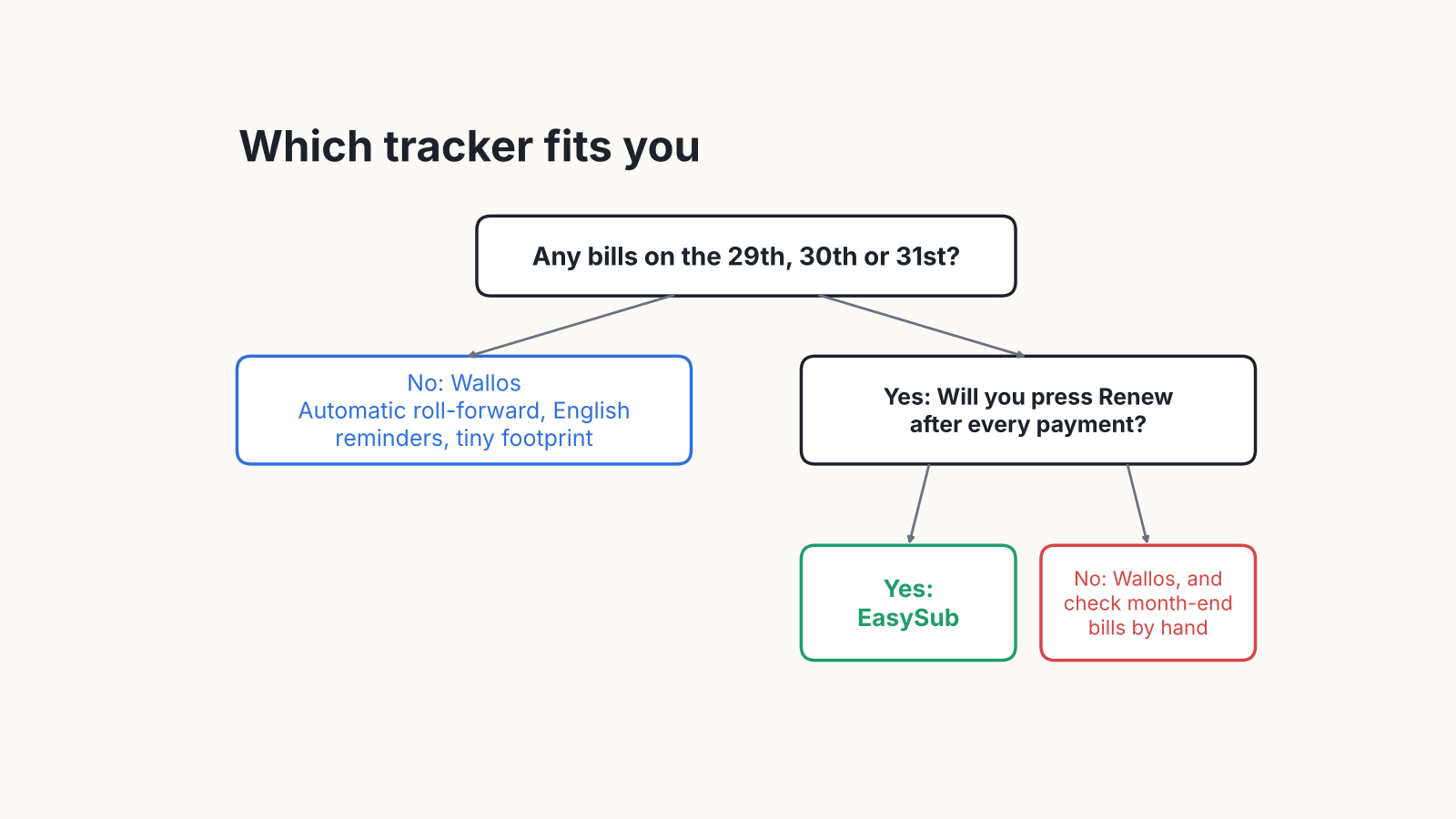
If everything bills between the 1st and the 28th, use Wallos and forget about it. If even one bill lands on the 29th, 30th or 31st, use EasySub and make Renew part of your routine, the same way you would tick off a paid bill on paper. Picking “from current due date” takes two seconds.
If you track the rest of your money too, the free YNAB alternative test and Sure vs Actual Budget cover full budgeting apps. And if this runs on a rented VPS, check it with how to know if your VPS is secure before you put your bills on it.
Check the date your tracker believes. Then check it against the bank.
2 comments