
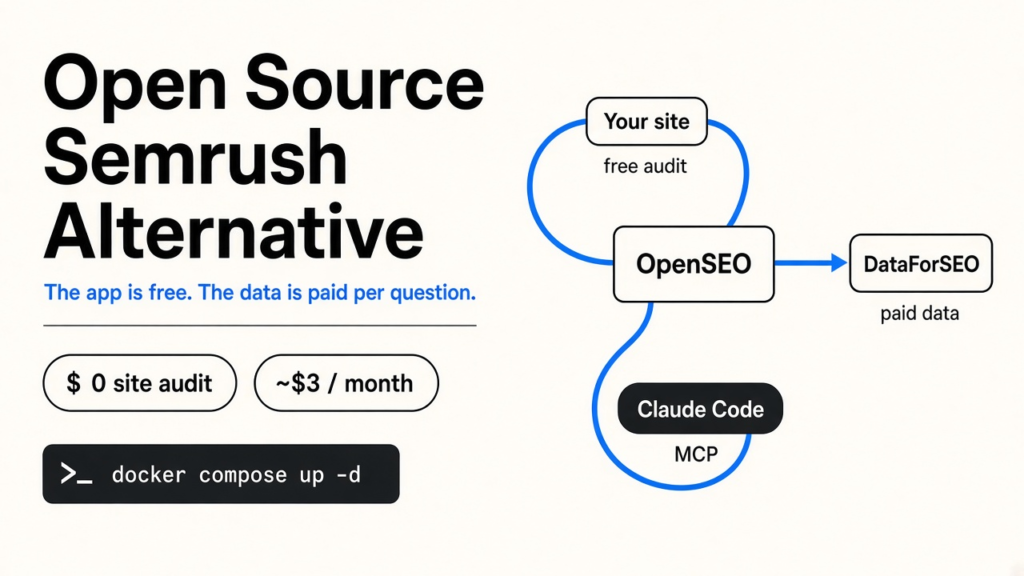
Short answer: Yes. OpenSEO is the best open source Semrush alternative you can self host. The app is free and MIT licensed, and its site audit costs nothing. Keyword, backlink and rank data come from DataForSEO, a pay-as-you-go data seller: a $50 top-up, then cents per search instead of $139 a month.
You open Semrush’s pricing page for a blog that earns nothing yet. The cheapest SEO plan is $139 a month billed monthly, and Ahrefs Lite is $129. That is a lot of money to learn which words people type into Google.
So you search for a free, open source version you can run yourself. Two serious open source options stand out: OpenSEO and RankMeFast. I installed both with Docker, pointed them at this site, and checked what actually works without paying anyone.
Here is the one idea to hold on to: the software is free, the data is not. Once you see why, picking the right tool takes five minutes.
Why can’t a free SEO tool give you free data?
Because the data comes from Google, and getting it at scale costs money for everyone.
Start with what an SEO tool does. SEO (search engine optimization, getting your pages higher in Google) runs on four kinds of facts. How many people search a phrase. Who ranks for it. Who links to whom. And what is broken on your own pages.
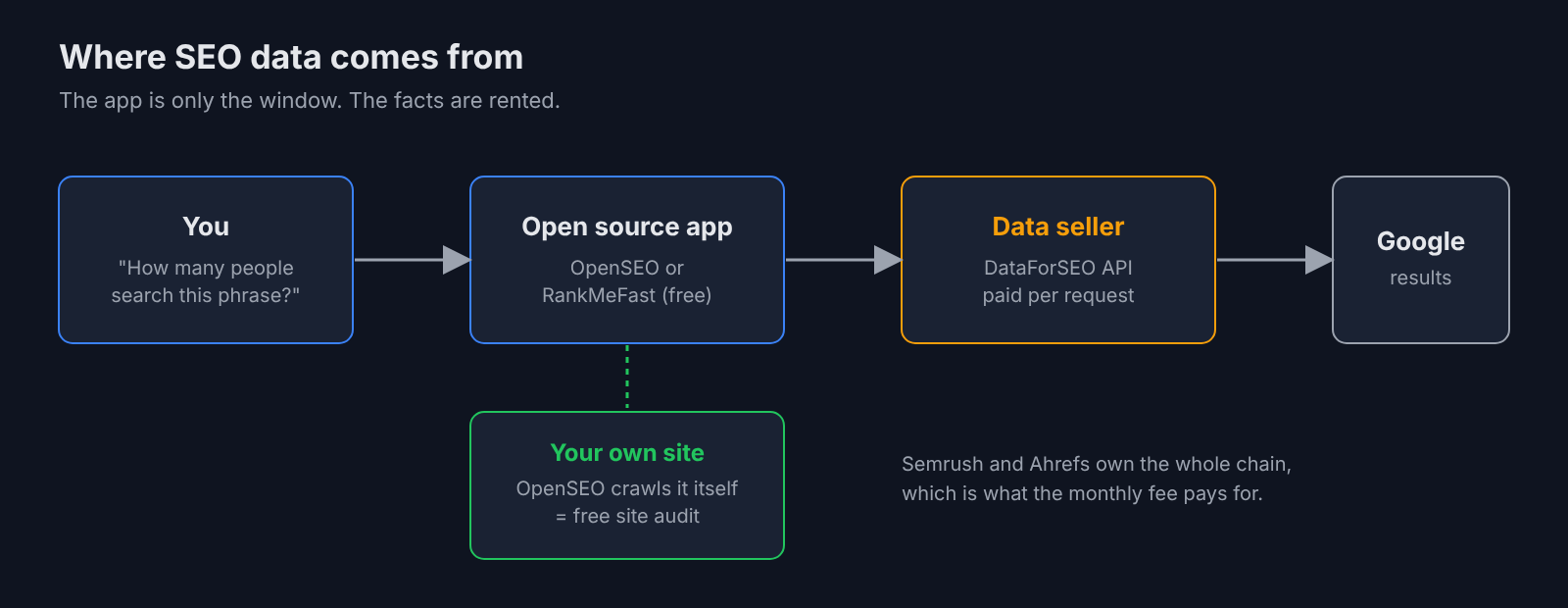
Most of those facts live outside your site. To know a keyword’s search volume, someone has to collect Google results again and again, store them, and keep them fresh. Semrush and Ahrefs run huge machines that do this. Their monthly fee pays for that machine.
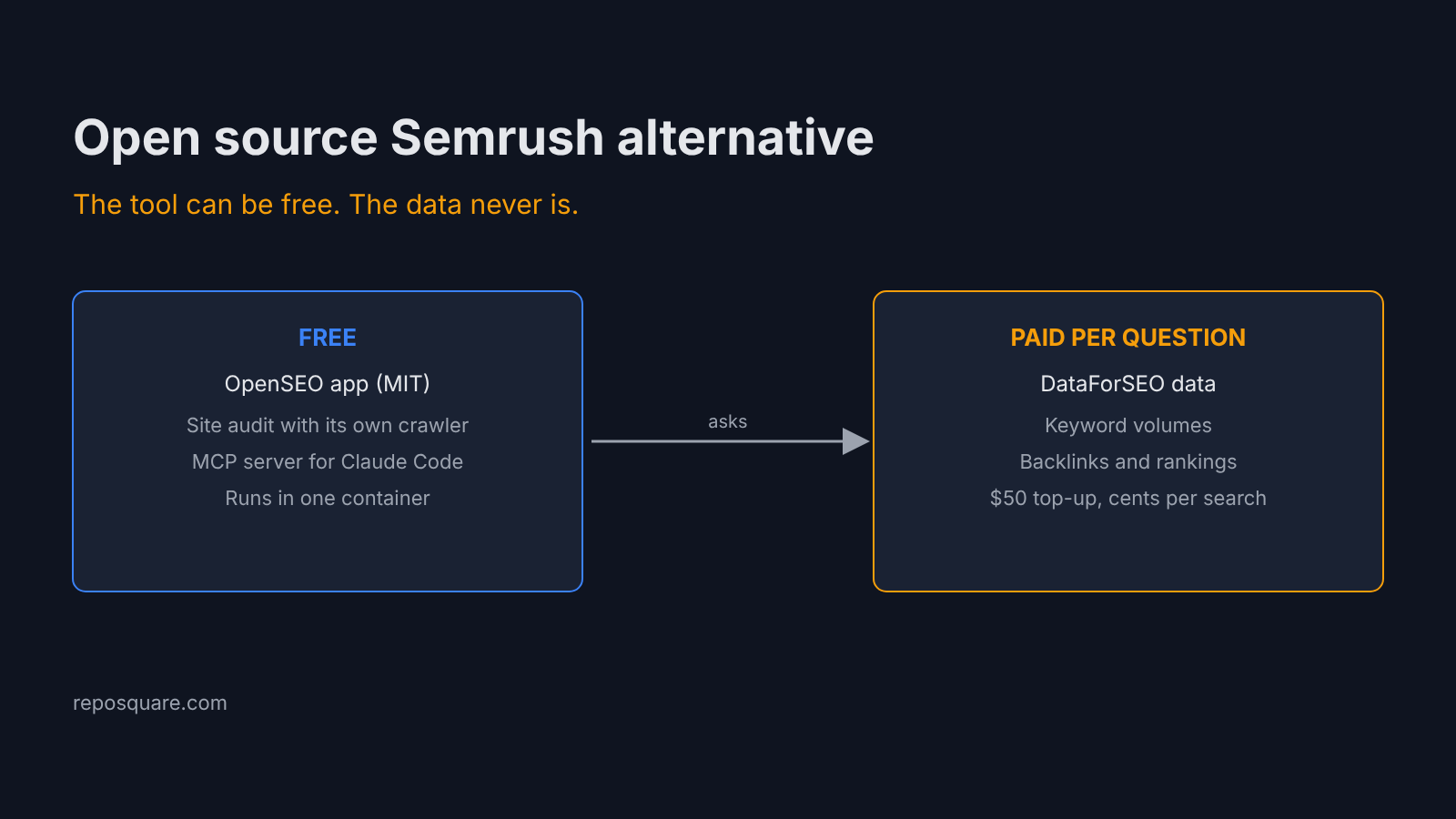
An open source SEO app skips building the machine. It rents the facts from a data seller instead. Both tools in this post use DataForSEO (a company that sells raw SEO data through an API, priced per request).
Think of it like a free TV with no channels. The screen costs nothing. The signal is what you pay for.
That is why the honest question is not “which tool is free?” It is “which tool needs the least paid data for the job I have?”
What do you get for free with OpenSEO?
A real site audit of your own website, plus a full MCP server, with zero keys.
OpenSEO is an open source SEO app, MIT licensed, that you can run on your own machine or on Cloudflare. It covers keyword research, domain overviews, backlinks (links from other sites pointing at yours), rank tracking (checking where your page sits in Google for a phrase over time), site audits and AI visibility checks.
I started it with Docker and no API key at all. The first screen asks for one.
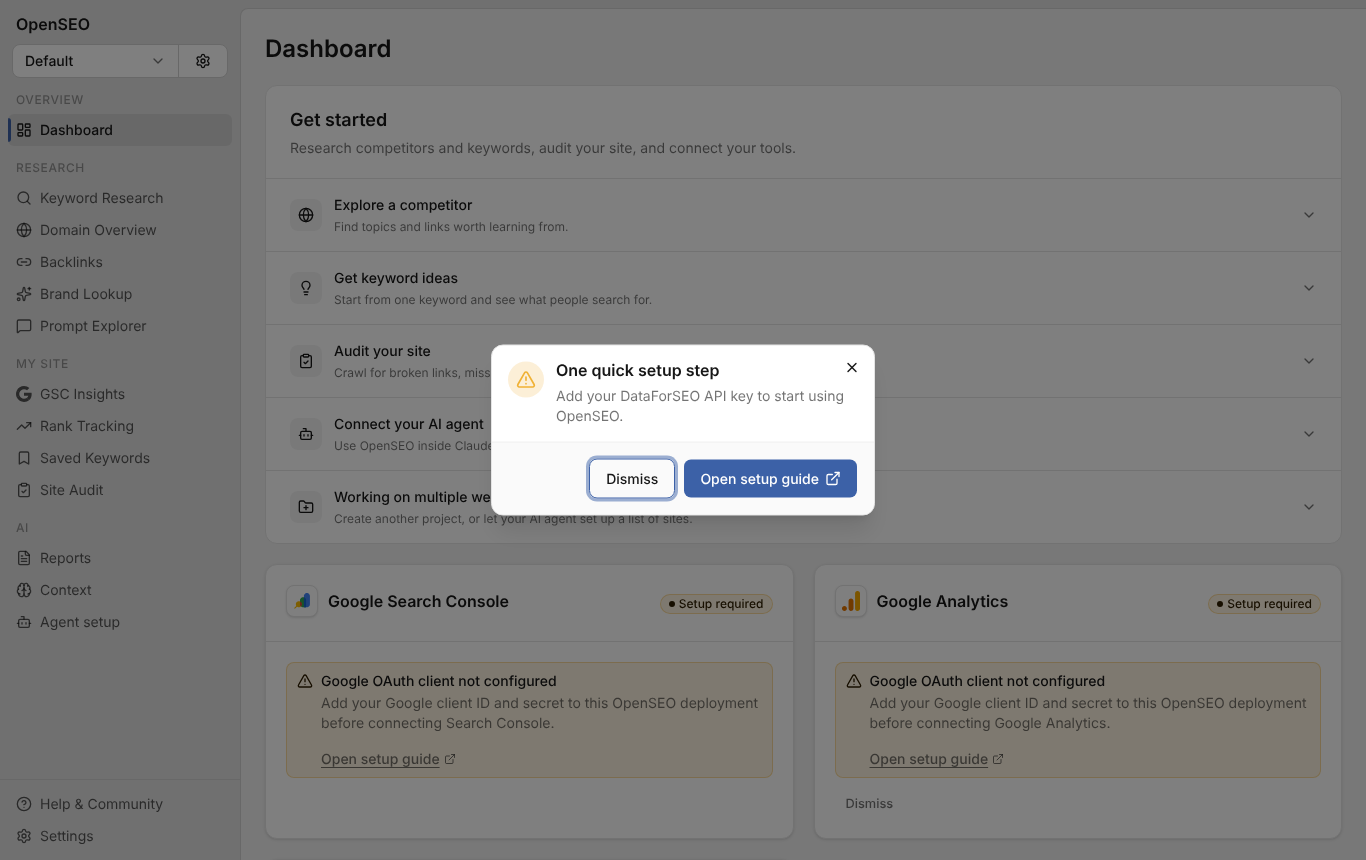
Dismiss that box and most of the left menu still loads. Keyword Research, Domain Overview and Backlinks need the key. Site Audit does not, because OpenSEO runs its own crawler (a bot that visits your pages one by one and reads them, like Google does).
So I gave it this site and a 50-page limit.
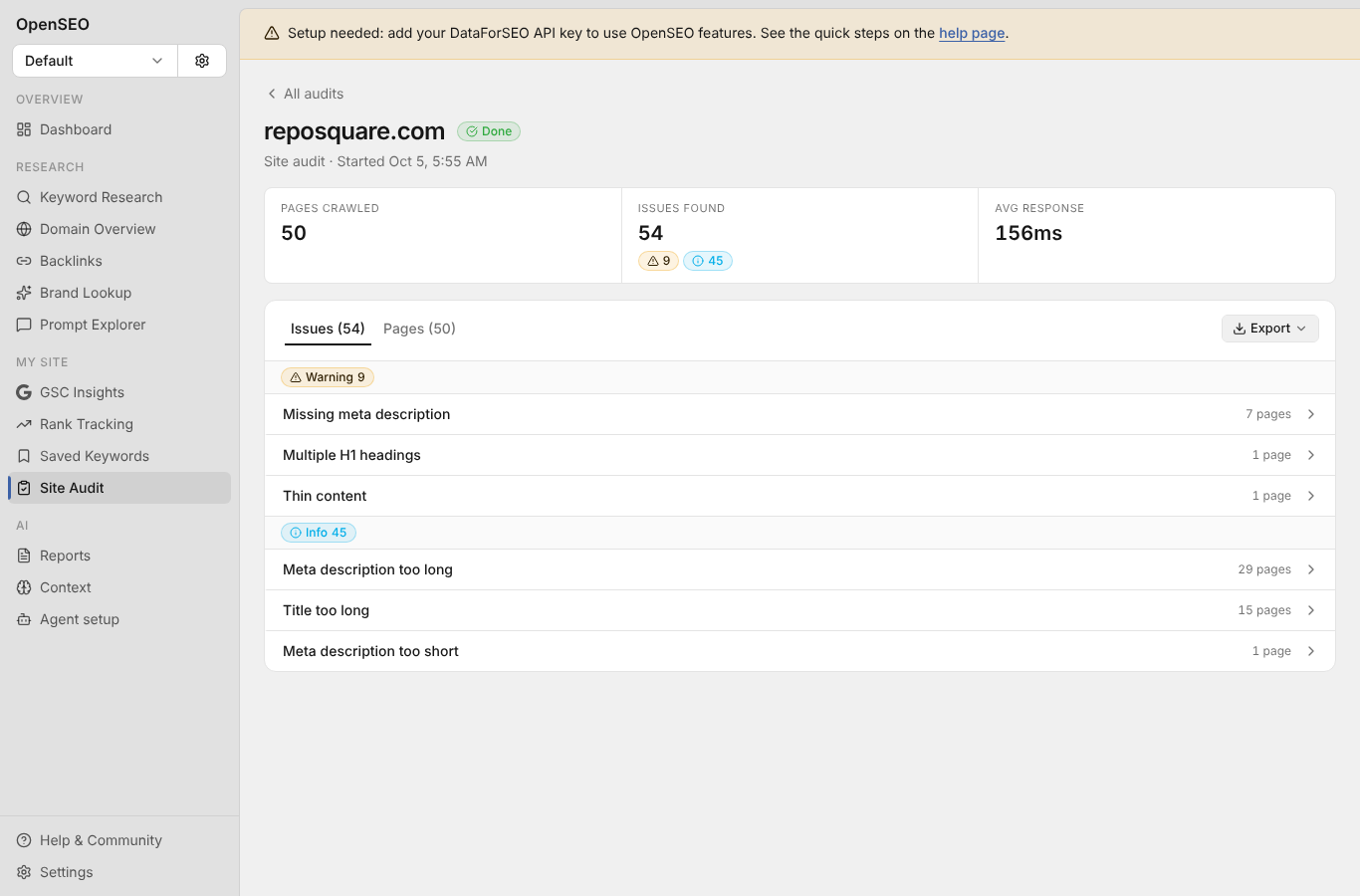
It finished in about a minute. 50 pages crawled, 54 issues, an average response of 156 ms. The issues were real and fixable: 7 pages with no meta description (the short summary Google may show under your link), 15 titles that are too long, one page with two main headings.
That is the free part, and it is useful on day one. Boring problems like these cost clicks, and you can fix them in an afternoon.
How much does OpenSEO cost to run with real data?
About $50 once to start, then roughly cents per search, with no monthly bill.
When you self host, you pay DataForSEO directly. New DataForSEO accounts get $1 of free credit, the minimum top-up is $50, and the balance does not expire.
OpenSEO publishes its own cost estimates: about $0.05 per keyword search and about $0.08 for a domain overview with a year of history. Those are hosted prices, which carry a 28% markup, so self hosting comes in a bit lower.
Here is a normal month for a small blog, using those hosted numbers as a ceiling:
- 40 keyword searches: about $2.00
- 10 competitor domain overviews: about $0.80
- Site audits: $0
That month costs under $3. At that pace, one $50 top-up lasts well over a year.
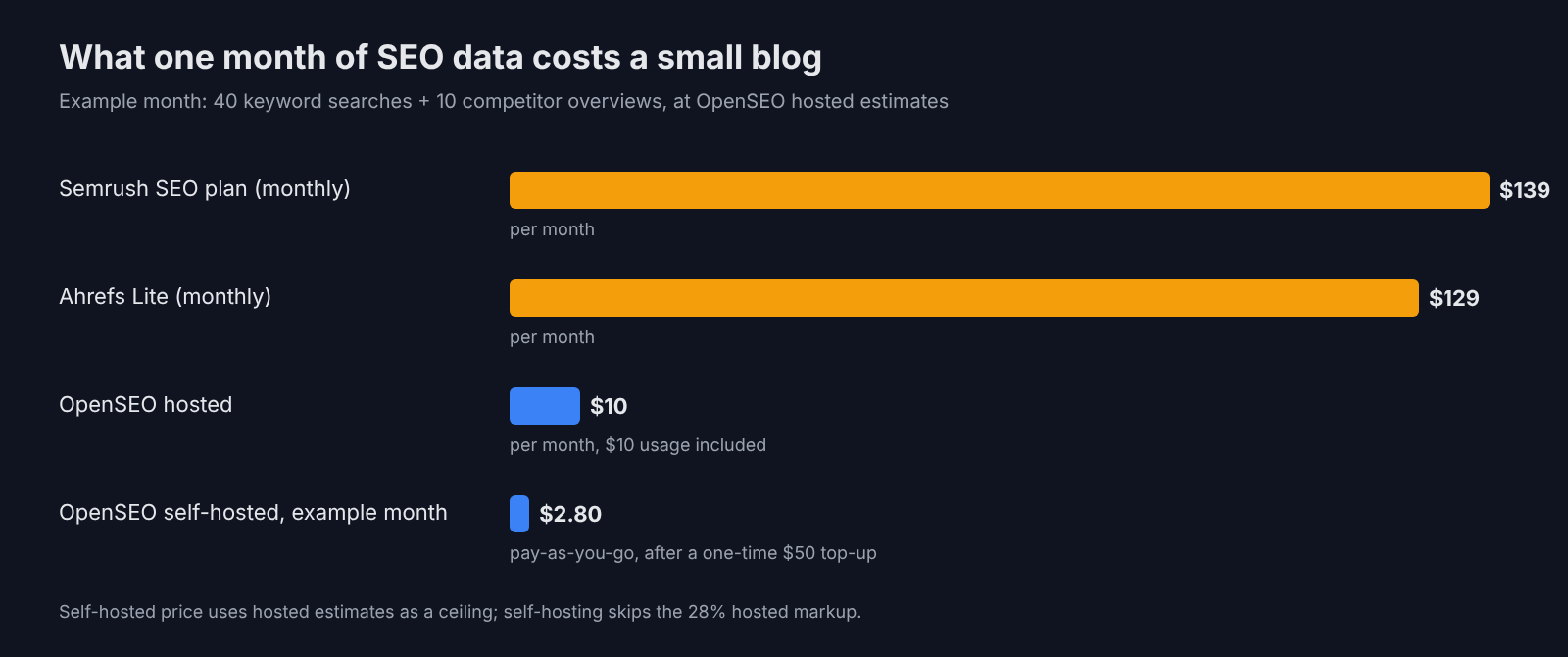
If you do not want to run anything, the hosted version of OpenSEO is $10 a month and includes $10 of usage. You trade a little privacy and control for skipping Docker.
How hard is OpenSEO to self host?
One container, one command, but the first start takes a few minutes.
A container (a sealed box that holds an app and everything it needs to run) keeps the setup simple. OpenSEO ships as one:
git clone https://github.com/every-app/open-seo
cd open-seo
cp .env.example .env
docker compose up -d
Then open http://localhost:3001. The code and docs live in the OpenSEO repo.
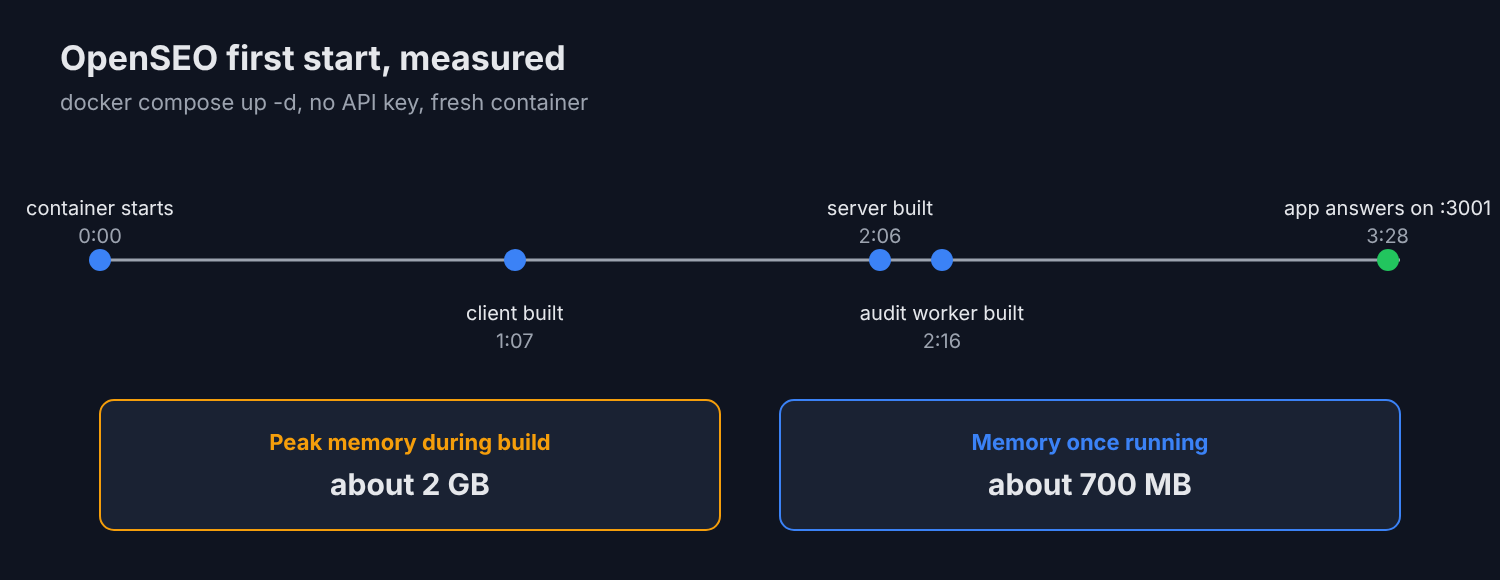
Two things surprised me. First, the container builds the app every time it starts fresh. My first launch took about three and a half minutes to answer. Memory peaked near 2 GB during that build, then settled around 700 MB, so a small 1 GB server will struggle.
Second, the key format trips people up. DATAFORSEO_API_KEY is not the key shown on the DataForSEO dashboard. It is the base64 (a way of turning text into a safe string of letters and numbers) of your login:password. OpenSEO’s health check says exactly this when the key is missing, which saved me a guess.
Docker mode also runs with no login at all. Keep it on your own machine or behind your own password, never open to the internet.
What about RankMeFast?
More features and a team setup, but without keys it shows demo data, not your site.
RankMeFast is a self-hosted SEO platform under the AGPL license (an open source license that requires you to share your changes if you run a modified copy for other people). It has site audits with 26 checks, rank tracking across Google, Bing, YouTube and Amazon, white-label reports, team seats and seven languages.
It is also a much bigger machine. It needs MongoDB, PostgreSQL and Redis (three separate databases) plus an API, a worker and a web front end. That is six containers instead of one.
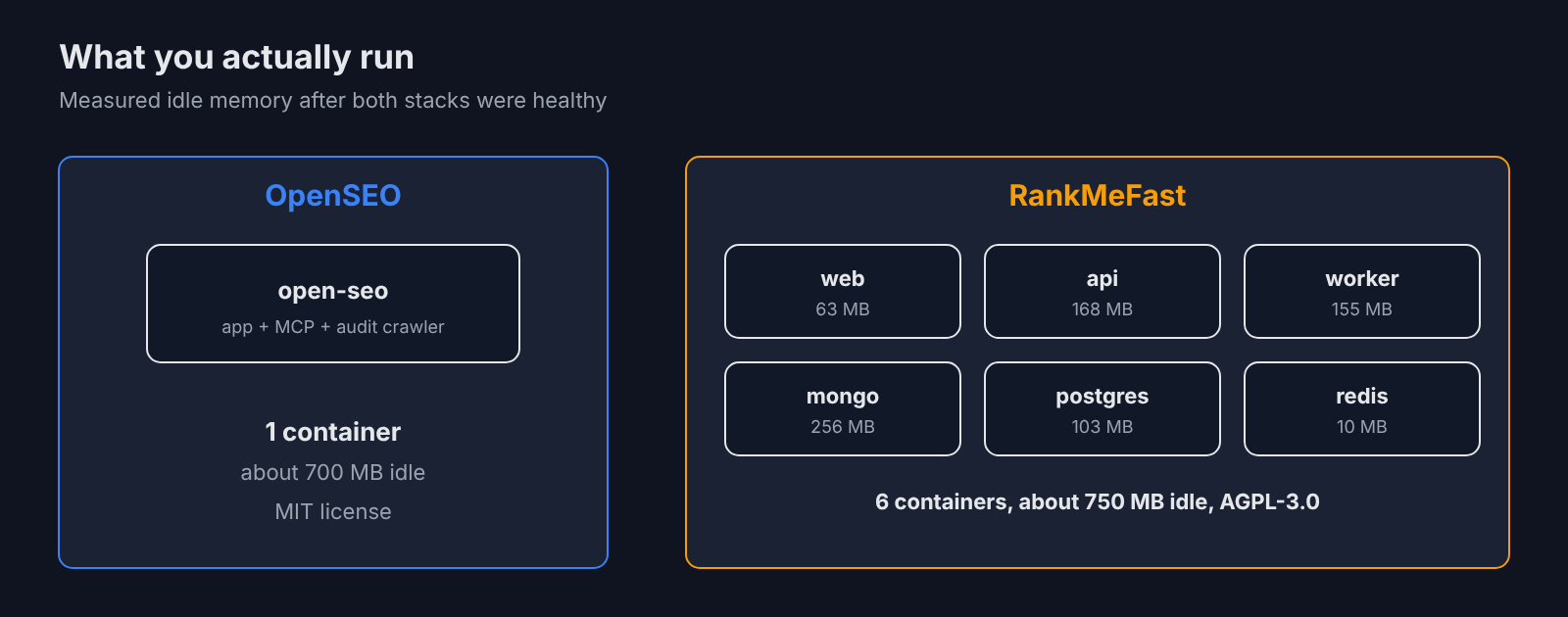
The README lists the minimum settings, but my first start still failed. The API kept restarting with CONTACT_FORM_RECIPIENT: Invalid email until I filled in that variable too. After that, all six services came up healthy and used about 750 MB together.
Then I ran an audit on this same site. Would it match what OpenSEO found?
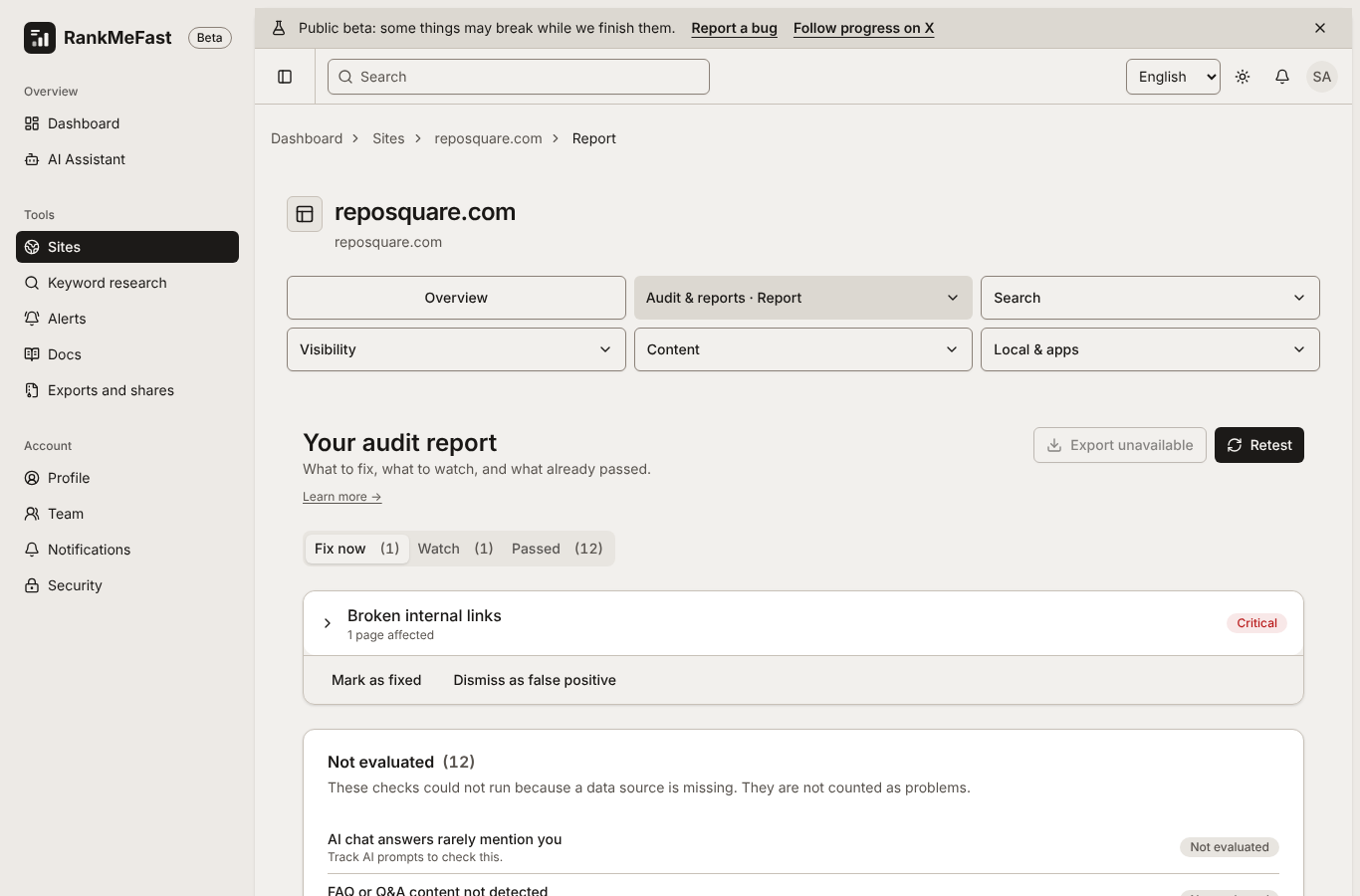
It came back with one “broken internal link” and 12 checks marked “Not evaluated”. That broken link is not real. Without keys, every RankMeFast provider runs a built-in fake that returns fixed demo data, so you can click around before paying.
That is fair, and the README says so. But it matters: RankMeFast does not crawl or scrape anything itself. Even its site audit goes through DataForSEO. So with RankMeFast, every useful feature needs the paid key from day one.
OpenSEO vs RankMeFast: which one should you pick?
OpenSEO for a solo developer or one blog. RankMeFast for an agency that will pay for data anyway.
| OpenSEO | RankMeFast | |
|---|---|---|
| License | MIT | AGPL-3.0 |
| Containers to run | 1 | 6 |
| Memory at idle (my test) | about 700 MB | about 750 MB |
| Free site audit of your real site | Yes, own crawler | No, demo data until you add DataForSEO |
| Keyword, backlink, rank data | DataForSEO key | DataForSEO key |
| Best for | One person, one or a few sites | Agencies, teams, client reports |
There are good reasons to pick RankMeFast. If you run SEO for clients, white-label reports, team seats and the plain-language “fix now” layout are things OpenSEO does not try to be.
For everyone else, the free audit decides it. OpenSEO is useful the minute it starts, and you only pay when you ask it a question that needs Google data. It is the same trade as picking a lightweight DBeaver alternative: less machine, less to look after.
Can Claude Code use OpenSEO?
Yes. The self-hosted app exposes an MCP server on the same port, and it worked without any setup.
MCP (Model Context Protocol, a standard plug that lets an AI assistant call outside tools) turns OpenSEO into something Claude Code can use directly. The local server answered at /mcp with 58 tools, from run_site_audit to rank tracking and Search Console reports.
Connecting it takes one line. Want to try it on your own setup? Run this:
claude mcp add --transport http openseo-local http://127.0.0.1:3001/mcp
Then I asked Claude Code to read the audit I had already run, group the issues by severity, and not call any paid tool.
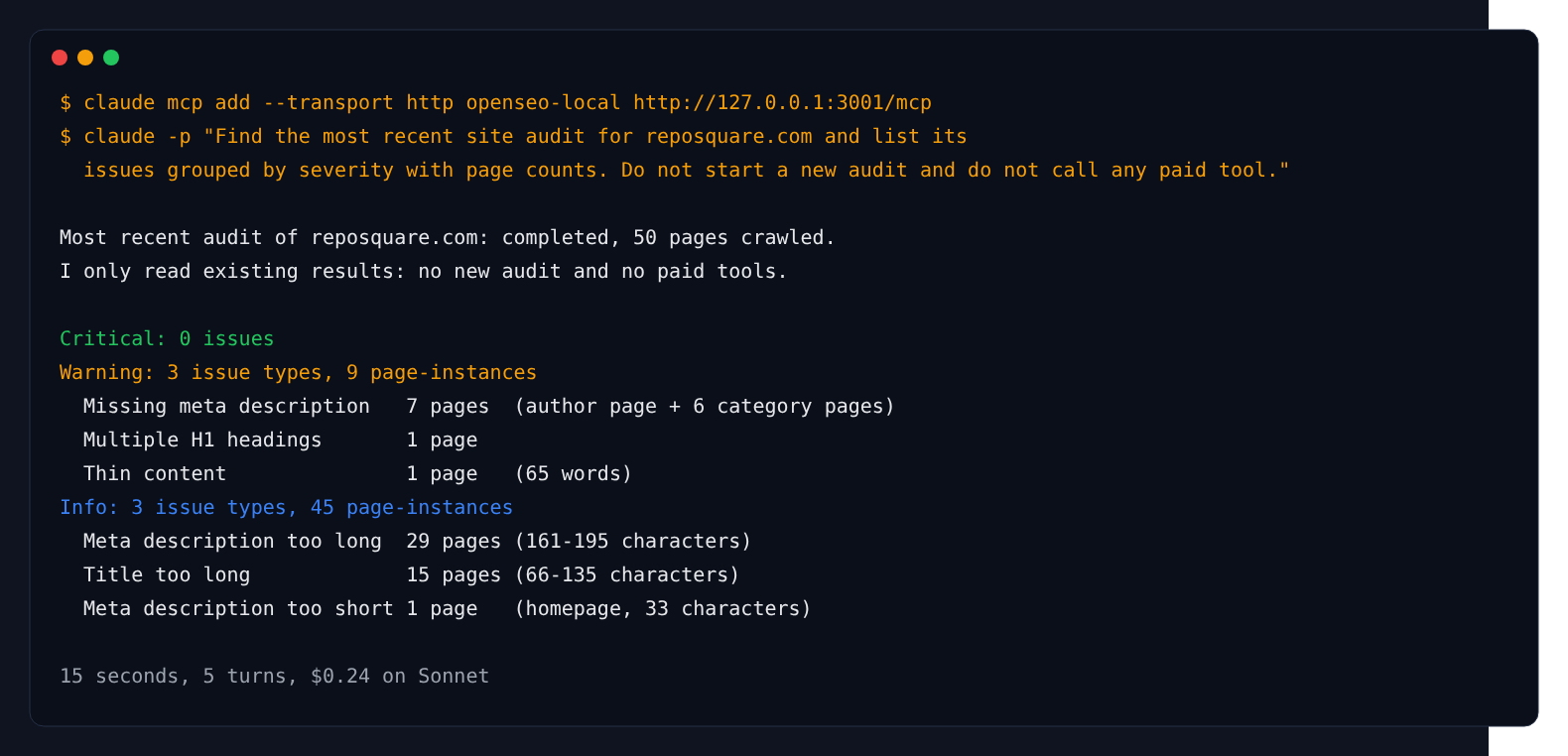
It took 15 seconds and five steps. It came back with a clean table, the exact pages behind each warning, and the cheapest fixes first. It also named the longest titles on this site, the worst at 135 characters, which is now on my own fix list.
This is where a self-hosted SEO tool beats a $139 subscription for developers. Your agent can audit a site, read the issues and open the pull request that fixes them, all on your machine. Pair it with a CLAUDE.md file that keeps the agent on your rules so its fixes match your site.
What does a free Semrush alternative not do?
It will not match Semrush’s own data, history or polish.
Know the gaps before you cancel anything. Four of them matter:
- Your numbers come from DataForSEO, not from Semrush’s or Ahrefs’ own databases, so volumes and backlink counts will differ.
- You pay per question, so a careless agent loop or a giant keyword export can cost more than you expect. Set a spending limit in your DataForSEO account, the same way you would watch Claude Code’s token bill.
- You run the server, so updates, backups and security are on you.
- RankMeFast is a public beta and says to expect breaking changes.
If you need daily rank tracking on thousands of keywords, a paid suite may still be cheaper. For one blog, the math above says no.
Start OpenSEO, run the free audit on your site, and fix what it finds. Pay for data only when a real question needs it. The tool was free all along. The data is the part worth paying for.
FAQ
Is OpenSEO really free?
The software is free and MIT licensed, and the site audit works with no key. Keyword, backlink and rank data need a DataForSEO account, which starts with a $50 top-up and then charges per request.
What is the best open source alternative to Semrush?
For one person or a small site, OpenSEO, because it runs in one container and audits your site for free. RankMeFast fits agencies that want team seats and client reports and will pay for data from the start.
Do I need a DataForSEO account for a self-hosted SEO tool?
For keyword volumes, backlinks and rankings, yes, in both tools. OpenSEO’s site audit is the exception, since it crawls your site itself.
Can I use OpenSEO with Claude Code?
Yes. The self-hosted app serves an MCP endpoint at /mcp, and claude mcp add --transport http connects it in one line.