
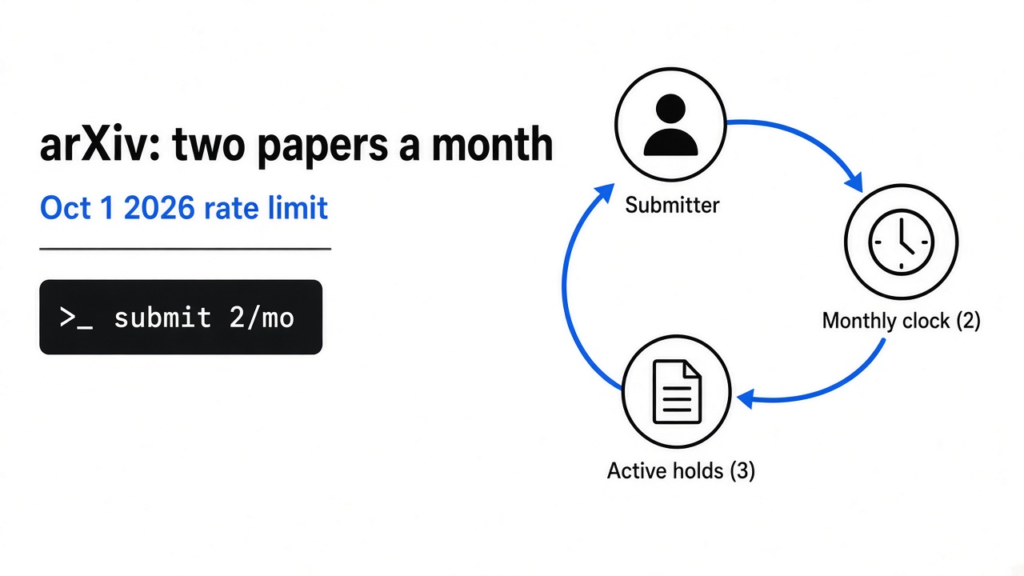
TL;DR: On October 1, 2026, arXiv (the free site where researchers post papers before a journal prints them) limited every submitter to two submissions per calendar month, and kept the older cap of three papers waiting at once. A rejected paper still uses a slot, because a volunteer already spent time on it. Delete the paper before it is announced and the slot comes back. Co-authors are not charged. Only the account that clicks submit is. AI writing tools are still allowed if you say you used them and the paper is real research.
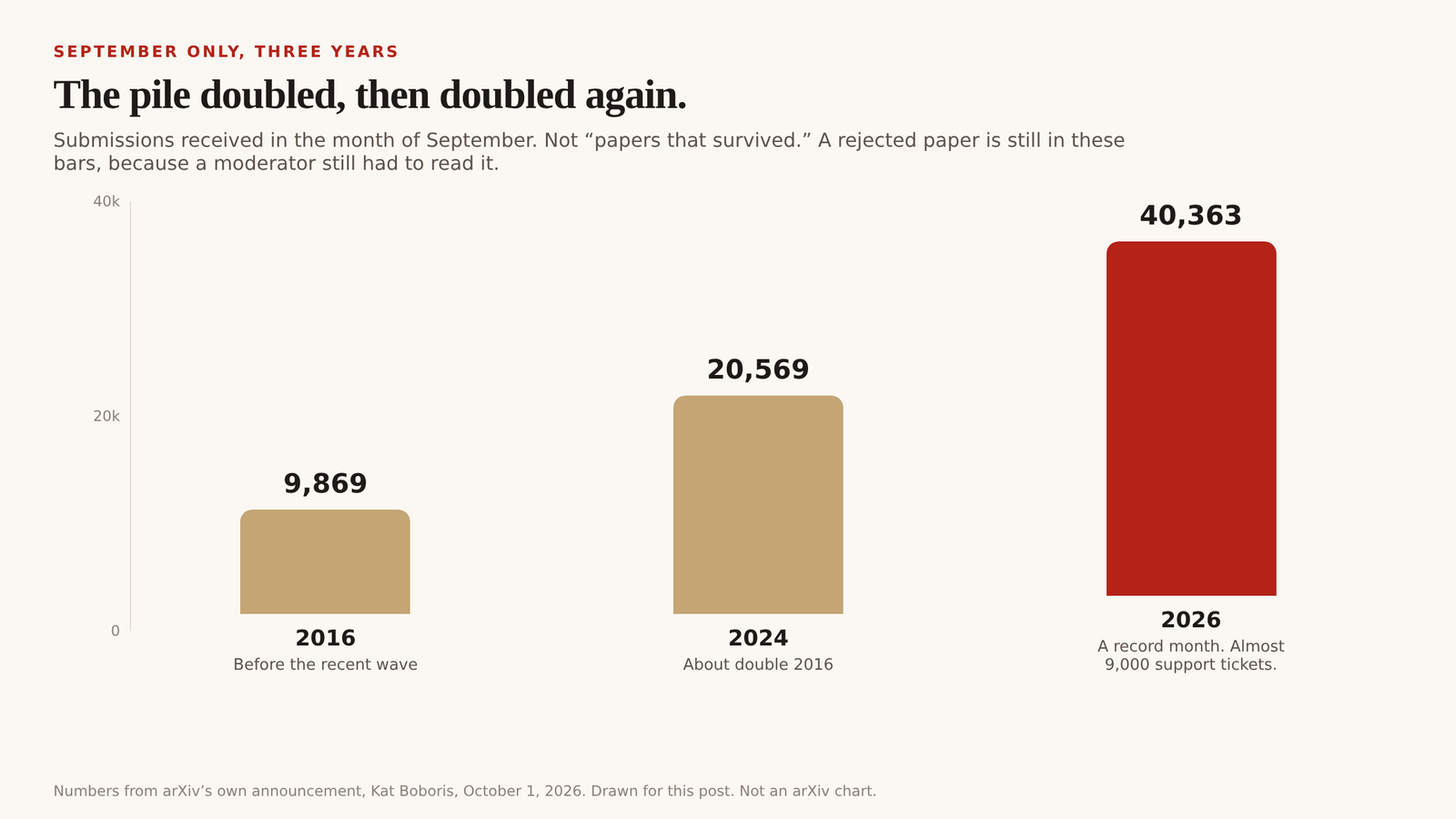
The number that matters is not how many good papers. It is how many times a person asked a moderator to look. September 2026 was 40,363 of those asks. September 2024 was 20,569. September 2016 was 9,869. Same month, ten years, about four times the pile. The last two years did the second doubling.
What changed on October 1?
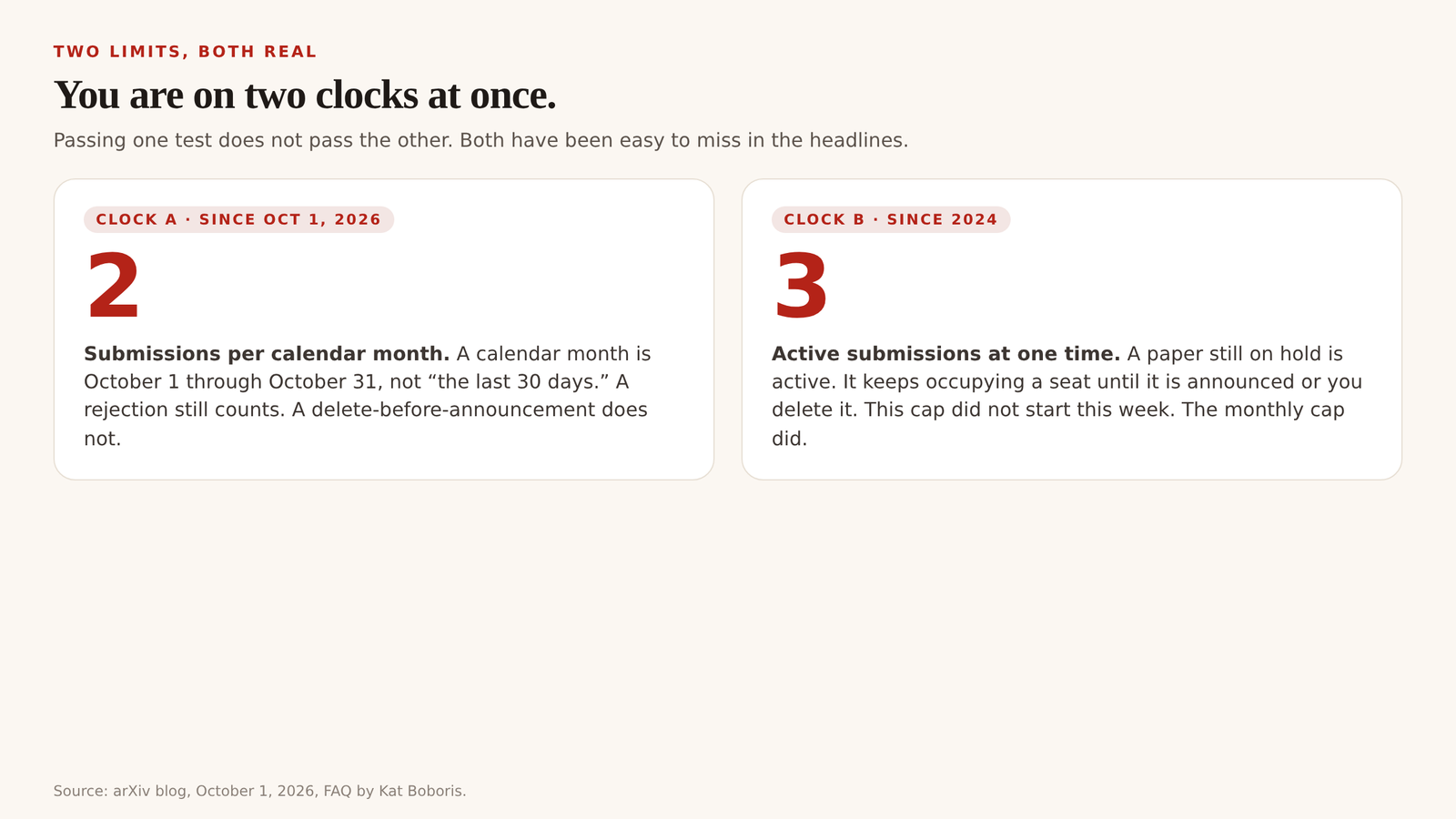
Two rules. One of them is new. One of them is not.
A submission is the act of sending a paper in for checking. An announced paper is one arXiv has already made public. The new limit counts submissions, not announcements. Kat Boboris wrote the announcement on October 1, 2026. The rule started that day.
| Rule | Limit | Since | What spends it |
|---|---|---|---|
| Monthly | 2 submissions per calendar month | October 1, 2026 | Sending a paper, even if it is rejected |
| Active | 3 submissions waiting at once | 2024, and still in force | A paper that is still on hold |
| Who | The submitter only | Same policy | The account that clicks submit, not every co-author |
A calendar month is the named month on a wall calendar. October 31 and November 1 are different months. It is not a rolling 30 days.
A category is a subject bucket, such as cs.AI (computer science, artificial intelligence). The two-paper limit is one pool for every bucket. A physics paper and a computer-science paper in the same month still use both slots.
What is arXiv, before the cap means anything?
A public shelf for papers, checked lightly by volunteers, not a journal.
arXiv was founded by Paul Ginsparg in 1991. It was hosted at Cornell University for decades. In 2026 it became its own independent nonprofit (an organization that is not a company and not a university, with a board and a staff). That legal change is not the reason for the cap. I am including it so you know who runs the site this month. Their about page says it hosts more than three million scholarly articles, in physics, mathematics, computer science, quantitative biology, quantitative finance, statistics, electrical engineering and systems science, and economics.
A preprint is a paper shared with the public before a journal has finished judging it, and sometimes instead of a journal. A journal is a publication that picks papers and puts its name on them. Peer review is the journal’s slow check: other researchers read the paper and argue for accepting it, revising it, or rejecting it.
arXiv’s check is different. A moderator is a volunteer who knows a field and looks at submissions in that field. The moderator asks whether the paper belongs in the archive and in that category. That is not the same job as a referee (the person a journal asks to do peer review). arXiv can still decline a paper for being unfinished, unoriginal, plagiarized, or outside what the archive is for. Prior publication in a journal does not guarantee arXiv will take it.
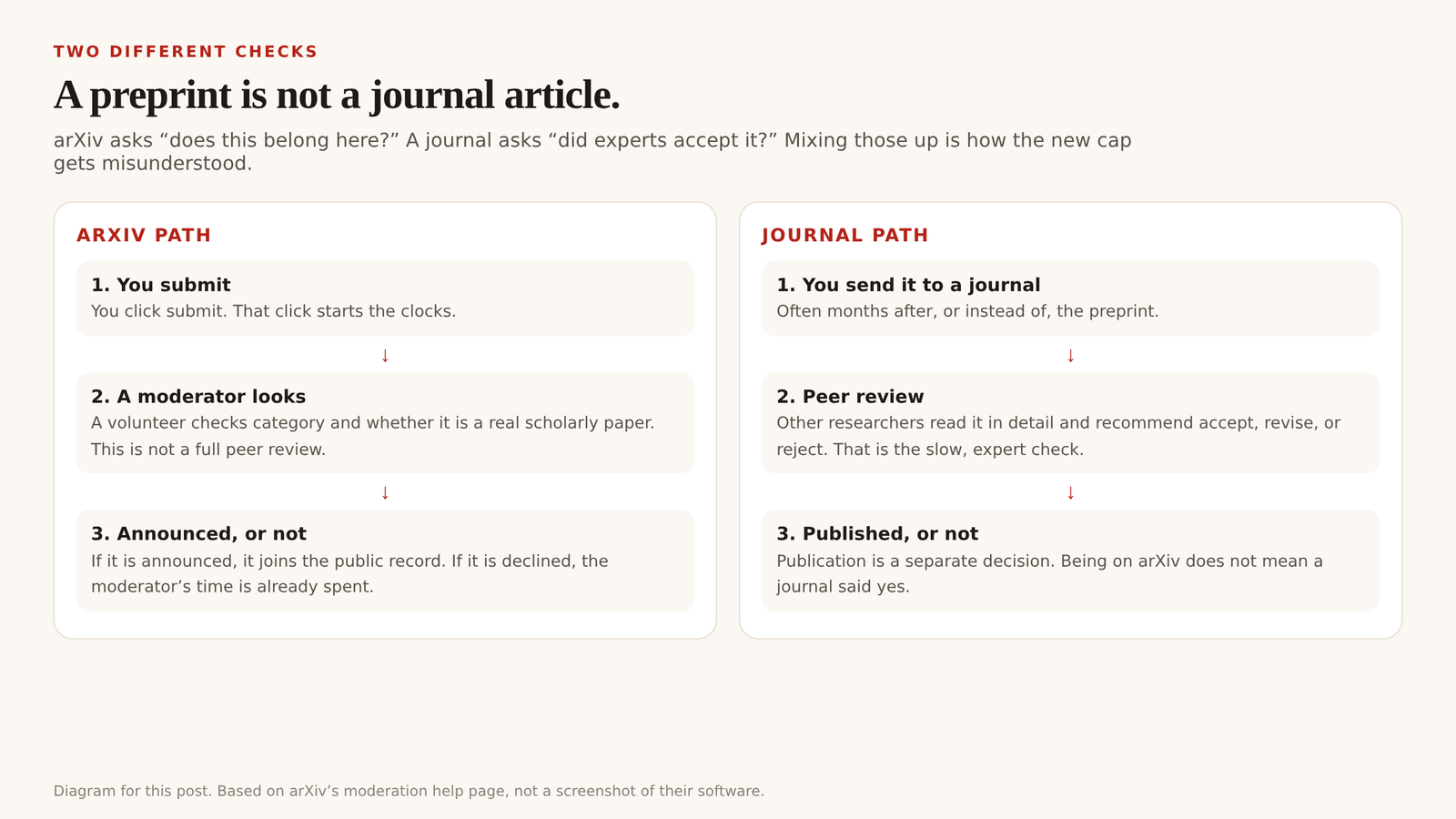
Once a paper is announced, arXiv’s own words are that it becomes part of the permanent scholarly record. I am not walking through withdrawal (taking a public paper down, or marking it withdrawn). That is a later process, and this post is about the clocks that start when you click submit.
What does the long chart actually show?
The shape of 35 years, plus a lifetime total. Not the September number.
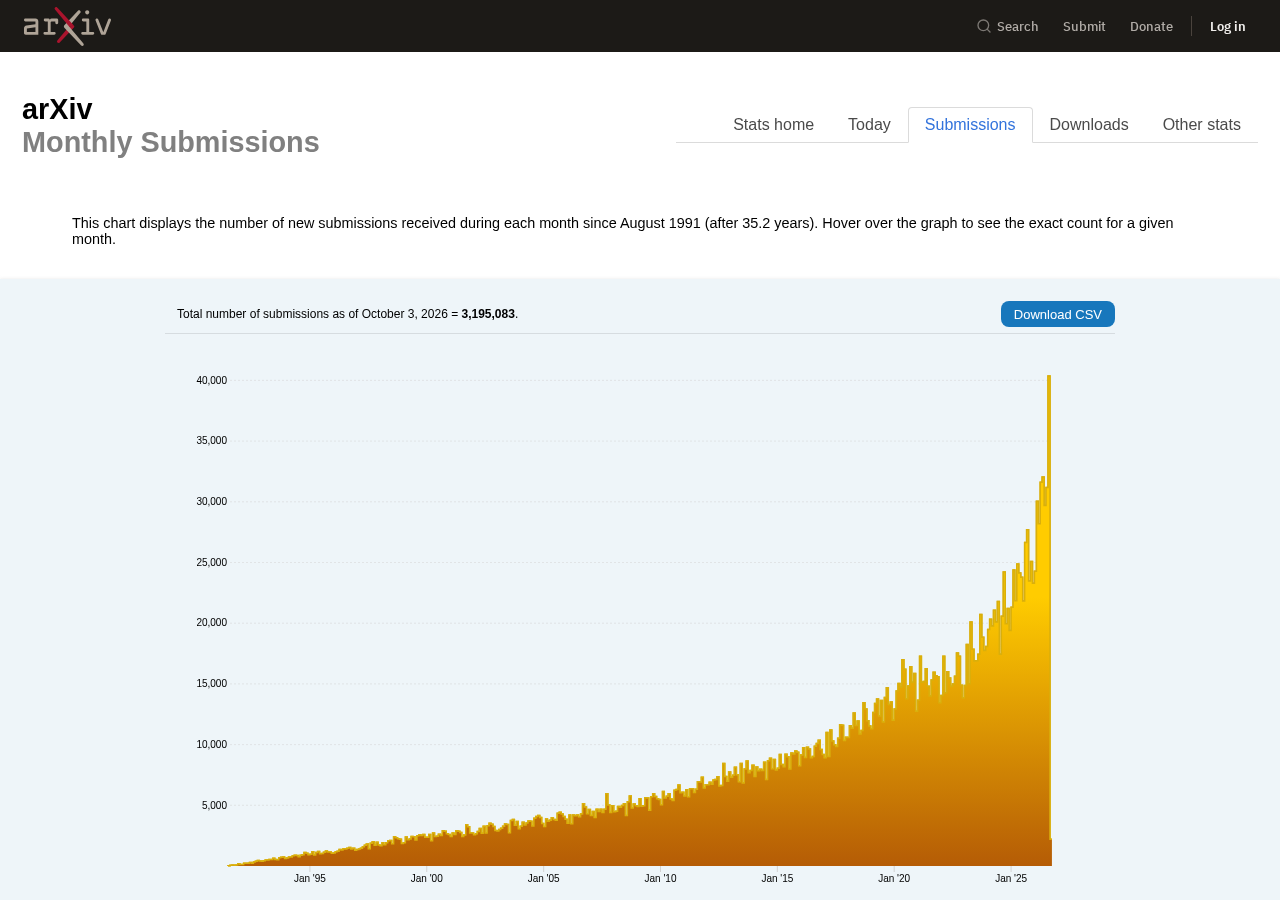
Do not read a precise September count off this picture. The page tells you to hover for a month’s exact number, and a screenshot cannot hover. Use the October 1 announcement for 9,869, 20,569, and 40,363. Use this picture for the shape: a long climb, then a steep recent rise that touches the 40,000 line.
The same page says that lifetime total leaves out 2,431 articles that were migrated in (moved from somewhere else, not submitted) and 156 deleted articles. Articles available that day: 3,197,514. Those are archive totals. They are not the monthly cap.
Why does a rejected paper still cost you?
Because the scarce thing is a person’s afternoon, not disk space.
Thomas Dietterich, Distinguished Professor Emeritus at Oregon State University and chair of the arXiv Editorial Advisory Council, wrote this in the announcement:
The heart of arXiv’s process for detecting and rejecting low-quality papers is our many volunteer moderators. We are so grateful that they donate their time and expertise every day. However, a relatively small proportion of authors are submitting a large number of low-quality papers and consuming a disproportionate fraction of the moderators’ time. This is unfair to authors who continue to submit quality papers — their papers can be delayed for days or weeks as a result.
A support ticket is a request for staff help, such as asking why a paper is stuck. September’s 40,363 submissions came with almost 9,000 of those tickets, according to the same post.
So the FAQ answer is blunt. If your paper is rejected, it still counts. You used one of the two looks a moderator can give you this month. If you submit two papers in October, accepted or not, you wait until November to submit again.
There is one undo. If you delete the paper before it is announced, it does not count toward the monthly limit or the active limit. arXiv says it still wants finished work, and it understands that people notice a real mistake after clicking. Delete-before-announce is that door. It is not a way to workshop a rough draft on the moderators.
Why did the pile double?
Writing got faster. The volunteer queue did not.
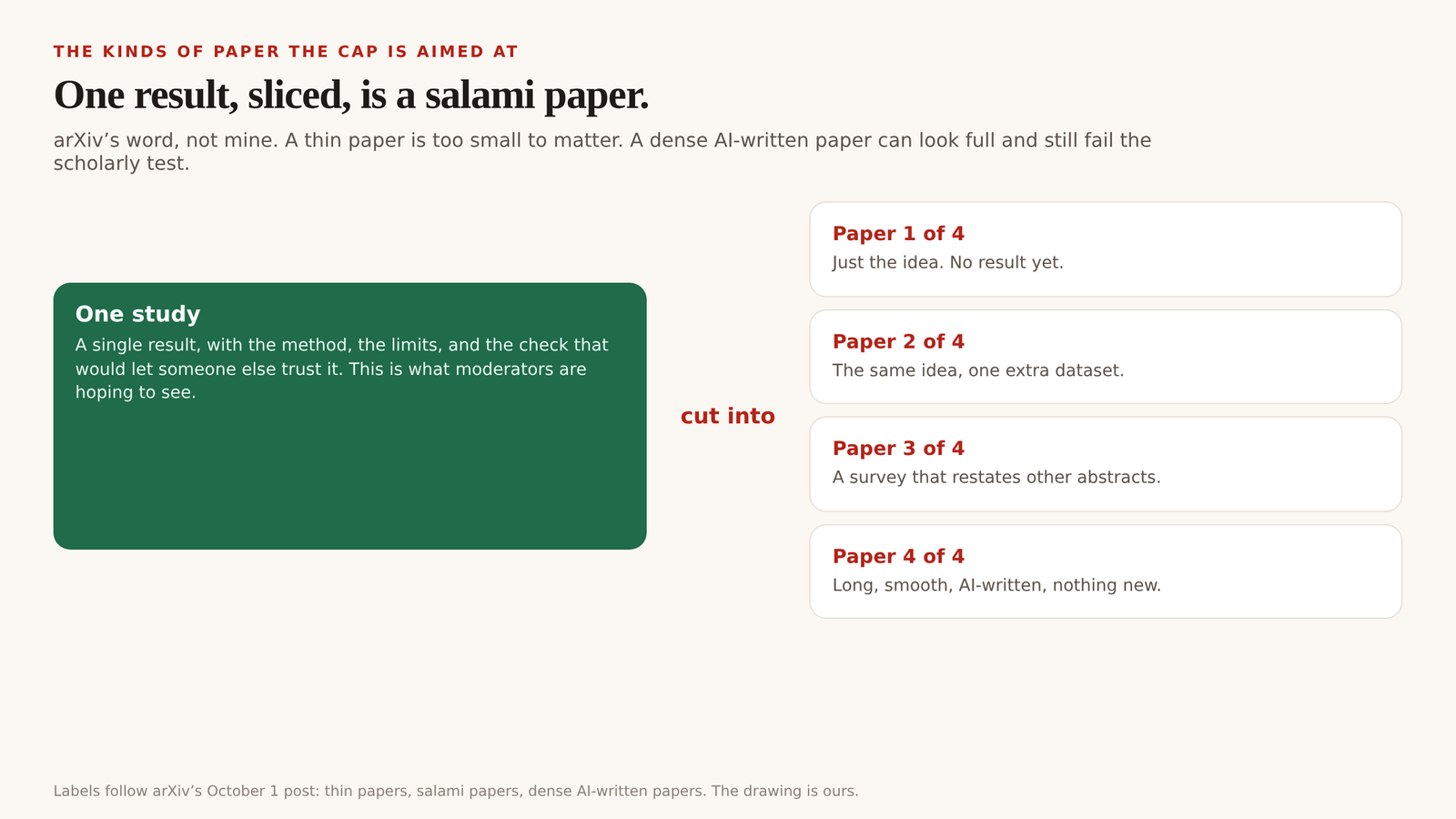
arXiv says AI tools (software that can draft, rewrite, or expand text) made it practical to produce more papers than the old habits assumed. It names three kinds of paper that eat moderator time:
- Thin papers of narrow scope (too small, or too local, to be of scholarly interest to the field).
- Salami papers (one piece of work sliced into several papers to raise the count).
- Dense, AI-written papers (long and smooth, and still not up to the archive’s standard).
Read the growth the way they printed it, not as only the AI category. From 2024 to 2026, cs.AI grew more than six times. Other categories about doubled over the same period. The cap is site-wide because the pile is site-wide. Computer science is where the jump is sharpest. It is not the only place the line went up.
They call the new rule a stopgap (a temporary patch while a better process is built). The job they named is to decide what fair use of advanced writing tools looks like, and to improve moderation tools. This is not presented as the permanent constitution of science.
Are you banned from using AI to write?
No. You are responsible for what the tool wrote, and you have to say you used it.
A generative AI language tool is software that produces text from a prompt. arXiv’s moderation policy, which the announcement links, says three things.
- Report significant use of sophisticated tools, including text-to-text generative AI, the way you would report an instrument or a piece of software. Follow the standards of your field.
- Every author who signs the paper is responsible for all of it. Fake citations, plagiarism, biased wording, and confident mistakes from the tool are the authors’ mistakes if they are left in.
- Do not list the tool as an author.
Scholarly interest, in their words, means the paper has originality, novelty, and significance for the community it is filed under. Course projects, research proposals, news, and political statements can be declined. So can a paper that still needs a serious rewrite. A survey that only restates other abstracts is the kind of thing this fight is about. A real paper that used a tool to fix English, and says so, is not what the cap was written to punish. The moderator still decides.
Which clock did you just burn?
A hold does not eat next month’s two. It does eat one of the three seats.
On hold means the submission has not been announced and is still in checking. arXiv uses that phrase in the FAQ. I am not inventing extra status names.
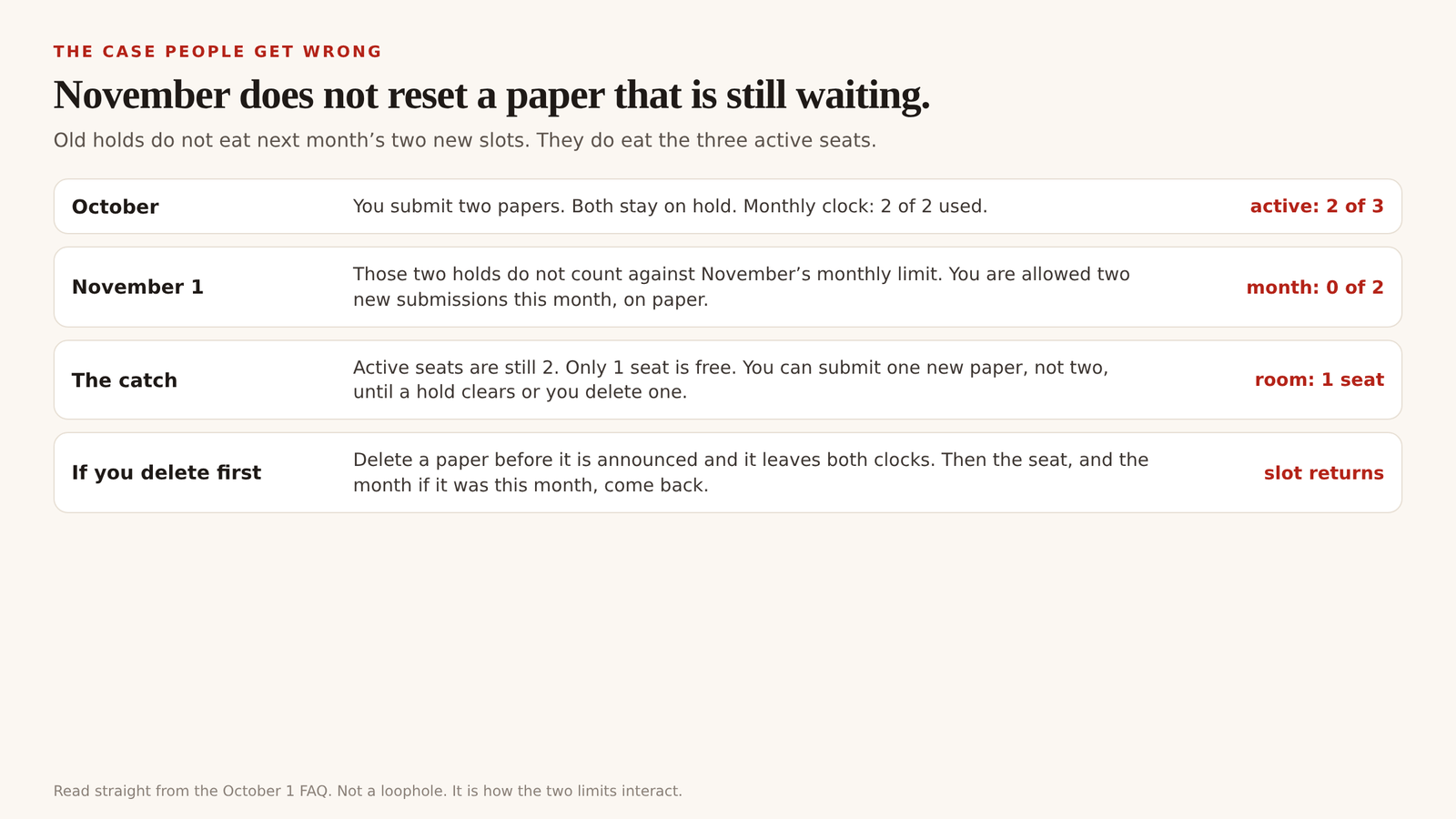
Walk it as a person, not as a slogan.
You submit two papers in October. Both stay on hold. Your monthly clock is finished. Their two seats are still occupied.
November 1 comes. Those holds do not count against November’s two new submissions. The FAQ is explicit about that.
They do count toward the three active seats. Two seats are full, so only one is free. You may submit one new paper, not two, until a hold is announced or you delete one before announcement.
If you needed both November papers for a conference (a meeting with a deadline for the paper to exist in public), the FAQ’s answer is to plan. There is no special bypass. The three-active limit has been in place since 2024. The new monthly limit makes the planning tighter.
Different subject areas do not give you extra slots. The FAQ says the limit applies across all categories.
Who does the limit follow?
The finger on the button. Not every name on the first page.
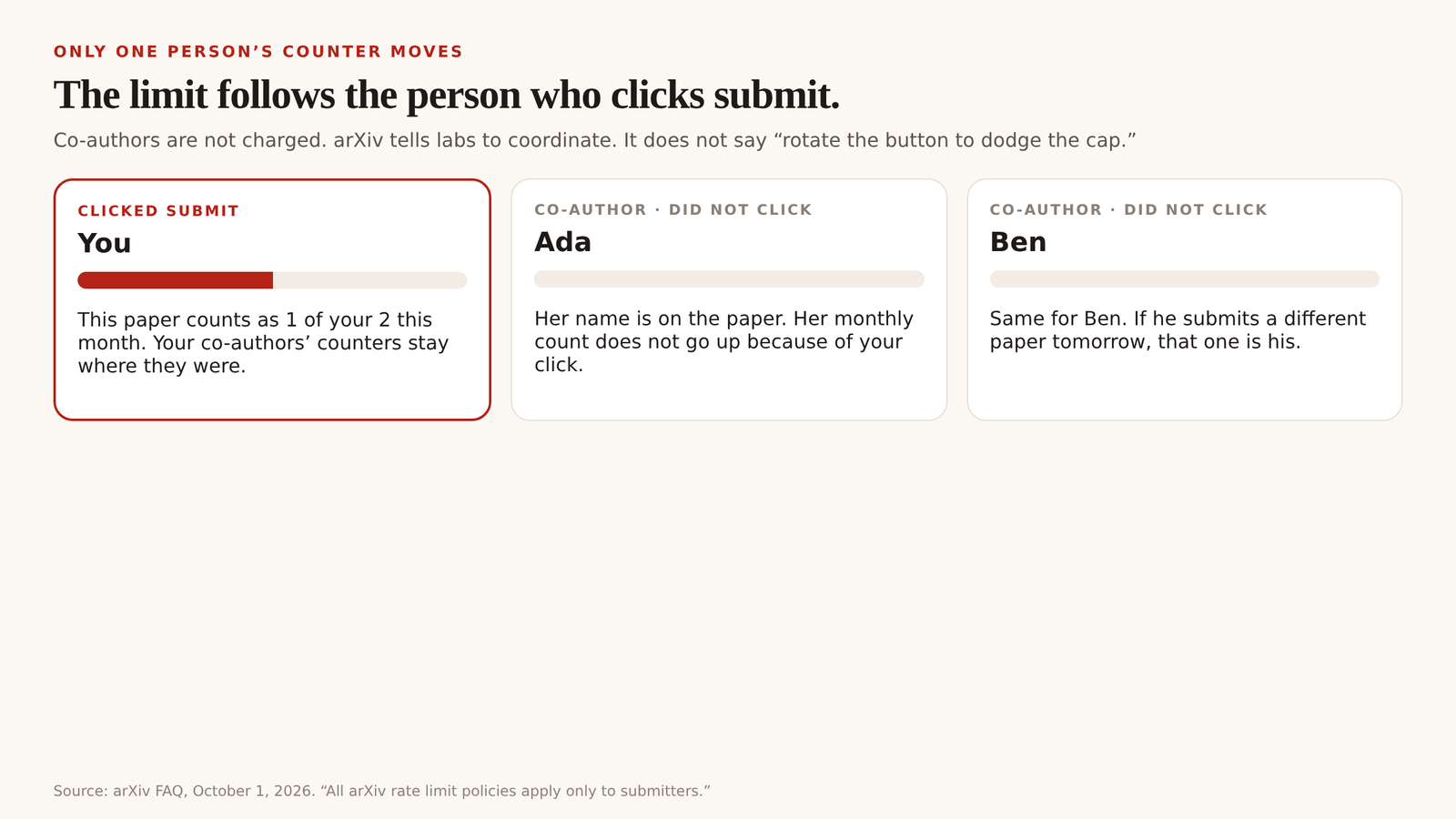
A submitter is the account that sends the paper. A co-author is someone else named on it. The FAQ says a paper you submit with several co-authors counts toward your rate, not theirs. It also says co-authors should coordinate.
There is a shorter line on the moderation help page: each author may submit up to two new submissions per calendar month, with a limit of three active submissions. That page then points you to the October 1 FAQ for the details. I read both on October 3, 2026. The FAQ is the one that spells out the co-author case. If you are coordinating a lab, follow the FAQ, and do not assume the word author in the short line charges every name.
What coordination means in practice: the person who still has a slot is the one who should click, so a finished paper is not stuck behind a colleague who already used both looks. arXiv asked for that coordination. It did not ask labs to invent authors. I am not going to write a dodge.
Versions are a third, quieter limit
After version 5, one replacement per week. I will not guess whether it also spends a monthly slot.
A version is one saved copy of the paper. The first is version 1. A replacement is a later version you upload (version 2, version 3, and so on).
The moderation help page adds a line the announcement FAQ does not walk through: for replacements, there is a one-per-week rate limit after version 5. I am reporting that sentence, not stretching it. I did not find a line that says a replacement also consumes one of the two new monthly submissions. I will not invent that. If you are on version 6 and also trying to post a brand-new paper, read both pages before you click, or ask arXiv, because those clocks might be separate and I cannot prove they are.
Common questions about arXiv two submissions per month
What should you do if you have a paper this month?
Spend the look as if you only get two.
- Finish the paper before you submit. A rejection spends the slot. A delete-before-announce gives it back, but only if you catch the problem yourself, before it is announced.
- Count holds, not just the calendar. If two papers are still on hold, you do not really have two free submits next month. You have one free seat.
- Decide who clicks. If your account is already at two, a co-author with room is the person the FAQ describes. Tell each other. Do not both assume the other one has a slot.
- If you used a writing tool in a significant way, say so in the paper, and check the citations yourself. The tool is not an author. You are.
- Do not slice one result into four submissions to stay productive. That is the behavior the cap is aimed at, and each slice still spends a look.
- For a conference deadline, plan the month before, not the night before. There is no exception printed for deadlines.
What this does not mean
arXiv did not ban AI-assisted papers. It did not say every fast paper is junk. It did not close the archive. It said a small share of authors is using a disproportionate share of volunteer time, serious papers are waiting days or weeks, and two submissions a month is the stopgap while they fix the process.
Third-party dashboards were already disagreeing with the announcement about September’s exact total. I am not using them. The counts in this post are the ones Kat Boboris published, plus the lifetime total printed on arXiv’s stats page on October 3, 2026. Read the full announcement on blog.arxiv.org.