
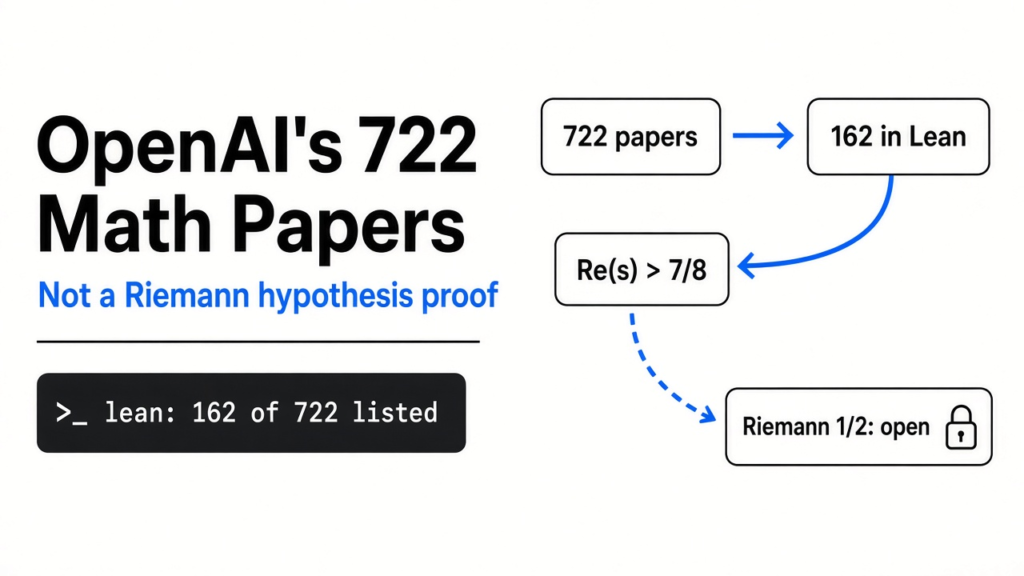
Short answer: OpenAI’s 722 math manuscripts (papers) went up on GitHub on October 6, 2026, grouped into 372 families (a main result plus its companion papers). An unnamed internal model produced them. About 4,000 problems were posed. The average kept result used about three hours of ChatGPT Pro thinking. The Riemann hypothesis (every interesting zero of the zeta function sits on one vertical line, at real part 1/2) is not solved. One family claims a weaker line, at 7/8, and that paper is in the Lean catalogue. On October 7 that catalogue listed 162 papers out of 722. Kakeya and the CM Hodge claim are in the manuscript map and not in that Lean list.
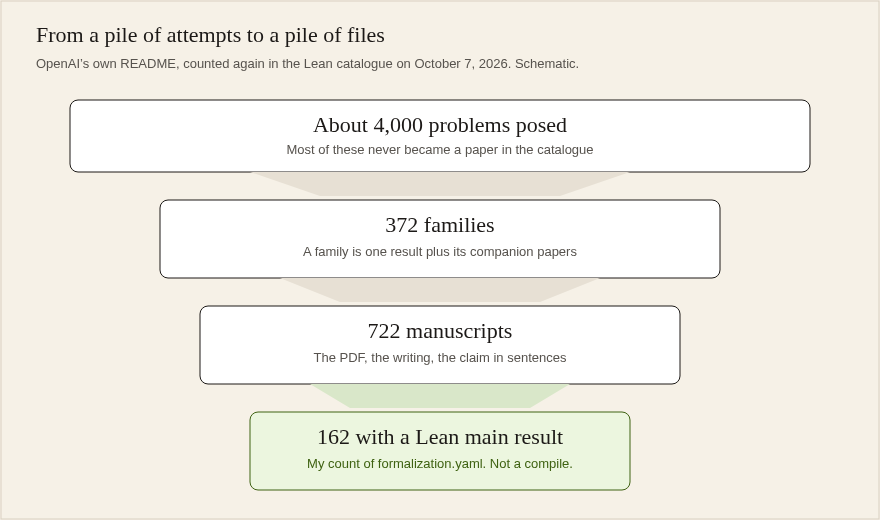
The number to remember is not 722. It is the gap between a paper that says a theorem and a file a computer has checked, and the second gap between that file and the famous problem you thought they meant.
What landed on October 6?
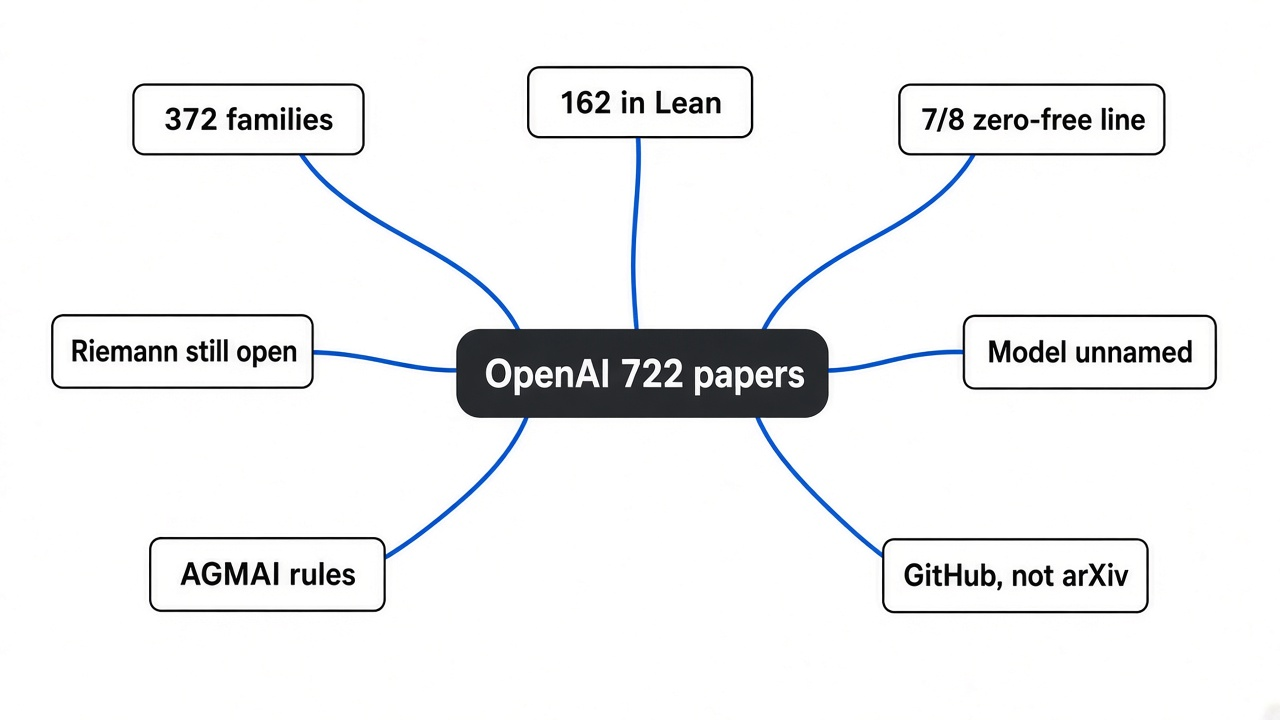
A public GitHub repository, an unnamed model, and a pile of papers at different stages of checking.
A manuscript is the paper: sentences, symbols, and a claimed theorem. A family groups related papers. OpenAI’s README says a family “may include a principal result, companion arguments, consequences, or alternative proofs.” So 722 is not 722 separate breakthroughs. It is 372 results, some of them written more than once.
The model is not named. The README calls it an unreleased internal OpenAI model. A frontier model, in their blog’s phrase, means a model at the top of what they can run. You cannot select it in ChatGPT from this release.
They say existing math tests had saturated (the score got so high it stopped teaching them anything). They moved the test onto open problems (questions a field has stated and not settled). About 4,000 problems were posed. They then grouped the output and kept what they judged significant. That kept set is the 372 families. 372 ÷ 4,000 is not a success rate. They did not publish one. A family is not the same object as one attempt.
| What | Number | Where it is stated |
|---|---|---|
| Problems posed | about 4,000 | README, “How the results were produced” |
| Families kept | 372 | README |
| Manuscripts | 722 | README |
| Average compute for a kept result | about 3 hours of ChatGPT Pro thinking | README and the October 6 blog |
| Abridged reasoning summaries | 10 families | README table |
| Papers with a formalized main result | 162 on October 7 | lean/formalization.yaml, October 7 |
| Checked statements in that same file | 185 | comparator entries in the yaml |
ChatGPT Pro thinking is their unit of compute, not a stopwatch on your laptop, and not a dollar price. The README does not give a dollar cost. Two jobs did not use this average: the zero-free region for the zeta function, and a proof of the Hodge conjecture for CM abelian varieties (a special case, defined below, not the full famous Hodge problem). The writeup for a weaker zeta line, real part greater than 11/12, was edited by a person for readability. They say so.
The license on the Lean project file is Apache-2.0 (a notice that lets you copy, change, and share the files if you keep the license).
The repository says some unformalized results could have issues, and that they will fix issues quickly and add more Lean later. If you read this after October 7, recount the file. Do not trust 162 as a permanent fact.
What is a proof, and what is Lean?
A proof is a chain of allowed steps. A PDF is one way to write the chain. Lean is another. They fail in different ways.
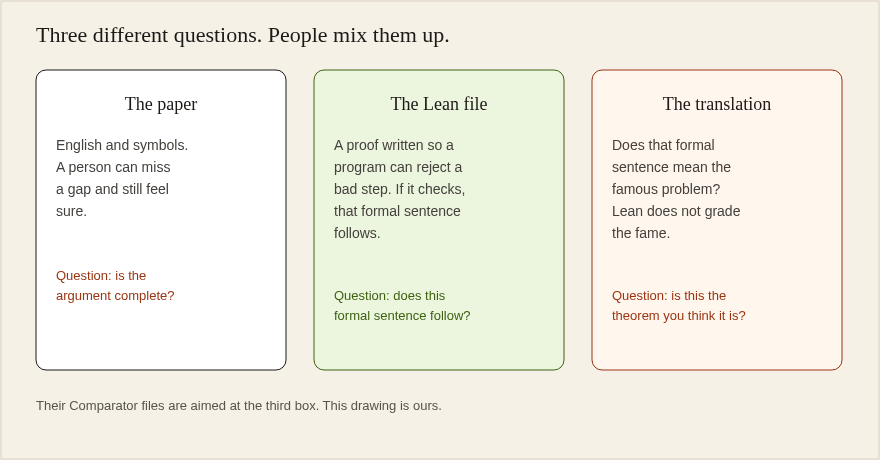
Start from a definition everyone shares. A step is allowed if it is an old theorem or a rule of logic. A proof is a chain of those steps that ends at the claim. A gap is a step that was skipped. People miss gaps, especially in a long paper.
Lean is a programming language (a language a computer can run) in which those steps are written so a checker can reject a bad step. A formalization is the proof rewritten in that language. If the checker accepts it, that formal sentence follows from the axioms and the library. It does not grade whether you translated the famous English problem correctly. That translation is a second job. OpenAI points at Comparator files for that second job.
Their catalogue’s own fields, on October 7, say status.scope: "Partial progress." and review.status: unchecked. “Unchecked” here means “this file has not marked a human review.” It does not mean “Lean failed.” It also does not mean “a person has signed the translation.”
What is the Riemann hypothesis?
A claim about where a function hits zero. Their 7/8 line is a different, weaker claim. The famous one is still open.
A complex number is a pair: a real part (the ordinary left-right number) and an imaginary part (the up-down number). You can plot it as a point on a plane.
The Riemann zeta function is a rule that turns most of those points into another number. On the numbers bigger than 1 it begins life as an infinite sum. Analytic continuation (a unique way of extending a smooth rule past the place the sum stops making sense) spreads it to almost the whole plane. At the point 1 it blows up. That blow-up is a pole (an infinity, not a zero). A zero is an input where the output is exactly 0.
Some zeros are boring and known: the negative even integers, −2, −4, −6, and so on. Those are the trivial zeros. The interesting zeros, the nontrivial zeros, sit in the critical strip (the vertical band where the real part is between 0 and 1).
The Riemann hypothesis, stated by Bernhard Riemann in 1859, says every one of those interesting zeros has real part exactly 1/2. It is unproved. It is one of the Millennium Prize problems (seven problems the Clay Mathematics Institute marked in 2000, with a million-dollar prize for a correct proof). Nobody has claimed that prize for this.
A zero-free region is a zone where a proof already says “no zeros in here.” For a long time the proved zone has hugged the right edge of the strip, the line where the real part is 1, and it gets thinner as you go up. A standard reference for that shrinking shape is Kevin Ford’s survey of zero-free regions. It is not a fixed vertical line standing still at every height.
A quasi-Riemann hypothesis, in the words of OpenAI’s own Lean note for family 003, “asks for a fixed zero-free half-plane Re(s) > θ with θ < 1.” Any fixed line strictly left of 1 would count. It does not have to be the middle line.
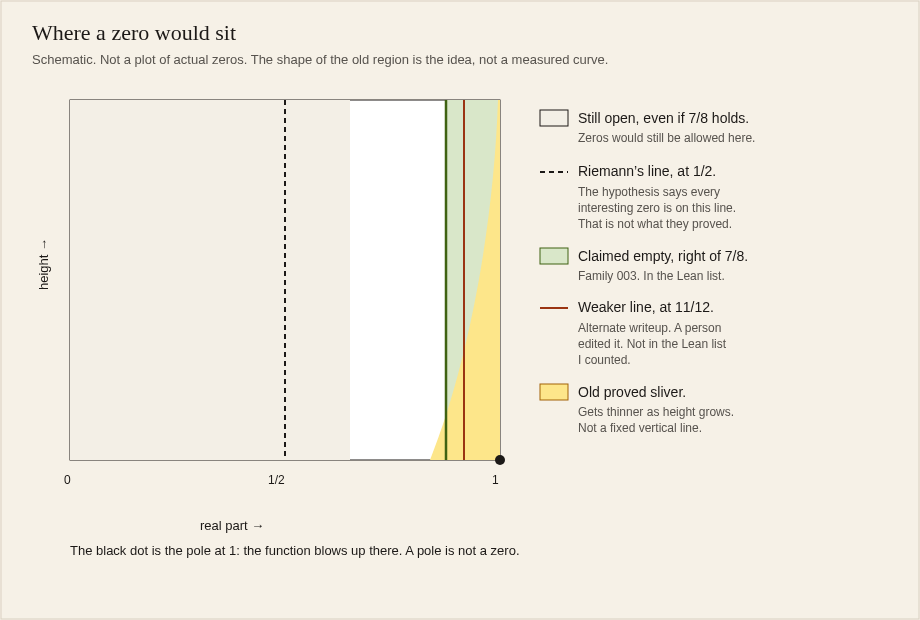
Family 003 in the manuscript map says every Dirichlet L-function, including the zeta function, has no zeros with real part bigger than 7/8. A Dirichlet L-function is the same kind of object as zeta, twisted by a character (a repeating pattern of coefficients). Seven eighths is 0.875. The Riemann line is 0.5. These functions have a mirror, called the functional equation (a proved identity that flips the plane around the line at 1/2). If a point is a zero, the flipped point is a zero too. Clear the far right and the far left clears with it. If family 003 is right, zeros are pushed into the middle band, from real part 1/8 to real part 7/8. The hypothesis says that whole band collapses onto the single line at 1/2. That is a different sentence from the one they wrote down.
The Lean note says the formalization gives θ = 7/8 for zeta, for every Dirichlet L-function, and also for finite-order Hecke L-functions over the number system called Q(√−3). That last number system is beyond this post. The note also says the pole at 1 is excluded, the paper’s later applications are not included, and a related real-zero gap (a Landau–Siegel zero, a possible real zero extremely close to 1 for certain of these functions) is only “some positive constant c, not a written-out number.” Zeros elsewhere between 0 and 1 are not ruled out by that side result.
There is a second writeup, for the weaker line at 11/12 (about 0.917). The README says a person edited that writeup for readability. The Lean catalogue has no “11/12” hit. The 7/8 paper is in the catalogue. The 11/12 paper, as an alternate, is a sentence in the manuscript map, not a line in the formalized-main-result list.
What did the computer actually check?
162 papers are listed as having a formalized main result. The headlines you saw are not all in those 162.
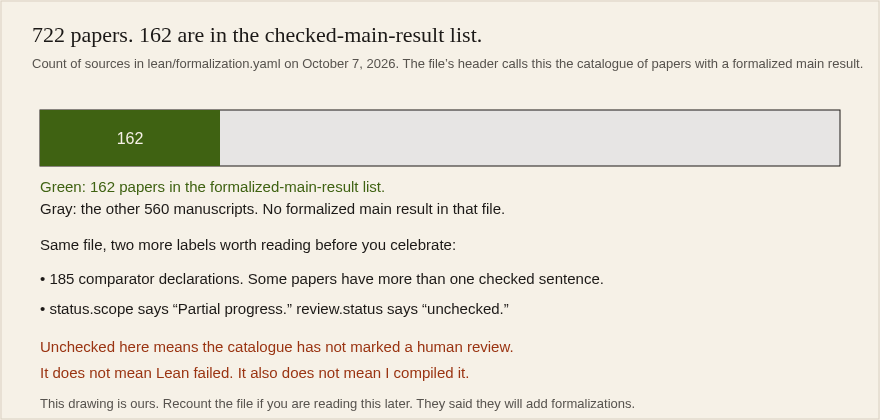
Counting sources entries of type: article in lean/formalization.yaml, and counting unique preprint paths, both give 162. The same file lists 185 comparator declarations, so some papers have more than one checked sentence. The header of the file calls it a catalogue of papers with a formalized main result.
A listing is not a compile, and the table below is not a reading of all 722 PDFs. A row in this table is “what the map claims” against “whether that paper’s path shows up in the catalogue.”
| Claim, as the repo’s map states it | In the Lean main-result list on October 7? |
|---|---|
| Family 003. No zeros with real part above 7/8, for zeta and Dirichlet L-functions. | Yes. The paper title is in the yaml. The scope note leaves out later applications. |
| The alternate 11/12 writeup for the same circle of ideas. | No “11/12” hit in the yaml. README: a person edited that writeup. |
| Family 087. Symmetric and nonsymmetric Mahler conjectures, in every dimension. | The symmetric paper is in the list. No nonsymmetric title appears there. The reasoning-summary list does mention both. |
| Family 074. Kakeya in 3D (maximal conjecture) and 4D (every such set has full Hausdorff dimension). | No. The yaml has no Kakeya hit. |
| The rational Hodge conjecture for complex abelian varieties with complex multiplication. | No. It is family 032 in the map, and the README names it as an exception to the three-hour procedure. “Hodge” does not appear in the yaml. |
| Kaplansky direct-finiteness, a counterexample in characteristic two and in odd characteristic. | Yes. Both papers are titles in the yaml. |
A conjecture is a precise claim that still lacks a proof. A counterexample is one case that shows the claim is false. Characteristic means which arithmetic the numbers are using, including whether adding 1 over and over eventually lands on 0. Kaplansky’s conjecture is not restated here in new symbols. The title is the claim. The Lean file would be the check, after someone compiles it.
Hausdorff dimension is a way of measuring size that can come out fractional, useful when a shape is too rough for ordinary length or area. Full dimension, in the 4D Kakeya sentence, means the set is as large as the whole 4D space, by that measure. A Kakeya set is a set that contains a unit line segment in every direction. Those words are defined here because the map uses them. That claim does not move into the “computer-checked” column. It was not in the list.
The Hodge conjecture, in full, is another Millennium problem: a statement about which geometric classes on a broad family of spaces come from actual geometric pieces. CM means complex multiplication (an extra symmetry on certain abelian varieties, which are a special kind of geometric space). Family 032 claims the rational form of the conjecture for those special spaces, and the README calls that work out as an exception to the usual three-hour run. That is not “the Hodge conjecture is solved,” and it is not in the Lean list.
What is still locked?
The files are public. The model, the prompts, and a chain of thought for each result are not.
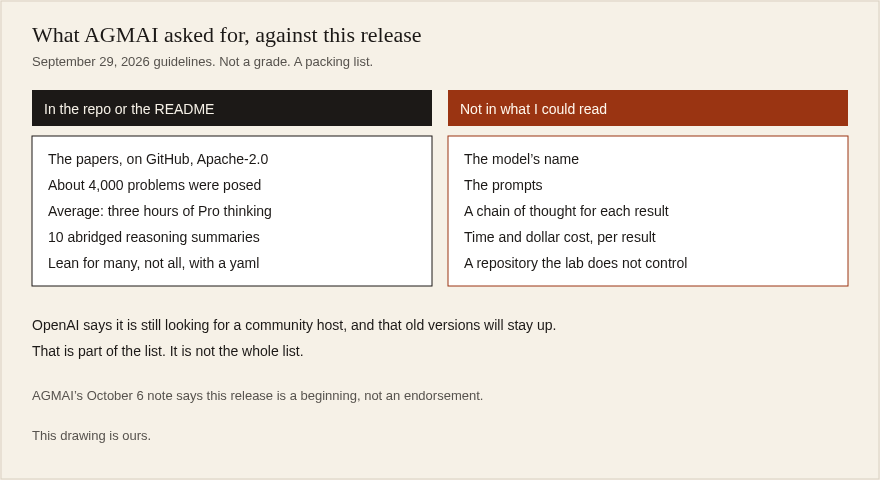
AGMAI is the Advisory Group on Mathematics and Artificial Intelligence, at the Institute for Advanced Study. It is not an OpenAI department. Its September 29, 2026 guidelines say the group does not endorse labs testing advanced problems on proprietary models (models the public cannot run), and asks them to stop.
For a result that people do not yet understand, the same document asks the lab to make public, for each result: the name of the model, the prompts (the instructions typed in), a summarized chain of thought (the model’s working, shortened), the time taken, and the estimated cost. It also asks for a repository the lab does not control, with a persistent citable identifier (a permanent id, the kind a journal or arXiv attaches) and a record of later edits. It asks that proofs be formalized, or that the formalization status be stated clearly if formalizing would delay the release. It asks for a public account of how many comparable problems were tried and failed.
Here is the match, from the files, not from a vibe.
- You get the papers, a version promise (old versions stay up), an attempt count of about 4,000, an average of three Pro hours, ten abridged reasoning summaries, and Lean for many results together with a
formalization.yamland comparator files. The October 6 blog says they will fund workshops and related programs. It does not name the sum, or the outside nonprofit AGMAI said should be the one handing money out. - You do not get the model’s name. You do not get the prompts. You do not get a summarized chain of thought for each family, only for ten. You do not get a per-result time or a dollar cost. The shelf is
github.com/openai/math, which the lab controls. OpenAI’s README says they are still exploring a community host. A GitHub path plus a promise to keep old files is not the same object as a DOI (that permanent id).
AGMAI’s October 6 statement says the release is important, that the group’s advice is not an endorsement, and that “this release is the beginning, not the completion, of the process of human understanding.” It tells the mathematical community to judge whether the September 29 recommendations were followed.
Two outside reactions, as reported by Joseph Howlett in Scientific American on October 6, are worth keeping next to each other. Andrew Sutherland, at MIT, said that until the model is released and people can replicate the results, claims about one-shotting a problem with a single agent should be treated as unverified. Daniel Litt, at the University of Toronto, said he sees no reason to keep the answers secret, and that making them public is a good thing for mathematics. Both can be right. The answers can be public and the method of getting them still unchecked.
Scientific American also reports an OpenAI spokesperson saying many of the new results are not yet understood by the company’s own mathematicians, and that the company is not bound by the advisory group’s recommendations. The spokesperson’s “one prompt, one agent” line is the spokesperson’s line to that magazine. The README’s line is narrower: the vast majority used the same procedure, with the two exceptions named above. Those are two different sentences, not one.
The yaml lists the author as OpenAI. AGMAI’s background norm is that the authors of a paper understand it, have checked it, and take responsibility for it. Set that norm next to the spokesperson line. There is no third sentence to add that they did not say.
Why is this on GitHub, five days after arXiv shut the fast door?
Because one submitter cannot walk 722 papers through arXiv in October. OpenAI did not write that sentence.
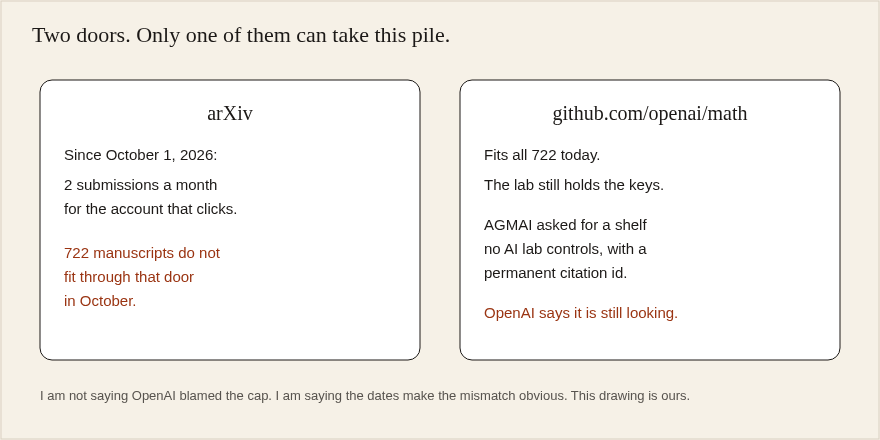
On October 1, 2026, arXiv (the free public shelf where researchers post papers before a journal) limited each submitter to two submissions a calendar month. We wrote that up here: arXiv will only take two papers a month from you. A submission is the act of asking a moderator to look. 722 manuscripts are not two.
AGMAI’s September 29 guidelines had already asked labs to deposit results in a scholarly repository that no AI lab controls. OpenAI’s blog says they used GitHub for this release, with a protocol for revisions and citations, and that they are still looking for a community-hosted place that meets the committee’s guidelines. Read that as an admission that this shelf is interim. Do not read it as “arXiv rejected them.” No OpenAI sentence says that.
GitHub is a reasonable place to put Lean files. It is a weak place to be the only library of record for 372 claims, because the lab can still rewrite the default view, even if they promise to keep history. The promise is in the README. The history is the thing to check before you cite a PDF path in a year.
How should you read one claim?
Five stops. A headline skips all five.
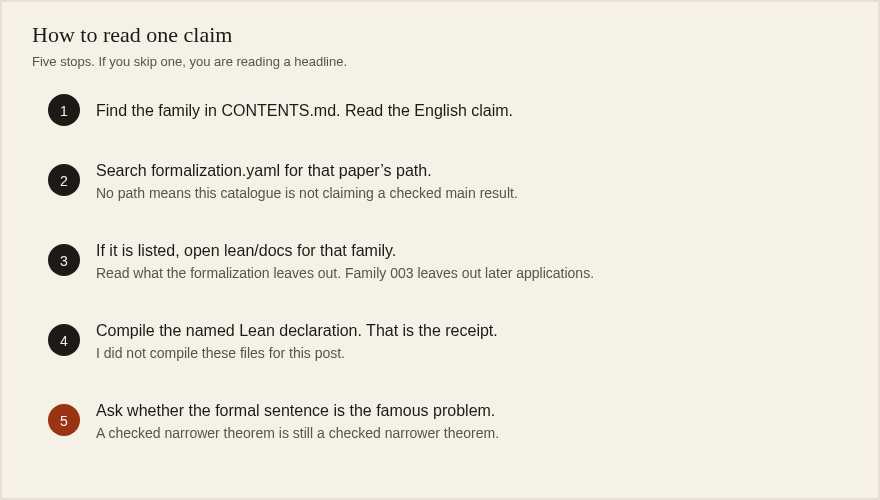
- Open CONTENTS.md and read the family’s English claim. Notice the words “quasi,” “rational,” “CM,” “dimension four,” or “alternate.” Those words are the difference between a famous problem and a cousin of it.
- Search formalization.yaml for that paper’s path. If the path is not under
sources, this catalogue is not claiming a formalized main result for it. Say “claimed in the map,” not “checked.” - If it is listed, open the note in
lean/docsfor that family. Family 003’s note is the pattern: it says what was formalized, and it says the later applications were not. - Compile the named declaration. That is the receipt. Their Lean README warns that building the whole library can fail on a low memory-map limit, and tells you to compile small portions.
- Only then ask if the formal sentence is the famous problem. A checked theorem that clears the strip to the right of 7/8 is a checked theorem about 7/8. It is not a checked Riemann hypothesis. A checked counterexample is a result, and it is a different kind of result from a proof that a conjecture is true.
If you only needed one action: pick a family, do steps 1 and 2, and write down which of the two boxes it landed in. That single split will keep you from repeating a bad headline.
What this does not mean
OpenAI did not solve the Riemann hypothesis. A row in a manuscript map is not a Lean check. A Lean check is not a proof that the English name matches, until someone has read the translation. The model is not something you can run. The 162 will move if they add formalizations, which they said they would.
Scientific American describes an earlier Navier–Stokes effort as a large, expensive agent swarm, and contrasts it with this release. That earlier effort is not re-audited here. This repository’s README does not price this run in dollars.
None of this says the results are empty. A public Lean file for a real 7/8 theorem, if it compiles and if the sentence matches, would be a large piece of mathematics. The way you find out is the five stops. The way you do not find out is the number 722.
Common questions about OpenAI’s 722 math papers
Did OpenAI solve the Riemann hypothesis?
No. Family 003 claims no zeros with real part above 7/8 for zeta and Dirichlet L-functions, a quasi-Riemann result. The hypothesis needs every nontrivial zero on the line at real part 1/2, and that is still open.
How many of the 722 papers are checked in Lean?
On October 7, 2026, lean/formalization.yaml listed 162 papers with a formalized main result and 185 comparator declarations. A listing is not a compile; building the named declaration is the receipt.
Which model wrote the papers?
An unreleased internal OpenAI model. The README does not name it, and you cannot select it in ChatGPT.
Why are the papers on GitHub instead of arXiv?
OpenAI says GitHub is an interim home with a revision and citation protocol while it looks for a community host that meets AGMAI’s guidelines. arXiv’s October 1 limit of two submissions a month per submitter would not fit 722 manuscripts, though OpenAI does not cite that as the reason.