
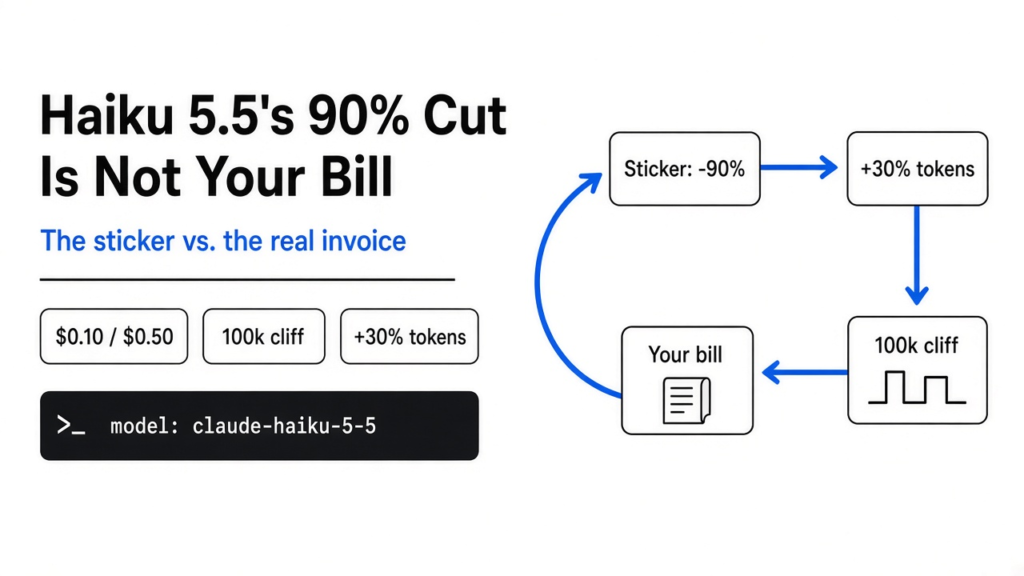
On 7 October 2026 Anthropic released Claude Haiku 5.5, model id claude-haiku-5-5. Claude Haiku 5.5 pricing looks simple: for prompts up to 100,000 tokens the list price is $0.10 per million input tokens and $0.50 per million output tokens, which is 90% below Haiku 4.5. Over 100,000 tokens those rates are $0.50 and $2.50, which is 50% below Haiku 4.5, and 5 times the short rate. The launch post’s own average is about 75% less to run, after a mix of short and long requests and after a new tokenizer that counts the same input text as about 30% more tokens. Multiply the sticker by that 30% and you do not get 75%.
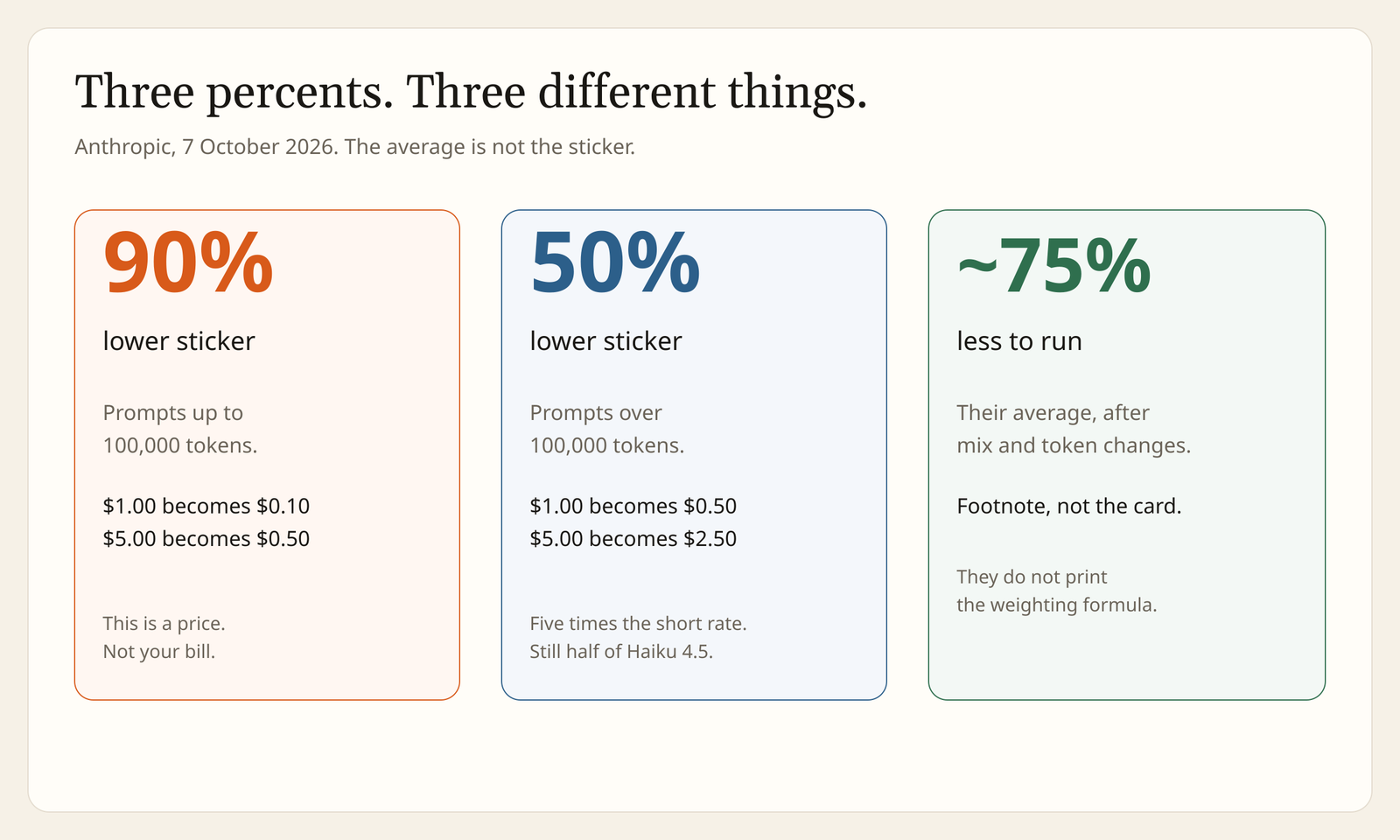
The number to remember is not 90. It is which sentence the 90 sits in.
What shipped on October 7?
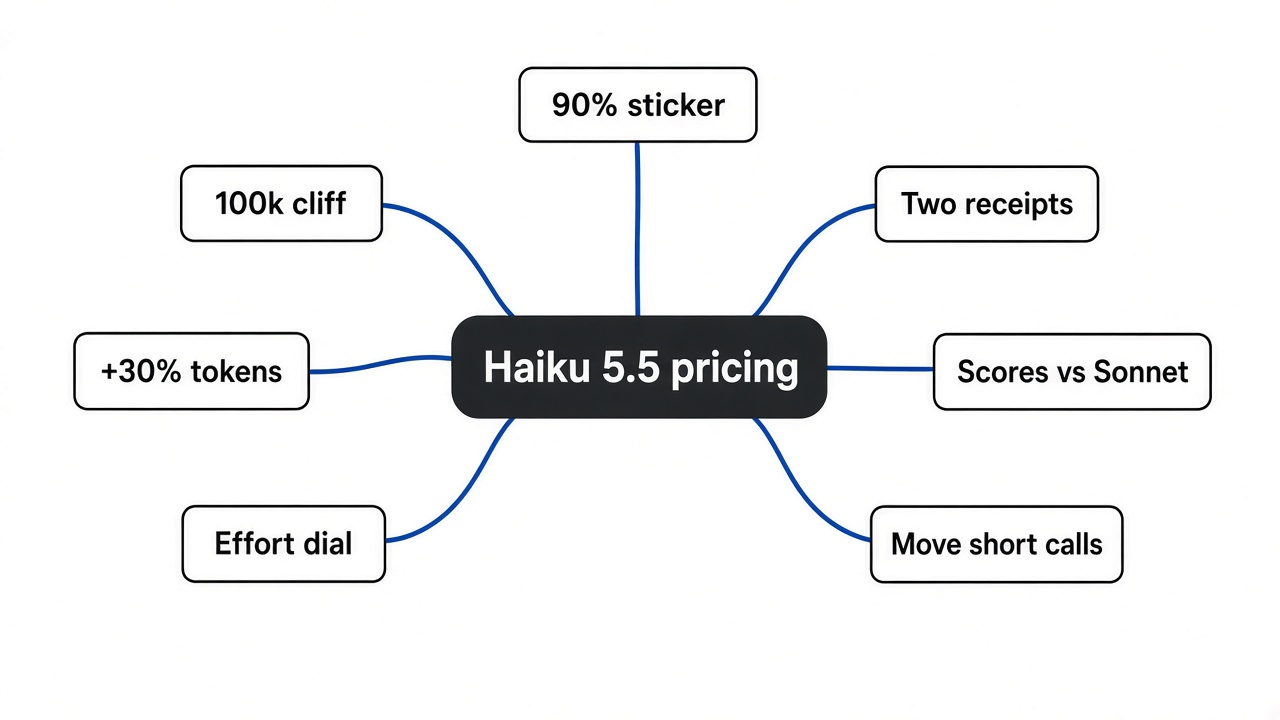
A small model with a new price card, a new splitter, and a spend dial. Not one discount.
A model (the program that turns your text into the next chunk of text) has a price card. A token (a chunk of text, often smaller than a word) is the unit on that card. An API (a way to send a request to someone else’s computer and get text back) is how you pay it. Haiku, in Anthropic’s lineup, is the small, fast one. Sonnet is the middle one. Opus is the large one.
The launch post, dated 7 October 2026, calls Haiku 5.5 “the cheapest, fastest, and most capable small model we’ve ever released.” It says that on average it now costs around 75% less to run. Footnote 2, on that same page, is the sentence that splits the headline:
“Claude Haiku 5.5 is priced 90% lower than Claude Haiku 4.5 for requests up to 100,000 tokens, and 50% lower for requests over 100,000 tokens. On Haiku 4.5, 90% of requests fell into the former category. This calculation also accounts for changes between Haiku 4.5 and Haiku 5.5 in how many tokens are used to complete a given piece of work.”
The same footnote says the new tokenizer (the splitter that cuts text into tokens) is similar to Sonnet 5.5’s and Opus 5.5’s, and that it uses slightly more tokens per task. The model docs are sharper than “slightly.” They say the same input text produces approximately 30% more tokens than on Haiku 4.5.
The official Claude account posted the careful sentence, not the 90: on average, around 75% less to run than Haiku 4.5. Posts elsewhere the next morning already led with $0.10 and $0.50, or with 90%, as if that were the whole card.
What is a token, in money?
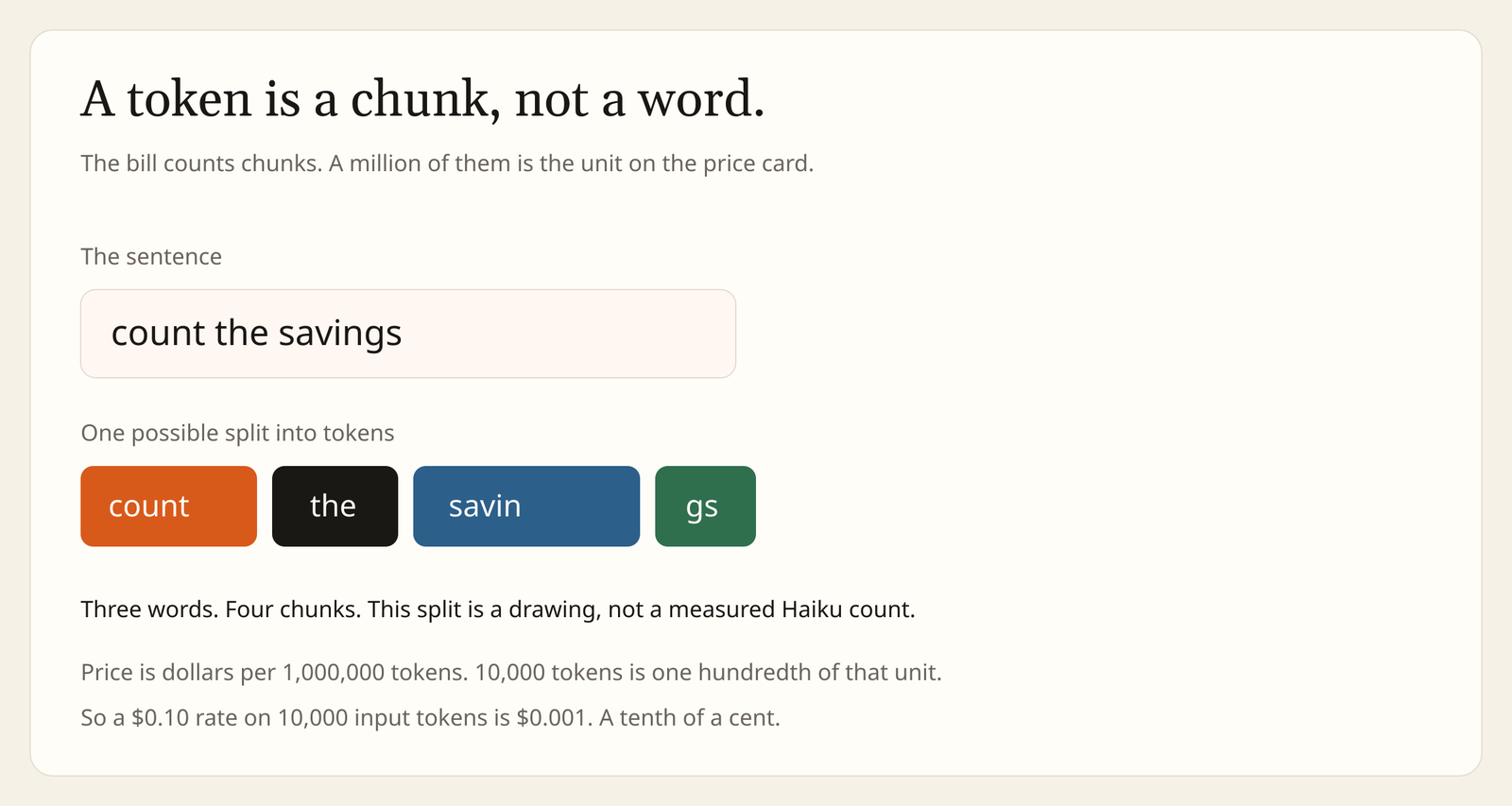
A chunk. The price is for a million chunks. Ten thousand chunks is one hundredth of the unit.
Start from the small thing. The model does not bill words. It bills tokens. “Savings” might be one token. It might be two. A drawing that splits “count the savings” into four boxes is a picture of the idea. It is not a count from Haiku’s splitter.
A million tokens is the unit written “per million” on the card. Divide your token count by 1,000,000, then multiply by the rate.
Ten thousand input tokens at $0.10 per million is 10,000 / 1,000,000 times 0.10, which is $0.001. A tenth of a cent. The scary numbers on the card are for volume. The mistake is using the wrong rate for that volume, not failing to read a decimal.
Why does one request have four prices?
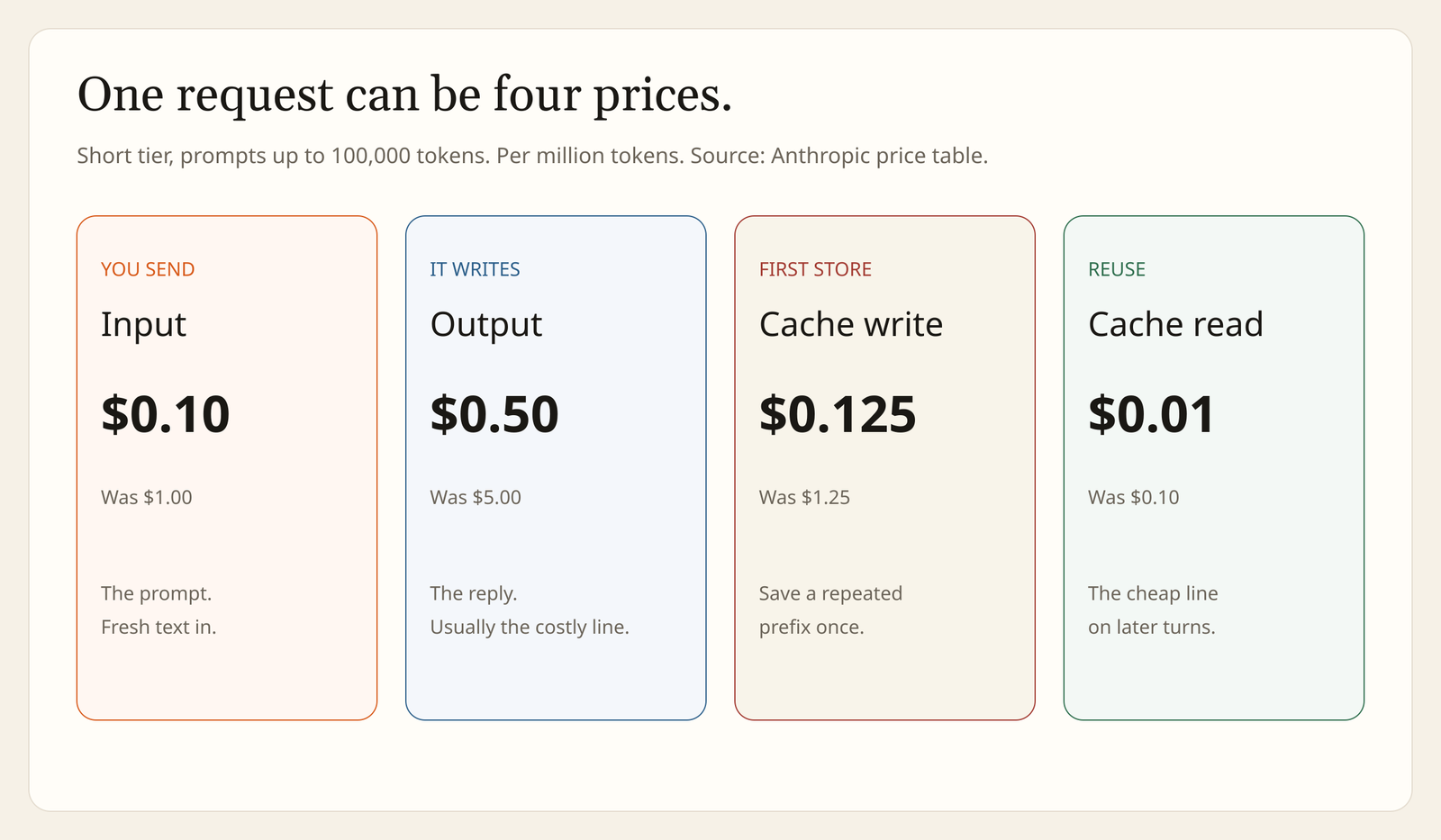
You pay to send, to receive, to store a repeated prefix, and to reuse that prefix.
Input tokens (the chunks you send, including the instructions) use the input rate. Output tokens (the chunks the model writes back) use the output rate. Output is usually the expensive line, because the output rate is 5 times the input rate on both Haiku cards: $5 versus $1 on 4.5, and $0.50 versus $0.10 on the short 5.5 tier.
A cache (a stored copy of a repeated prefix, so the provider does not recompute it) has two prices. A cache write (the first time that prefix is stored) costs more than a normal input. A cache read (each later time you reuse it) costs less. Agent loops (a program that calls the model again and again with the same instructions on top) live or die on the read line.
Short tier, prompts up to 100,000 tokens, per million tokens, from the launch table:
| Line | Haiku 5.5, up to 100k | Haiku 5.5, over 100k | Haiku 4.5 |
|---|---|---|---|
| Input | $0.10 | $0.50 | $1.00 |
| Output | $0.50 | $2.50 | $5.00 |
| Cache read | $0.01 | $0.05 | $0.10 |
| Cache write, launch table | $0.125 | $0.625 | $1.25 |
The model docs also list a 1-hour cache write (a longer-lived store) at $0.20 per million up to 100,000 tokens and $1.00 over that. I am not folding that into the launch table’s $0.125. Two windows, two prices. The docs also say the batch API (a slower queue for jobs that can wait) is 50% off input and output. That discount is a separate switch. It is not already inside the 75%.
Where is the cliff?
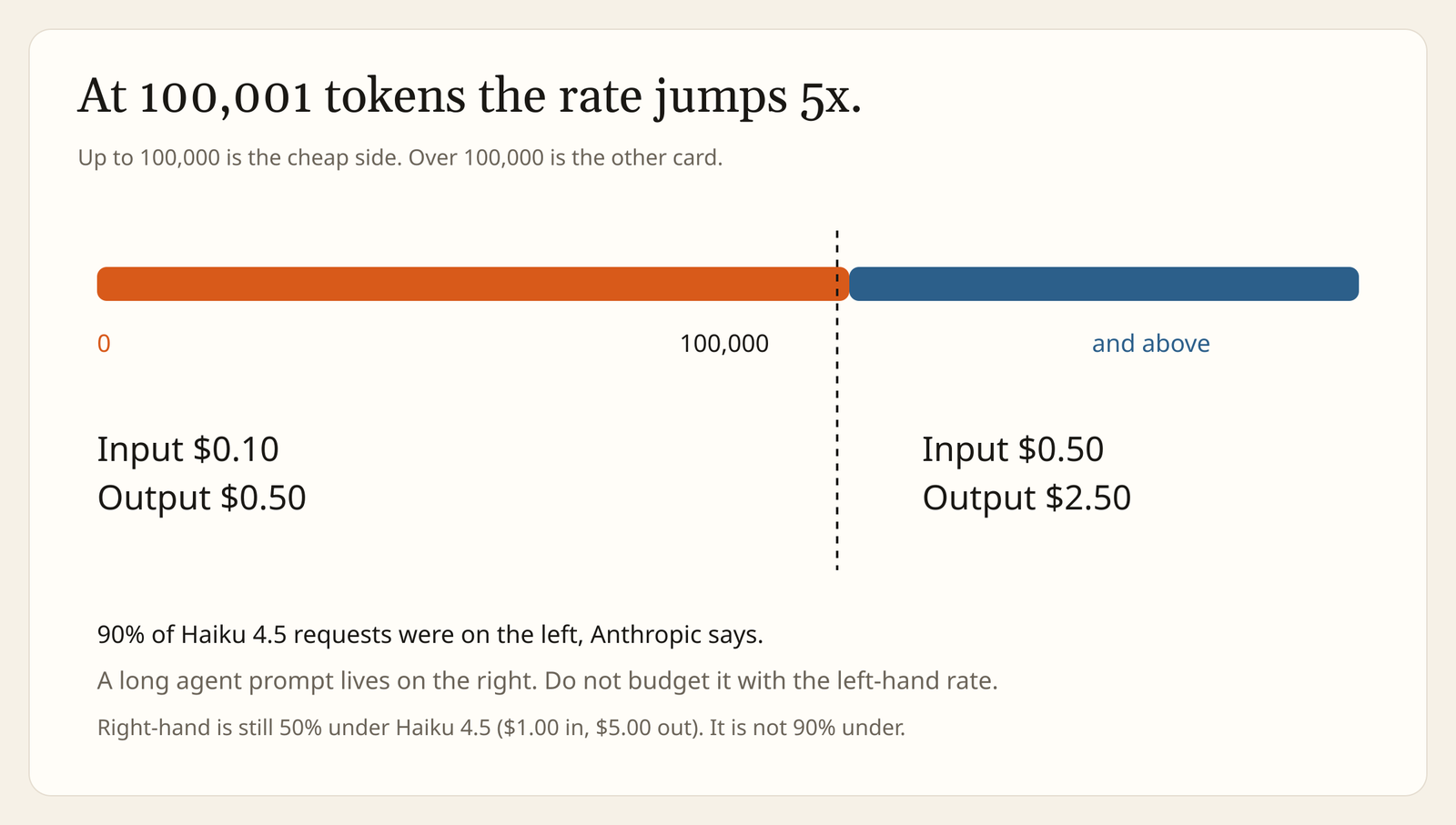
100,000 tokens is still the cheap card. The next token is the other card.
A prompt (the text you send in one request) is what Anthropic counts for the cliff. The launch page says “up to 100,000 tokens” and “over 100,000 tokens.” Read literally, 100,000 is the cheap side, and 100,001 is the dear side.
On the dear side, input is 5 times the short rate ($0.50 versus $0.10) and output is 5 times ($2.50 versus $0.50). That dear side is still half of Haiku 4.5. Half off is the 50% in the footnote. It is not the 90%.
Anthropic says 90% of requests to Haiku 4.5 fell under 100,000 tokens. Read the noun. Requests. Not tokens. Not dollars. Ten short classification calls (a call that picks a label) and one long agent transcript can be “90% of requests” while the long transcript is most of the bill.
The docs card also says the context window (how much text one request can hold) is 1 million tokens, and the maximum output is 128,000 tokens. A 1 million context is a warehouse. The cheap price only covers the first 100,000 of a prompt. The warehouse is not the discount.
Why does the same paragraph cost more tokens?
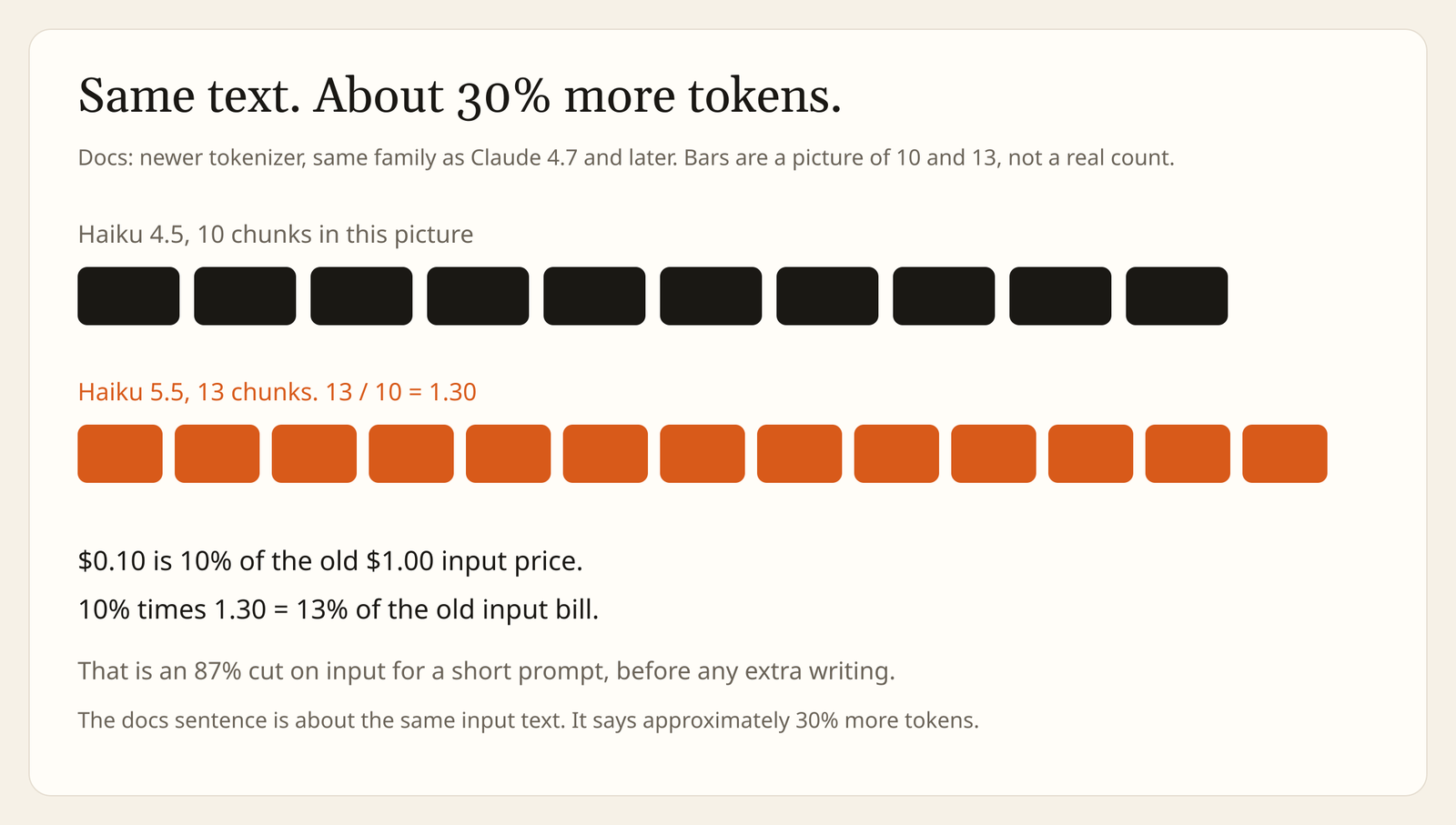
Because the splitter changed. The docs say about 30% more, on the same input text.
The model docs, not the launch adjective “slightly,” say this: “As with all models that use this tokenizer, the same input text produces approximately 30% more tokens on Claude Haiku 5.5 than on Claude Haiku 4.5.” Approximately. Use 1.30 as their figure, and treat every product of it below as arithmetic, not a measurement.
The sticker cut on a short prompt is 90%, which means you pay 10% of the old rate. Ten percent times 1.30 is 13% of the old input bill. You saved 87% on input, not 90%, before the model writes anything extra.
The docs sentence is about input text. The same splitter cuts output text too. If the reply uses the same words as it would have on Haiku 4.5, those words should also count as more tokens. The docs give no measurement for output. The receipts below apply 1.30 to output as an assumption, and say so.
Why is 87% not the published 75%?
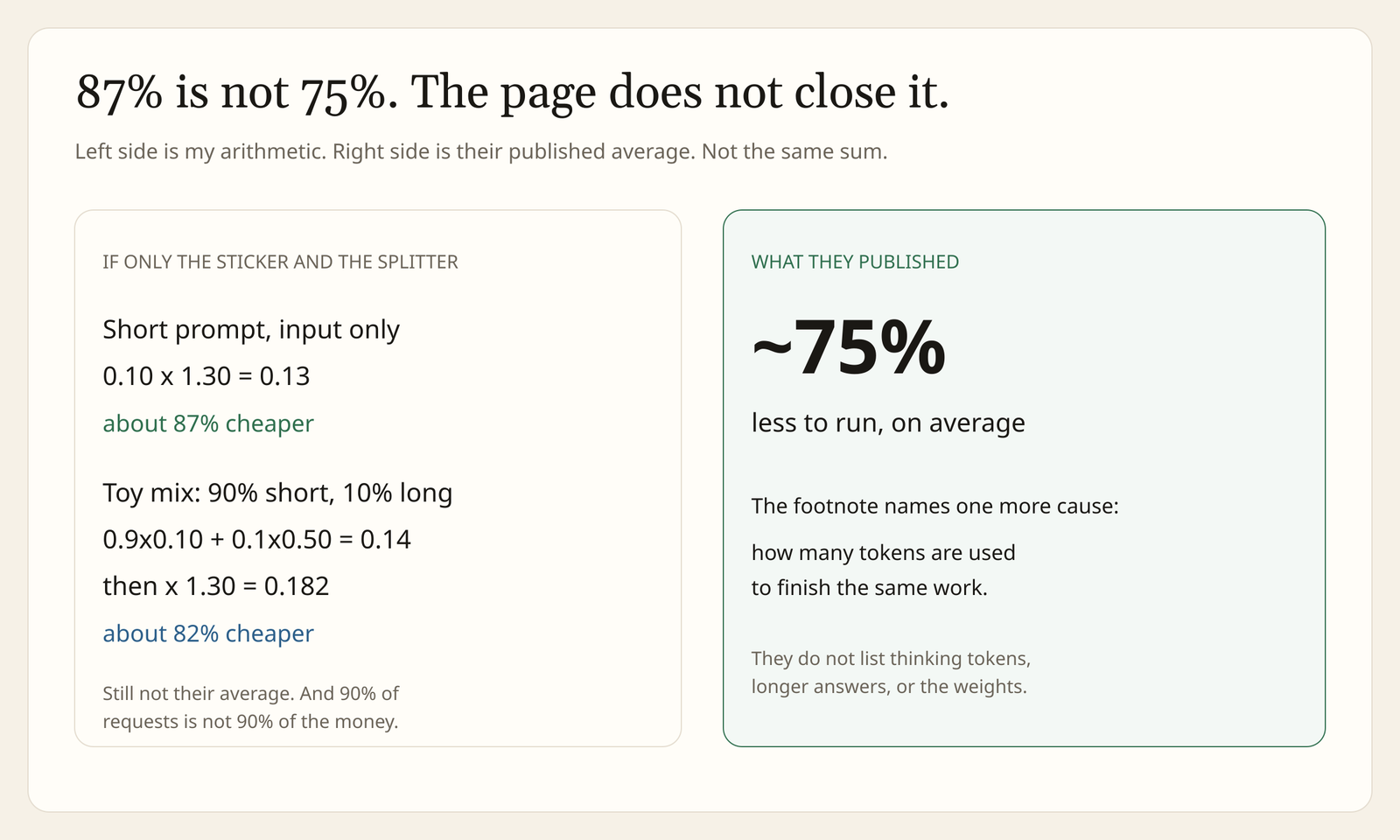
Because 75% is an average bill, and they do not print the weights.
Do the short case first. Pay 0.10 of the old price, then inflate tokens by 1.30. The input bill is 0.13 of the old input bill. That is about 87% cheaper. That is not 75%.
Do a toy mix next, and mark it as a toy. Suppose 90% of requests pay the short rate (0.10 of the old rate) and 10% pay the long rate (0.50 of the old rate), and suppose every request is the same size. Then the blended rate is 0.9 times 0.10 plus 0.1 times 0.50, which is 0.14. Times 1.30 tokens is 0.182. You would pay about 18% of the old bill, which is about 82% cheaper. Still not 75%. And the equal-size assumption is the weak one: Anthropic’s 90% is a count of requests, not a count of dollars. A long request is a bigger bill. Weighting by requests understates how much the cliff matters if your long calls are the work.
The footnote names the missing piece and does not size it: “how many tokens are used to complete a given piece of work.” That can include a longer answer. It can include thinking tokens (chunks the model spends before the visible reply). The launch post does not list those weights.
One illustration, labeled as a what-if, shows how the gap can close. Take the short receipt below, $0.00195 on Haiku 5.5 against $0.015 on Haiku 4.5. If the new model also wrote 4,000 extra output tokens, those cost 4,000 / 1,000,000 times $0.50, which is $0.002. The new total is $0.00395, which is about 74% below $0.015. That is a story about how thinking can eat a discount. It is not a measurement. Do not quote it as Anthropic’s formula.
What is effort, and why is medium already spending?
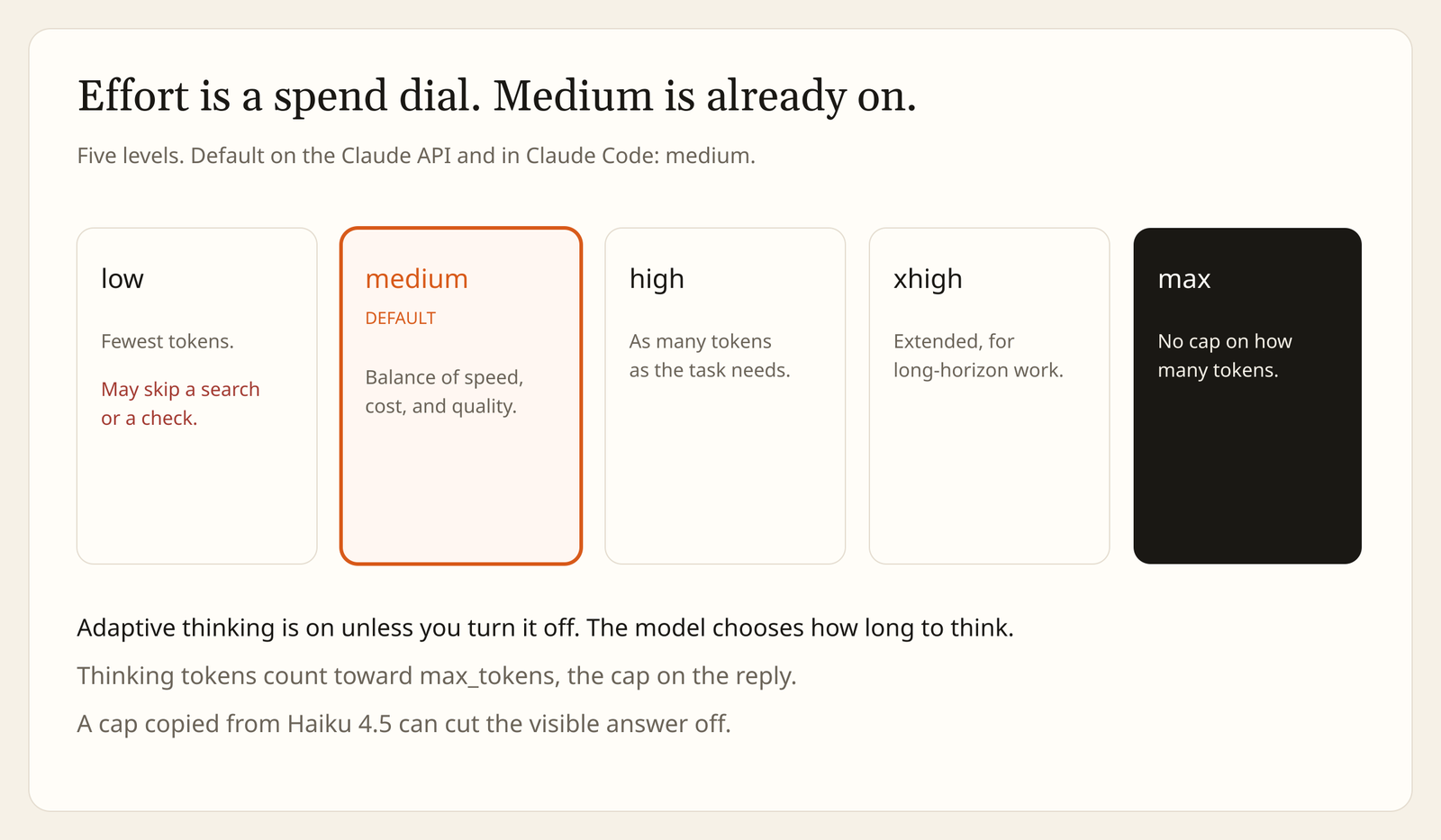
A dial for how many tokens the model may burn while thinking. The default is not “off.”
Adaptive thinking (the model decides how long to think, instead of a fixed budget you set) is on by default. Effort (the dial that steers that decision) has five settings: low, medium, high, xhigh, and max. The effort docs say Haiku 5.5 supports all five, and that medium is the default on the Claude API and in Claude Code (Anthropic’s coding tool that edits a project for you; here is how Claude Code works under the hood).
low is the cheapest and fastest. The same docs say that in long agent prompts the model is more likely to skip a search, stop early, or skip a check at low. high spends as many tokens as the task needs. max has no constraint on token spending. Turning the dial up is a choice to buy more output tokens. Those tokens are the line at $0.50, or at $2.50 if the prompt is over the cliff.
The migration notes say thinking tokens count toward max_tokens (the cap on how long the reply is allowed to be). They do not say thinking is free. There is one output price on the card. If thinking tokens are output tokens, they use that price. The price tables show no second, cheaper rate for thinking. Check the first invoice before you believe they were free.
A cap copied from Haiku 4.5 can now cut off the visible answer, because thinking uses part of the same cap. Recount tokens. Raise the cap if the answer is arriving chopped. The docs also say to omit temperature, top_p, and top_k (older knobs for randomness). A non-default value returns a 400 (the request is rejected as invalid). That is not the model refusing the task.
Two receipts, labeled as arithmetic
Short work is close to the headline. Long work is not. Neither receipt includes thinking.
These rows are arithmetic, not a meter reading. Input tokens on 5.5 are the 4.5 count times 1.30, from the docs’ “approximately 30%.” Output tokens on 5.5 are the same 1.30, which is my assumption, not their sentence. No cache. No extra thinking tokens. Round to the nearest hundredth of a cent only at the end; the totals below are exact products.
| Case | Haiku 4.5 | Haiku 5.5 | What is left of the bill |
|---|---|---|---|
| Short. 10,000 in, 1,000 out. Becomes 13,000 and 1,300. | $0.015 | $0.00195 | 13% left. About 87% cheaper. |
| Long. 200,000 in, 2,000 out. Becomes 260,000 and 2,600. Long tier. | $0.21 | $0.1365 | 65% left. About 35% cheaper. |
The short math: 10,000 / 1,000,000 times $1 is $0.01, plus 1,000 / 1,000,000 times $5 is $0.005. New side: 13,000 / 1,000,000 times $0.10 is $0.0013, plus 1,300 / 1,000,000 times $0.50 is $0.00065.
The long math lands on the dear card because 260,000 is over 100,000. Input is 260,000 / 1,000,000 times $0.50, which is $0.13. Output is 2,600 / 1,000,000 times $2.50, which is $0.0065. You did not get 90% off. You did not get 75% off. You got about 35% off in this picture, and only if the answer did not think.
If your real prompt is a long thread, budget the right-hand column and then add thinking. Do not budget $0.10.
Does $0.10 mean the same price as GPT-6 Luna?
On the short Haiku tier, the two stickers match. On the long Haiku tier, they do not.
OpenAI’s 22 September 2026 post on GPT-6 Sol and Luna lists Luna at $0.10 per million input tokens and $0.50 per million output tokens. That is the same pair as Haiku 5.5’s short tier. Haiku’s long tier is $0.50 and $2.50. A sentence that says “Haiku 5.5 matches Luna” is true for prompts up to 100,000 tokens and false above that, unless Luna carries a long-context surcharge that is not on that announcement table. This compares the two published tables only.
Same sticker is not the same product. The next section is Anthropic’s scores, which are their scores.
What do the scores actually say?
A large jump from Haiku 4.5. Not a reason to retire Sonnet for hard coding.
A benchmark (a fixed test with a score) on a launch page is the vendor’s number. The launch charts, as published on 8 October, compare Haiku 5.5 with Haiku 4.5, GPT-6 Luna, and Sonnet 5.5.
| Test | Haiku 5.5 | Haiku 4.5 | GPT-6 Luna | Sonnet 5.5 |
|---|---|---|---|---|
| GDPval-AA, knowledge work | 1620 | 735 | 1437 | 1840 |
| AA-Briefcase | 1578 | 614 | 1336 | 1824 |
| OSWorld 2.1, offline, computer use | 72.4% | 15.7% | 48.9% | 83.9% |
| Humanity’s Last Exam, no tools | 45.9% | 10.2% | no number on the chart | 56.9% |
| Humanity’s Last Exam, with tools | 57.4% | 18.7% | no number on the chart | 64.5% |
| Terminal-Bench 4.0 | 39.2% | 0.0% | 16.4% | 70.6% |
| FrontierCode 1.1 | 46.4% | not on the chart | 42.4% | 52.1%, marked Xhigh |
| Chartography, no tools | 46.4% | 6.4% | 29.1% | 61.6% |
Read Terminal-Bench before you move a coding agent. Sonnet 5.5 at 70.6% is not Haiku at 39.2%. The launch post says Sonnet 5.5 and Opus 5.5 remain better for complex agentic coding like that test, and that Haiku 5.5 is for more narrowly scoped tasks. The 0.0% on Haiku 4.5 is their cell. The launch post does not explain the zero as a broken harness (the scaffold that runs the test). A zero is a zero until they explain it.
On the chart, Haiku 5.5 is ahead of Luna on every row where both have a number. Ahead of Luna is not ahead of Sonnet. The knowledge-work rows are points, not percents. Do not turn 1620 into a percentage.
Footnote 1 on the launch post says Haiku 5.5 is their fastest model at each model’s standard speed, and that it runs less quickly than Opus models in Fast Mode (a paid faster setting). Fastest in the normal lane is not fastest in every lane.
The models overview table lists a knowledge cutoff (the date through which the model’s memory is strongest) of June 2026. A cutoff is not a promise about today’s news. It still has tools, if you give it tools.
What breaks the hour you change the model string?
Old knobs return a 400. Old token counts are wrong. Old caps can clip the answer.
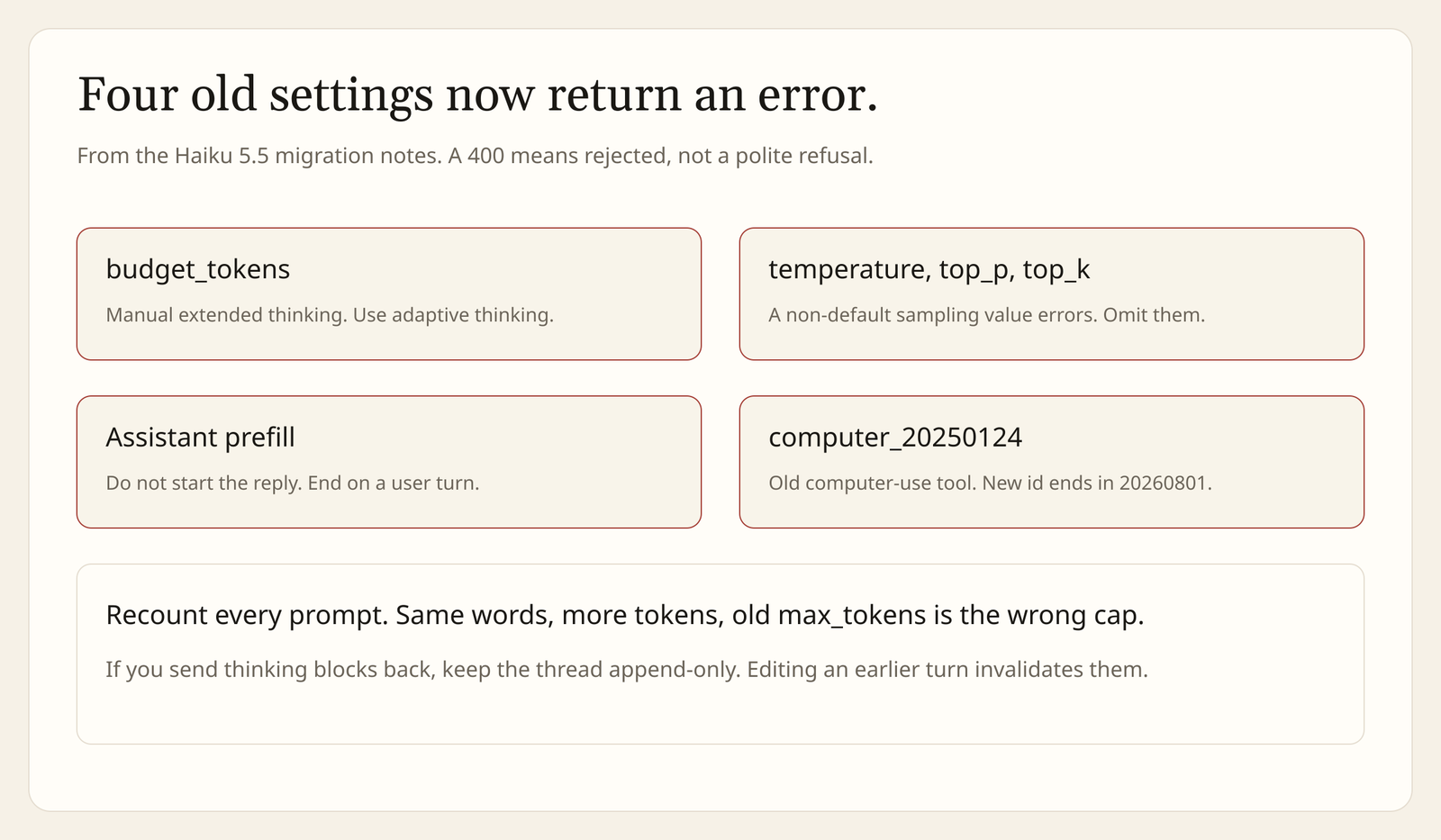
The Haiku 5.5 migration notes say all of this:
budget_tokens(the old way to set a thinking budget by hand) returns an error. Use adaptive thinking, and steer it with effort.- A non-default
temperature,top_p, ortop_kreturns an error. Omit them. - Assistant prefill (starting the reply yourself so the model continues your sentence) returns an error. End the message list on a user turn.
- The old computer-use tool id
computer_20250124is replaced, on the Claude API and Google Cloud, bycomputer_toolset_20260801. - If you send thinking blocks back, do not edit earlier turns. Changing them invalidates those blocks. Keep the thread append-only (add to the end, do not rewrite the past).
Then recount. The same prompt is more tokens. max_tokens has to cover thinking plus the visible answer. The model id to call is claude-haiku-5-5.
Where it runs, from Anthropic’s Haiku page: on claude.ai for Free, Pro, Max, Team, and Enterprise, where you can select it; on the Claude Platform API; in Claude Code; and on Amazon Web Services, Google Cloud, and Microsoft Foundry.
What about the Sonnet cache cut in the same post?
A second discount, for a different model, and it is not 75% either.
The same launch says Anthropic is halving Sonnet 5.5 cache reads, from $0.20 per million tokens to $0.10, and that Sonnet 5.5 now runs around 20% cheaper on most agentic work. Cache reads are one line. If that line is a slice of an agent bill, halving the slice is not halving the bill. Their “around 20%” is the claim about the whole bill. If you came for Haiku and you actually run Sonnet on the long coding loop, this is the line to reprice, not the 90%.
What should you do this week?
Move the short, repeated calls. Leave the long coding loop on Sonnet until you measure it. Recount before you believe a percent.
If a call is classification, extraction (pulling a field out of a document), routing (picking which bigger model should answer), or a short subagent (a helper call inside a larger job), and the prompt is under 100,000 tokens, the short card is the product. The jump from Haiku 4.5 on the vendor charts is large. The short receipt, before thinking, is about 87% cheaper on my arithmetic, close to the spirit of the headline and better than a vague 75% you cannot audit.
If the prompt is a long agent thread, price the long card, then add thinking at the output rate. My picture of a 200,000-token prompt was about 35% cheaper, not 75%, and it included no thinking. Turn effort to low only if you can stand a skipped check. The docs warn you about that skip.
Do not swap Sonnet for Haiku on Terminal-Bench-shaped work because the input price is twenty times lower ($0.10 versus Sonnet’s $2). A wrong patch is more expensive than the tokens. The launch post already says Sonnet and Opus stay better at that job.
Before the first production day: change the model string, delete the old sampling knobs, delete budget_tokens, recount tokens, and raise max_tokens until the visible answer survives thinking. Then read one real invoice. The 75% is their average. Your mix is your mix.
Common questions about Claude Haiku 5.5 pricing
How much does Claude Haiku 5.5 cost?
For prompts up to 100,000 tokens, $0.10 per million input tokens and $0.50 per million output tokens. Over 100,000 tokens, $0.50 and $2.50. Cache reads are $0.01 and $0.05 per million on the two tiers.
Is Claude Haiku 5.5 really 90% cheaper than Haiku 4.5?
Only the short-tier sticker is 90% lower. The new tokenizer counts the same input text as about 30% more tokens, so a short prompt is about 87% cheaper on input. Anthropic’s own average is around 75% less to run.
What happens when a prompt goes over 100,000 tokens?
The whole request moves to the long card: $0.50 in and $2.50 out per million tokens. That is 5 times the short rate and still 50% below Haiku 4.5, not 90%.
Do thinking tokens cost extra on Haiku 5.5?
There is one output price on the card. Thinking tokens count toward max_tokens, and medium effort is already the default, so budget thinking at the output rate and check the first invoice.
Should I replace Sonnet 5.5 with Haiku 5.5 for coding agents?
Not for hard agentic coding. On Anthropic’s Terminal-Bench 4.0 chart Sonnet 5.5 scores 70.6% against Haiku 5.5’s 39.2%. Move short classification, extraction, routing and subagent calls first.