
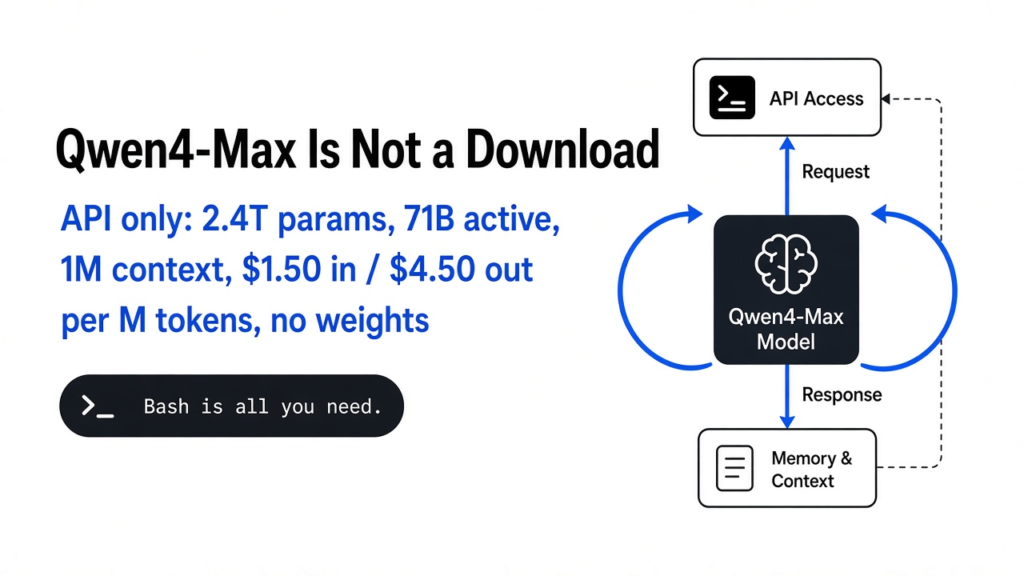

What is Qwen4-Max? It is Alibaba’s new top model, and it is not a download. Alibaba put it on its public API on 16 November 2026. An API (a front door other programs knock on) is how you use it. The file of learned numbers stays on their machines. The headline number is 2.4 trillion. The number that decides whether you can run it at home is zero. Zero weight files. Zero install. If you only remember one line, remember that.
I have not sent it a prompt. I read Alibaba’s press note, the Model Studio card for model id qwen4-max, and the public price table, then checked what launch-day writeups added. Where those disagree, the card and the price table win.
what is qwen4-max
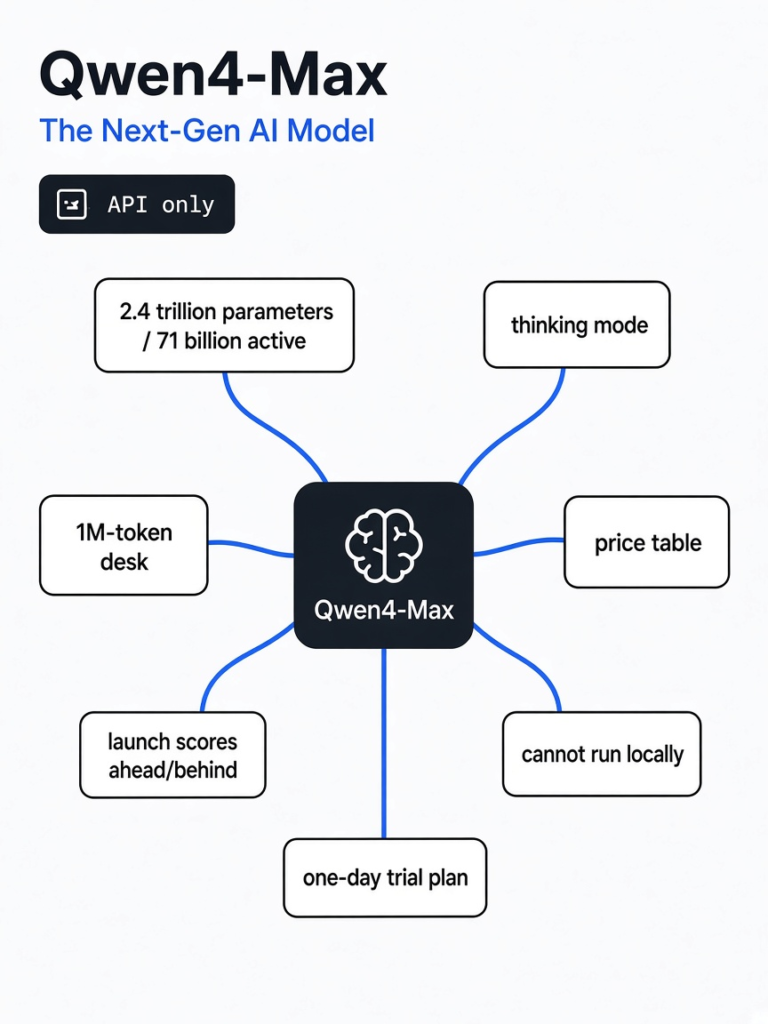
Start from a blank page. A model (the program that continues text) is a giant pile of stored numbers plus a small procedure that uses some of those numbers to guess the next chunk of an answer. Qwen4-Max is Alibaba’s new top of that pile. You do not download the pile. You send a request. They run the pile. They send text back.
your program
    |  text, and (on the product pages) pictures or video
    v
QwenCloud API   model id: qwen4-max
    |
    v
their servers do the math
    |
    v
text comes back, including any scratchpad you asked to keepThe press note says it has native vision (it can take pictures, not only words). Launch trackers say the API also accepts video and returns text. I have not pushed a video through it, so I will not swear to a frame rate or a file type. The model id I would type is qwen4-max. The surfaces named in the press note are QwenCloud (the API and the Token Plan, which is their prepaid credit), QwenWork, and QwenStudio (the chat site at chat.qwen.ai).
A Token Plan preview opened around 11 November. Qwen’s own site shows a post dated 15 November. The press note and the public price row are 16 November. Treat 16 November as the day the API price became a public line, not as three different models.
what is a token
Every number below is counted in tokens (small chunks of text, not whole words). You need that word before the prices mean anything. A token is the unit the model eats and the unit the bill uses. In ordinary English, a rough rule is about four characters per token, so three-quarters of a word. Code, Chinese, and screenshots do not obey that rule. A screenshot is not “one token because it is one picture.” It becomes many tokens. I am not inventing a picture price. I am saying: do not budget a video call as if it were a paragraph.
"unbelievable"
   |  a tokenizer (the splitter) cuts the word
   v
[un] [believ] [able] <-- three tokens, one wordWhen a page says “per 1 million tokens,” it means one million of those chunks, in or out. It does not mean one million words, and it does not mean one million requests.
what does 2.4 trillion parameters mean
A parameter (one stored number the model learned) is a single knob in the pile. 2.4 trillion parameters is the size of the library. It is not the amount of work done for each token. Alibaba’s press note says the library is a sparse mixture-of-experts model (most of the library sleeps, and a small slice works on the token in front of it) with 2.4 trillion parameters in total, and that only 71 billion of them wake up per token.
Read the two numbers as different bills. 2.4 trillion is how much had to be stored and trained. 71 billion active (awake for this token) is closer to how much math happens when your request arrives. Alibaba says that awake slice is 25 percent smaller than the awake slice in Qwen3.8-Max, even though both are described at the same 2.4 trillion total. Smaller awake slice, on their telling, is why a stronger model can still cost less to run.
Secondary writeups add architecture the short press note does not spell out: extra parameters that only look up short local patterns (n-gram embeddings, a table of little phrases), a sparse attention trick, and gated residual branches (skip-paths that add the earlier math back in, with a gate that can turn the path down). I am not going to teach those as if I had the paper in front of me. The part you can use without the paper is the split between the library and the slice that wakes up.
what is a mixture of experts
Before the initials. Imagine a hospital. You do not wake every doctor for a sore throat. A person at the desk (the router, a small chooser) sends you to one or two specialists (experts). The other doctors stay home. That is a mixture of experts. Sparse means most experts contribute nothing on this token. Dense (the opposite) means every knob joins in every time, which is simple and expensive.
token arrives
    |
    v
router picks a few experts
    |
    +--> expert A  (awake, does math)
    +--> expert B  (awake)
    +--> experts C..Z  (asleep, cost ~ 0 for this token)
    |
    v
their answers are added togetherSo “2.4 trillion” is a storage brag. “71 billion active” is the work. People hear the first number and go looking for a download the size of a data center. There is nothing to download. Even if the weights leaked, a 2.4 trillion library does not fit on a laptop. The open download Alibaba has actually promised is a later, smaller Qwen4, with no date and no size. Same-day posts on X were already asking where that small one is. Asking is not a release.
what is the one million token context
A context window (how much text the model can look at in one request) is the desk, not the library. Qwen4-Max’s desk is 1,000,000 tokens. At the English rule of thumb, that is on the order of 750,000 words, several novels, or a large repo if you are lucky about how the code splits. Pictures and video spend the same budget and spend it faster than prose.
The card lists ceilings, and they share the desk. They are not a bonus on top of the million.
| Ceiling on the card | Tokens |
|---|---|
| Context length (the whole desk) | 1,000,000 |
| Max input, thinking off | 991,808 |
| Max output, thinking off | 131,072 |
| Max input, thinking on | 983,616 |
| Thinking plus the answer, together | 262,144 |
|<------------ 1,000,000 tokens, one desk ------------>|
|  your prompt + tool results  |  scratchpad + answer  |
input tokens output tokensIf you fill the desk, there is no room left to write. 991,808 plus 131,072 is more than 1,000,000, so those two ceilings cannot both be full at once. Same for the thinking numbers. Plan for the desk, then stay under the ceiling that matches the mode you turned on.
Long desk does not mean “paste the company.” Attention (the step where one token looks at the others) gets more expensive as the pile grows, and models get worse at finding the one line that matters. Alibaba says the new design changes attention, the residual paths, and the embeddings (the table that turns a token id into the first vector of numbers). That is a claim about their architecture. It is not a promise that a million-token paste will find the bug.
what is thinking mode
Thinking mode (the model writes a scratchpad of steps before the answer you see) is on by default in the card I read. enable_thinking defaults to true. reasoning_effort defaults to high. The thinking budget defaults to 131,072 tokens. Temperature (how random the next token is allowed to be) defaults to 1.0 while thinking and 0.7 when thinking is off. You do not have to memorize those. You do have to know that a naive call thinks, and the scratchpad is billed as output.
prompt  --input price-->  scratchpad  --output price-->  answer
                              ^
                              |
                    this part is often longer than the answer
and it is not freeOutput on the international list is $4.50 per million tokens. A 20,000-token scratchpad is $0.09 before the answer exists. A 100,000-token scratchpad is $0.45. Turning thinking off is a real switch (enable_thinking false), not a vibe. Leave it on when the task is a hard multi-step job. Turn it off when you want a short rewrite and you are watching the bill.
what does a call cost
Prices below are list prices I read on Alibaba’s Model Studio price table for the international deployment (the Singapore row), thinking and non-thinking the same. Other regions are cheaper on that same page. Beijing and the global row list $1.413 per million input and $4.24 per million output. Cache read there is about $0.071. Read the row for the region you actually call. These numbers move.
| Line (international / Singapore) | Per 1 million tokens |
|---|---|
| Input | $1.50 |
| Output, scratchpad plus answer | $4.50 |
| Cache write, kept 5 minutes | $1.875 |
| Cache write, kept 1 hour | $3.00 |
| Cache read, explicit or implicit | $0.075 |
A cache (a stored copy of a repeated prefix, so the next call does not pay full input price for the same long prompt) is not a discount you sprinkle on one-shot calls. The 5-minute write costs $0.375 more per million than a normal input. Each later read saves $1.425 per million versus sending it again. Two fresh sends of 1 million tokens cost $3.00. One 5-minute write plus one read costs $1.95. The cache wins on the second call, if the second call happens before the 5 minutes die. The 1-hour write is $3.00, which is already the price of two fresh sends, so it only wins on the third send. Do not turn on a 1-hour cache for a prompt you will send once.
Worked task, international list, no cache. 80,000 tokens of repo context in, a 20,000-token scratchpad, a 2,000-token answer.
| Piece | Tokens | Price | Cost |
|---|---|---|---|
| Input | 80,000 | $1.50 / M | $0.120 |
| Scratchpad | 20,000 | $4.50 / M | $0.090 |
| Answer | 2,000 | $4.50 / M | $0.009 |
| Total | $0.219 |
Same input as a cache hit, scratchpad unchanged: input drops from $0.120 to $0.006, and the call is about $0.105. The scratchpad is now most of the bill. That is the loop. Shrink the desk if it repeats. Shrink the scratchpad if the task is easy. A full 1 million-token input with no cache is $1.50 before the model writes a word.
Free quota: the Singapore row lists 1 million tokens, valid 90 days from activation, model release, or approval, whichever is later. The price page says that free quota is a Singapore thing. Do not budget on a free million in a region whose row does not list one. Default rate limit on the Singapore tier I saw: 5 million tokens per minute at the lowest spend tier, stepping up if the account spends more. Fine-tuning (further training on your data) is marked not supported. Model deployment (running a private copy) is marked not supported.
Alibaba’s own Work360 comparison says average task cost fell about 60 percent versus Qwen3.8-Max, with 35 percent fewer tokens at High effort. A launch writeup turns that into $4.43 down to $1.67, about 62 percent, on that private test. Believe the direction. Recompute your own task. Their task is not your repo.
where the scores are ahead and where they are not
I have not rerun anything. Alibaba’s press note says Qwen4-Max beats Qwen3.8-Max overall on Work360, their private test across 721 fields, and that it ranks 6th on Code Arena (a public coding leaderboard). Sixth is not first. A coding agent does not move house for sixth.
The table under this is MarkTechPost’s reading of Alibaba’s launch chart, 16 November 2026. None of it was reproduced for this page. The same writeup notes that Moonshot’s own card gives different Terminal-Bench numbers than this chart. When two vendor cards disagree, the honest sentence is “the chart says,” not “it scored.”
| Test, as that chart labels it | Qwen4-Max | A neighbor on the same chart | How I would use it |
|---|---|---|---|
| HLAB-Vals-1.1, legal agent work | 21.3 | Kimi K3.1 at 11.7 | The rare chart where the gap is large |
| Agents’ Last Exam v1.1 | 46.7 | Opus 5.5 and Kimi K3.1 at 43.4 | A small lead on an agent exam |
| DeepSWE v1.1 | 75.7 | Kimi K3.1 at 75.5 | A photo finish, not a reason to switch |
| BioMysteryBench | 85.0 | GPT-6.1 Sol at 84.4 | Essentially tied at the top of that chart |
| Work360, Alibaba’s own | 52.69 | Qwen3.8-Max at 47.74 | Better than their previous model, on their test |
| Terminal-Bench 4.0 | 48.5 | Kimi K3.1 at 67.2, Opus 5.5 at 59.6 | Behind on terminal work |
| ProgramBench | 31.5 | Opus 5.5 at 65.0 | Far behind on this hard coding set |
| Chartography, no tools | 54.2 | GPT-6 Astra at 71.1 | Behind on chart reading |
| Humanity’s Last Exam, no tools | 51.7 | Opus 5.5 at 59.8 | Behind on this hard-question set |
The pattern is the useful part. The wins they are waving are long professional jobs and a couple of agent exams. The losses are hard coding and vision-heavy tests. If your work is “read a thick packet and call tools,” it is worth a trial on your packet. If your work is “edit this repo until the tests pass,” these numbers do not say it won. Do not let 2.4 trillion talk you out of the table.
can i run it on my own machine
No. Weights (the actual file of parameters) are not released for Qwen4-Max. The card says deployment is not supported and fine-tuning is not supported. There is no quant (a smaller, less precise copy) to load, because there is no file to quantize. A quant of a file you do not have is a rumor.
Qwen4-Max          hosted API only        you are here
smaller Qwen4 "open-weight, soon" no date, no size, no checksumOpen-weight means you can download the numbers and run them without their API. Alibaba’s press note promises that for smaller Qwen4 models, not for this one. Wait for a file with a checksum. Do not wait by pointing a local runner at an API. The same shape showed up with Mistral Large 4, where the preview API arrived first and the open weights are still pending.
Your prompt leaves the machine. That includes the repo you pasted to fill the desk. A million-token window makes that leak larger, not smaller. If the code cannot leave the building, this model is the wrong shape, no matter how good the legal-agent chart looks.
what should i do with it
For now, use it only as an API trial with a real task and a calculator. Take one packet you already know the answer to. Send it once with thinking on and once with thinking off. Compare the scratchpad length to the answer length. If the prefix will be sent again inside a few minutes, price the 5-minute cache against two fresh inputs before you celebrate. If the prefix is sent once, skip the cache. The write can cost more than the send.
Do not switch a coding agent off the back of this launch. Sixth on Code Arena, and a ProgramBench number that is less than half of the leader on that chart, is a reason to keep your current coder until you have your own pass rate. Do try it if the job is a long document plus tools, which is the shape of the charts it actually leads.
Do not hunt for a GGUF (a local model file) named Qwen4-Max. Anyone offering one right now is not offering this model. The thing worth watching is the smaller open release, whenever it has a date.
what i refused to pretend
I have not called the API, so I have no latency number and no sample answer. I have not confirmed video upload with my own request. I have not treated a launch-day chart as a measurement I made. The 328-billion-style embedding figure shows up in secondary writeups and not in the short press note I used, so it stays out of the facts. The model id, the desk size, the ceilings, the default thinking switch, the “not supported” lines, and the Singapore prices are from Alibaba’s own card and price table as read on 16 November 2026. If those pages change, the pages win, and this post should be updated.
Common questions about Qwen4-Max
Can I download Qwen4-Max and run it on my own computer?
No. Alibaba has not released weights for Qwen4-Max, and the model card lists deployment and fine-tuning as not supported. It is a hosted API only. A smaller open-weight Qwen4 is promised, with no date and no size.
How much does Qwen4-Max cost?
On the international (Singapore) price row I read on 16 November 2026, input is $1.50 per million tokens and output is $4.50 per million, and the scratchpad counts as output. Other regions list lower prices. Read the row for the region you call, because these numbers move.
What does 2.4 trillion parameters mean?
It is the size of the stored library, not the work done per token. Alibaba says only about 71 billion parameters wake up for each token, because the model is a sparse mixture of experts.
Is Qwen4-Max good for coding?
On Alibaba’s launch chart it ranks 6th on Code Arena and sits well behind Opus 5.5 on ProgramBench and Terminal-Bench 4.0. Its strongest results are long professional jobs and a couple of agent exams. Test it on your own repo before you move a coding agent.