
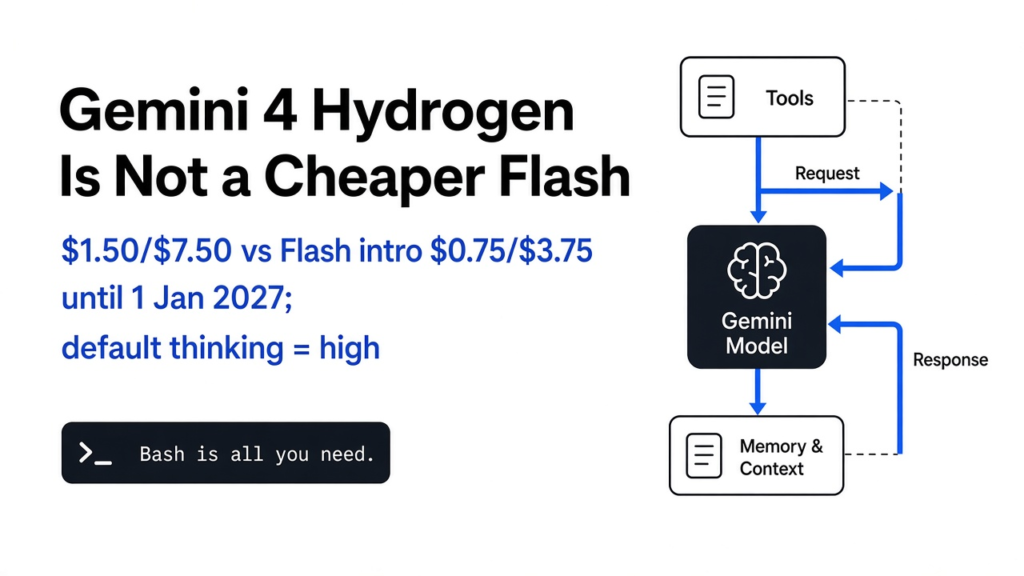

Gemini 4 Hydrogen shipped on 12 November 2026. The useful question is not whether the new name is fast. The useful question is which job you hand it, and what that job costs before 1 January 2027.
I checked on 14 November 2026, and I have not called the model. Every price and score below is copied from a Google page that day, or from arithmetic on those prices. A lab score is labeled as a lab score.
what gemini 4 hydrogen actually is
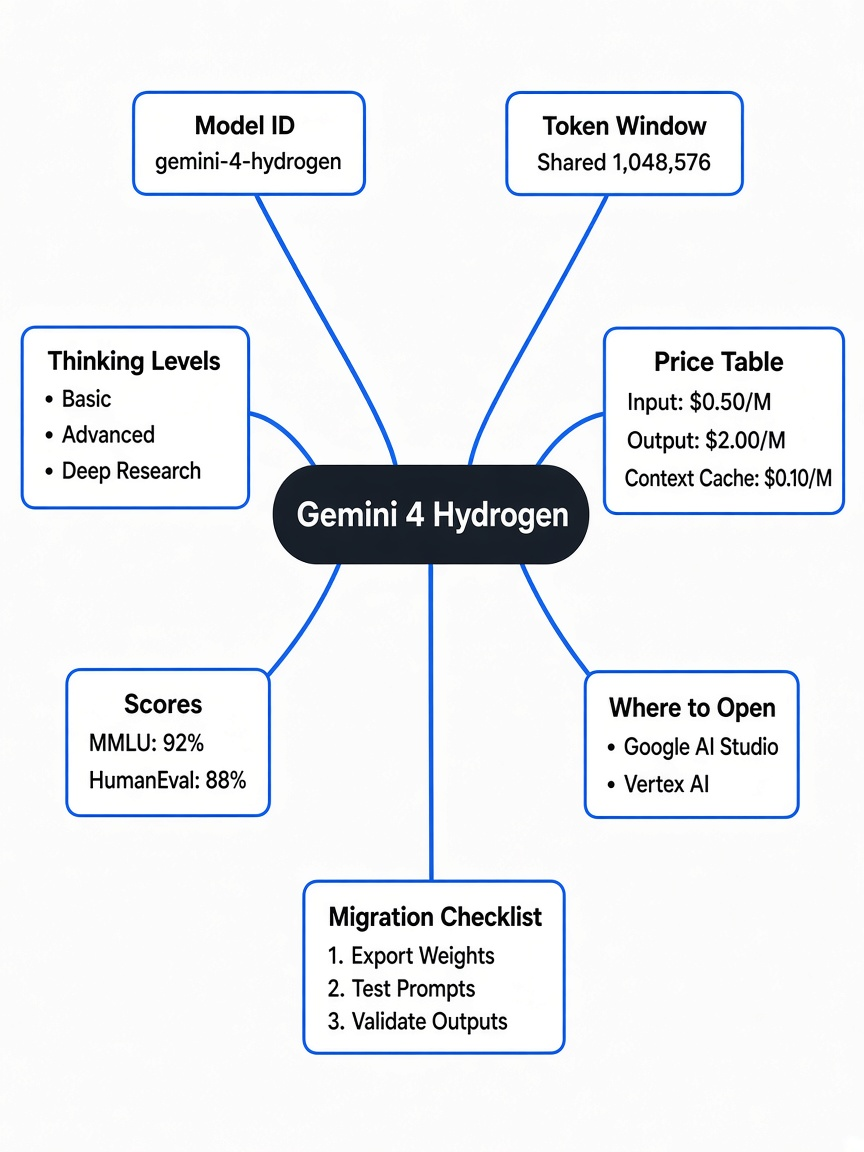
Prerequisite: a model (the program that reads your text and writes the next text) is not the app wrapped around it. The Gemini app, Google Search, AI Studio, and a coding agent are different doors onto a model. Gemini 4 Hydrogen is the model id (the exact string your code sends) gemini-4-hydrogen.
Google’s model card says Hydrogen is adapted from Gemini 4 Carbon. Adapted means this is not a tiny model trained from nothing. It is a fast member of the same family, aimed at short steps. Carbon and Argon are the ones Google points at long, hard reasoning. Hydrogen is the one it points at the many small steps in between, alone or as the worker under those two. The older page for the heavy one is what Gemini 4 Argon costs and who can call it.
An agent (a loop that reads a goal, calls tools, looks at the result, and tries again) spends most of its life on those short steps. That is why the launch post talks about agentic workflows (jobs made of many tool calls, not one clever paragraph). The model card’s own limit line matters more than the slogan. Hydrogen can still hallucinate (write a confident sentence that is not true). It can stall. At higher thinking levels it may spend more tokens to chase a better answer. None of that is a reason to skip it. It is a reason not to swap the id and walk away.
the three words the price hides
Prerequisite: you do not need the training math. You need the bill.
A token (a small piece of text, often a word or part of a word, and the unit Google bills) is the coin. A context window (the pile of tokens the model can see and write in one call) is not a bucket that holds a million tokens of your prompt and then another million of the answer. Cloud’s developer guide says Hydrogen has one shared limit of 1,048,576 tokens. Input and output share it. Output here means three things added together: thinking (the hidden scratch work before the answer), function calls (the tool requests, such as “read this file”), and the answer you actually see.
A thinking level (a switch for how much scratch work the model may do) has four settings: low, medium, high, and xhigh. Cloud’s guide says high is the default. That is the trap in the word default. Argon’s public docs use medium as the default. If you change only the model id, Hydrogen starts on high. High thinking tokens are billed as output, at the output price, and they also count against max_output_tokens (the cap on that output pile). A huge prompt leaves less room for the answer, because the window is shared.
The foreground cap is smaller than the headline. One synchronous reply (a call that waits for the answer in that request) stops at 65,536 output tokens unless you turn on long decode (the extra setup that lets one job continue past that segment, up to the shared million minus what you already sent). The model card says the same thing: 64K default synchronous output, up to 1M with the long path. “One million output tokens” in the launch post is the ceiling of the long path, not what a normal call returns.
why it is not a cheaper flash
Prerequisite: a launch price is a row on a table, and the table has dates on it. Google’s Cloud model-garden pricing page, read 14 November 2026, is the row I used. Global means the cheaper region line. A non-global call (a request pinned to the US or EU) is about 10 percent more.
| Model, global list price | Input, per 1M tokens | Output, per 1M tokens, response and reasoning | Until |
|---|---|---|---|
| Gemini 4 Hydrogen, standard | $1.50 | $7.50 | No intro end date on this row |
| Gemini 4 Hydrogen, priority | $2.70 | $13.50 | The fast lane, not the default |
| Gemini 4 Hydrogen, batch or flex row | $0.75 | $3.75 | Half price only if that tier actually serves you |
| Gemini 3.8 Flash, introductory | $0.75 | $3.75 | Through 31 December 2026 |
| Gemini 3.8 Flash, after the intro | $1.50 | $7.50 | From 1 January 2027 |
| Gemini 4 Argon or Carbon, introductory | $2.00 | $10.00 | Through 30 November 2026 |
| Gemini 4 Argon or Carbon, after | $4.00 | $20.00 | From 1 December 2026 |
| Hydrogen cache read, global | $0.075 | A reread of a shared prefix, not a new prompt | |
| Hydrogen non-global standard | $1.65 | $8.25 | If you pin US or EU |
Same tokens, two bills. Take 80,000 input tokens and 4,000 output tokens, and do not add extra thinking. Flash at the intro price is 80000 / 1000000 * 0.75 + 4000 / 1000000 * 3.75, which is $0.075. Hydrogen is 80000 / 1000000 * 1.50 + 4000 / 1000000 * 7.50, which is $0.15. Twice the money, before Hydrogen does any extra thinking. Google’s launch post says Hydrogen finishes tasks 2.5 times faster than Gemini 3.8 Flash at the high setting, and that some graph and SQL jobs used 12 to 23 percent fewer tokens. Faster, and a bit fewer tokens, does not cross a 2x price gap. I have not retimed those jobs.
After 1 January 2027 the standard Flash row matches Hydrogen’s standard row. That is the day “not a cheaper Flash” expires, if both prices are still what they are today. Until then, an easy step that Flash already solves should stay on Flash. A hard step that you were about to send to Argon is a different sum. The same 80,000 and 4,000 tokens on Argon is $0.20 through 30 November and $0.40 from 1 December. Hydrogen at $0.15 can be the cheaper heavy call. It is not the cheaper light call.
The half-price row is real on the price table and unreliable as a plan. On 13 November a developer reported that Vertex generateContent returned 400 with the text “Flex API is not supported for model: gemini-4-hydrogen”, while a flex call on the Gemini API did return. AI Studio’s model page lists batch, flex, and priority as methods. Read the serving tier on one small call before you cut a monthly forecast in half.
One more line on that pricing page is easy to skip. If a completion passes 32,000 tokens and then dies on a client or server timeout, Google says you can still be charged for the tokens that were retrievable. That note takes effect 13 November 2026. A long agent that times out is not a free failure.
the score that is not a sweep
Prerequisite: a benchmark (a fixed test, with a score that is only meaningful for that test) is not “the model is smarter.” Google’s launch post says Hydrogen scores 51 on the Artificial Analysis Intelligence Index at the default high thinking level, against 50 for Argon, and 54 at xhigh. The index is one blended score from one lab. xhigh is the setting that is allowed to think more, and the model card warns that higher thinking levels may use more tokens. A higher index at xhigh can be a more expensive answer. I am not repeating a third-party claim about how many extra tokens that was. I have not measured it.
The model card, results as of November 2026, is the table that should replace the screenshots. It compares Hydrogen with Claude Sonnet 5.5 and GPT-6.1 Terra. It does not print the thinking level on each row. Read the card before you quote a row.
| Test on the model card | Hydrogen | Sonnet 5.5 | GPT-6.1 Terra | How to say it out loud |
|---|---|---|---|---|
| SWE-sweep | 13.5% | 3.1% | 5.8% | Hydrogen leads. About 86 of 100 still fail. |
| Terminal-Bench 4.1, labeled cheating-adjusted | 57.0% | 63.9% | no score in the cell | Sonnet leads. Cheating-adjusted is the card’s label, not my gloss. |
| Agents’ Last Exam v1.1 | 71.6% | 60.4% | 69.8% | Hydrogen leads this workflow test. |
| AutomationBench-AA | 76.1% | 71.8% | 60.2% | Hydrogen leads. |
| Vending-Bench 2, bank balance | $14,549 | $11,165 | $9,107 | A score inside a simulated shop, not revenue. |
| OSWorld-2.1, offline subset | 77.6% | 83.9% | 74.2% | Sonnet leads this computer-use slice. |
| MKA, Climb WSR accuracy | 53.4% | 52.0% | 43.8% | A small lead on a visual knowledge-work test. |
| Chartography | 66.6% | 61.6% | 63.2% | Hydrogen leads. |
| Terminal-Bench-Science 0.1 | 51.4% | 59.9% | 58.3% | Sonnet leads, Terra is next. |
| HLE-Diamond | 58.8% | 53.3% | 47.3% | Matches the 58.8% in the launch post. |
Google’s own “more than tripling Terminal-Bench 4.1” line is 57% against Gemini 3.8 Flash at 18.2%. That sentence is about leaving Flash. It is not the sentence “Hydrogen beats Sonnet at the terminal.” The card says the opposite on the cheating-adjusted row. On Terminal-Bench 4.0 the launch post is also careful: it talks about Orchestrator (a router that can hand work to more than one model) reaching near-Carbon success while using 24% less quota and finishing 19% faster. That is a claim about the router, not about Hydrogen alone.
SWE-sweep is the number I would put on a slide if I were forced to pick one, and I would put the failure rate next to it. Leading 13.5% to 3.1% and 5.8% means Hydrogen is the least bad of the three at finding and fixing bugs without breaking other code. It does not mean the agent can be left alone with the repository.
where you can actually open it
Prerequisite: “available” on a blog is not the same as “the menu lets me click it.”
Google’s launch post, and the Google account’s post the same day, split the doors.
- Gemini API, AI Studio, Android Studio, and Gemini for business: Google says all tiers, including the free API tier. The free tier is not a promise about training. On other Gemini API models, Google has used free-tier prompts to improve products and left paid-tier data out of that. Read the current data-use line on your project before you paste a private repository into a free key. I am not going to invent a Hydrogen-only exception the pricing page did not show me.
- Gemini app and Search: rolling out. In the app, free accounts get Hydrogen only through auto model selection (a switch that lets Google pick the model per prompt). Google’s own help line, linked from the launch post, says most prompts still use Flash-Lite, and harder prompts may use Flash or Pro. “It is in the app” does not mean your next chat used Hydrogen.
- Antigravity, Gemini in Chrome, and Gemini in Sheets: the launch post and Google’s post say paid Google AI Pro and Ultra. Some Antigravity docs say Hydrogen is on every plan, including partner bundles. On 13 and 14 November, people on a Jio Google AI Pro bundle, and at least one free account, reported the model greyed out, with a tooltip that it is for paid Pro and Ultra. If the menu says Unavailable, trust the tooltip over a paragraph.
The knowledge cutoff (the date after which the model was not trained on the world) is March 2026 on the model card, and the card says some domains are older than that. I checked this on 14 November 2026. Hydrogen does not “know” that it launched. It does not know this week’s news. A search tool, or a file you pass in, is how it sees anything newer. The weights will not.
what breaks if you only change the model id
Prerequisite: a migration (the edit that points old code at a new model) is a list of deleted settings, not a renamed string.
Cloud’s developer guide for Hydrogen says all of the following. I am treating that guide as the contract, and you should re-read it if a month has passed.
Set the id to gemini-4-hydrogen. Set the thinking level on purpose. High is already the default. Use low when the step is cheap and obvious. Use xhigh only when you have decided the extra output tokens are worth the index. Remove thinking_budget and any minimal setting from the old call. Those knobs are not this model’s knobs.
Remove sampling knobs the guide says are unsupported: temperature, top_p, top_k, frequency penalty, presence penalty, and more than one candidate. If your client library still sends them, the call can fail, or the library can silently drop the control you thought you had.
Remove explicit caching (the old call where you paid to store a prompt prefix and reuse it by id). Hydrogen does not support it. Implicit caching (an automatic discount when the start of the prompt repeats) applies to a shared prefix of 4,096 tokens or more, and durable caching is on by default. Put the stable instructions at the front of the prompt. The price table’s cache-write column is marked as taking effect on 12 January 2027, at $1.875 per million tokens globally, which is more than the input price. Do not budget that write charge before 12 January. Do not assume you can pre-fill a cache yourself, because the explicit API is gone.
Keep the thought signature (the receipt the API returns so the next turn can continue the same hidden reasoning). The guide says to send it back on previous turns, and only on the first function call when calls are parallel. If you strip it while compacting history, set the prefix mismatch behavior to drop, or the next turn is a different conversation than you think.
Install a current Google Gen AI SDK. The guide names google-genai 2.34.0 or newer on Python so continuation across long replies is handled for you. A foreground segment still ends at 65,536 tokens. Past that, you are on the long-decode path, and past 32,000 tokens a timeout can still be billed.
Last contract line, and the one a roadmap slide will omit. The guide calls Hydrogen a short-term generally available release with a minimum 45-day retirement notice. Generally available means the stable id is public, not a private preview. Short-term means Google is not promising the year-long life it promises for other ids. The Gemini API deprecations page, read the same day, lists gemini-4-hydrogen with release date 12 November 2026 and no shutdown date. No date is not a promise of forever. Keep a second model id in the config. Forty-five days is enough to move, and not enough to discover the hard-coded string in a job you forgot.
what to do on monday
Prerequisite: you do not need a new agent framework. You need one bill and one fallback.
- Print the last day of real usage for the model you use now. Count input tokens and output tokens separately. Output includes thinking. Multiply by the two rows, Flash intro and Hydrogen standard. If the task is easy and the Hydrogen bill is about double, leave it on Flash until 1 January 2027, then test again.
- If the task is the hard one you were sending to Argon, price Hydrogen against Argon’s 1 December price, not against today’s intro. Set thinking level to medium or low for the first week so the default of high does not decide the bill for you.
- Change the id in one service, not in every service. Delete temperature and the explicit cache call in that same edit. Confirm a 4,096-token prefix if you want the cache-read discount.
- In the Gemini app, do not assume the answer came from Hydrogen. In Antigravity, if the row is grey, you do not have it, whatever the docs paragraph says.
- Keep Flash, or Argon, as the second id. Hydrogen can be retired with 45 days’ notice, and it does not know anything after March 2026 unless you hand it the file.
I would switch a noisy agent loop to Hydrogen only after one day of token logs. I would not switch a cheap classifier, a short summary, or a Flash call that already passes its tests. The name is new. The coin is still the output token, and until New Year that coin is twice the intro price of the model Hydrogen is supposed to replace.
Links to check these numbers
- Launch post, 12 November 2026, updated 13 November: Introducing Gemini 4 Hydrogen
- Model card, knowledge cutoff March 2026, and the comparison table: Gemini 4 Hydrogen model card
- Token accounting, default thinking high, no explicit cache, 45-day notice: Cloud developer guide
- List prices, the 32K timeout billing note, and the 12 January 2027 cache-write date: Cloud model garden pricing
- No shutdown date listed: Gemini API deprecations
- The Argon price this post is comparing against: Gemini 4 Argon on reposquare
Common questions about Gemini 4 Hydrogen
Is Gemini 4 Hydrogen cheaper than Gemini 3.8 Flash?
No, not until 1 January 2027. On the global list, Hydrogen standard is $1.50 per million input tokens and $7.50 per million output tokens. Gemini 3.8 Flash is $0.75 and $3.75 through 31 December 2026. The same 80,000 input and 4,000 output tokens cost $0.15 on Hydrogen and $0.075 on Flash.
What thinking level does Gemini 4 Hydrogen use by default?
High. Argon’s public docs use medium, so changing only the model id moves you to high. Thinking tokens are billed as output, so set the level on purpose.
Where can I use Gemini 4 Hydrogen?
Google says the Gemini API, AI Studio, Android Studio and Gemini for business have it on all tiers. The Gemini app and Search are rolling out, and Antigravity, Gemini in Chrome and Gemini in Sheets are listed for paid Google AI Pro and Ultra. If your model menu says Unavailable, trust the tooltip.
Will Gemini 4 Hydrogen be around long?
Google calls it a short-term generally available release with a minimum 45-day retirement notice. The deprecations page listed no shutdown date when I checked. Keep a second model id in your config.