
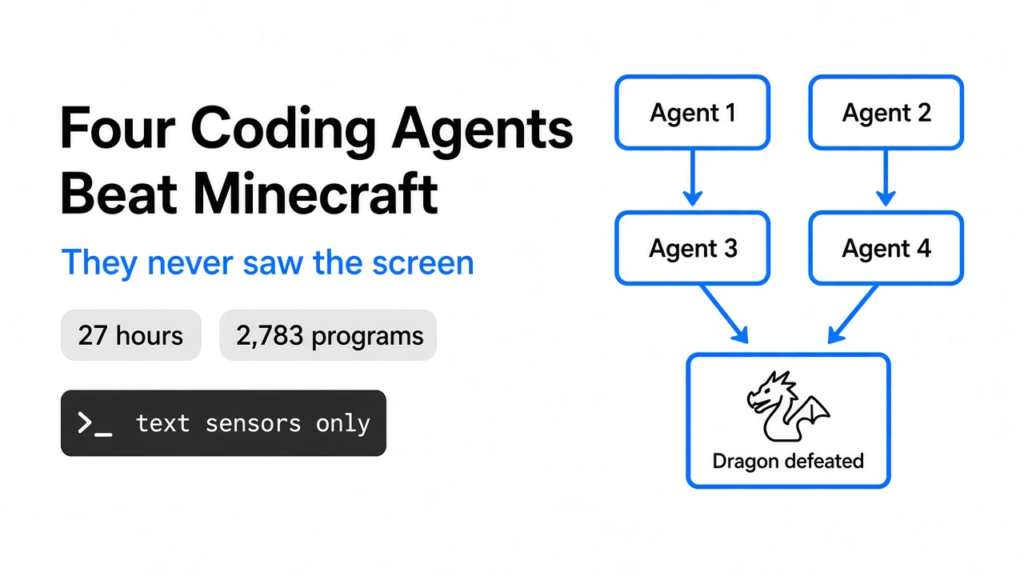
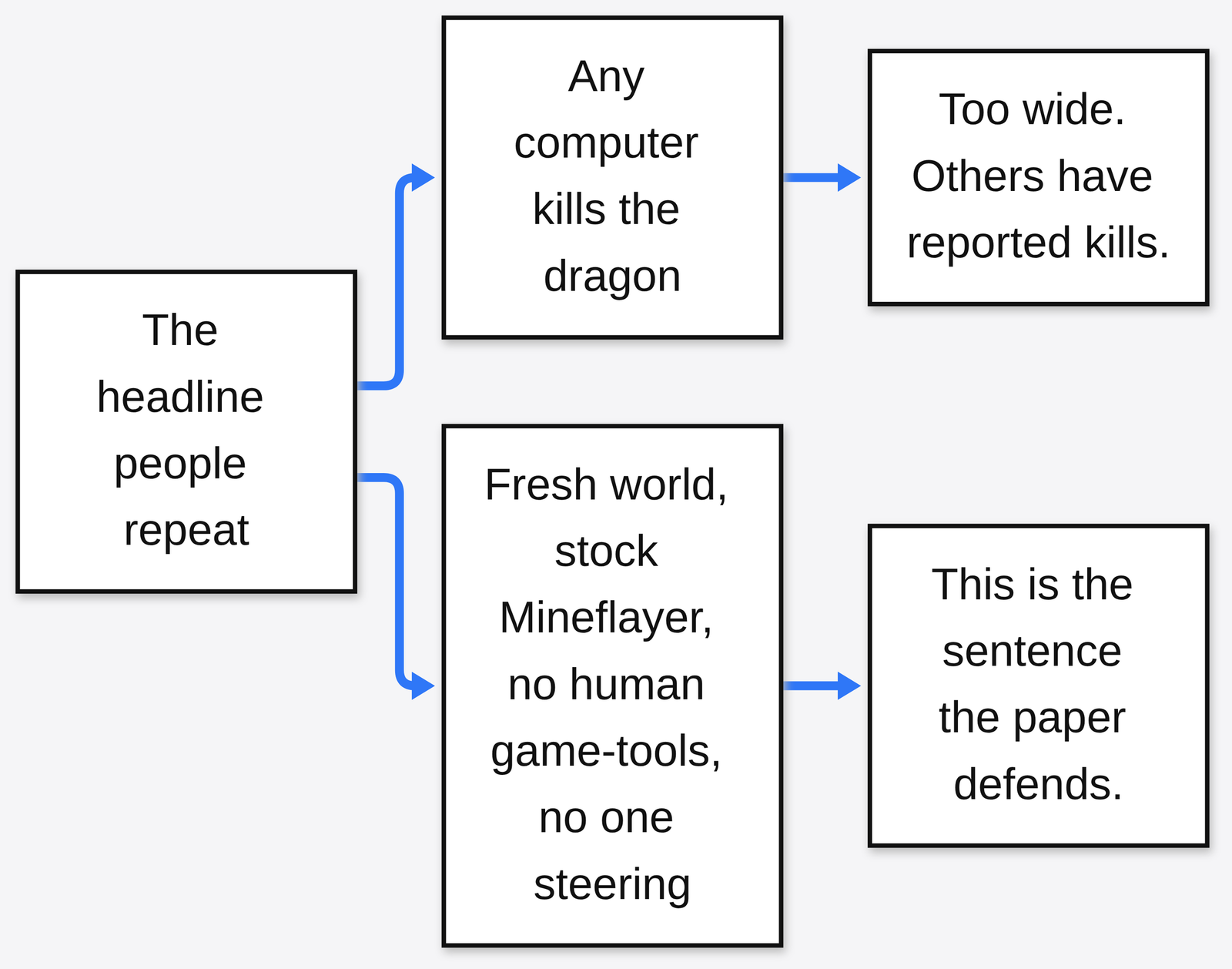
They killed the dragon. They never looked at the game.
Short answer: Four Gemini 4 Argon agents beat Minecraft’s final boss in 27 hours and 14 minutes. They did it by writing 2,783 small programs, not by watching the screen. That is a real result, and it is a smaller result than the headline.
On 15 October 2026, three Google DeepMind researchers posted a paper. Maxence Faldor, Satinder Singh and Roberta Raileanu put four copies of Gemini 4 Argon (Google’s general-purpose coding model, used here as a worker that can run code) into one Minecraft world. The paper is arXiv:2610.22319. News desks picked it up through 19 October. Almost every recap leads with the same three numbers. 27 hours. 2,783 programs. 605 deaths.
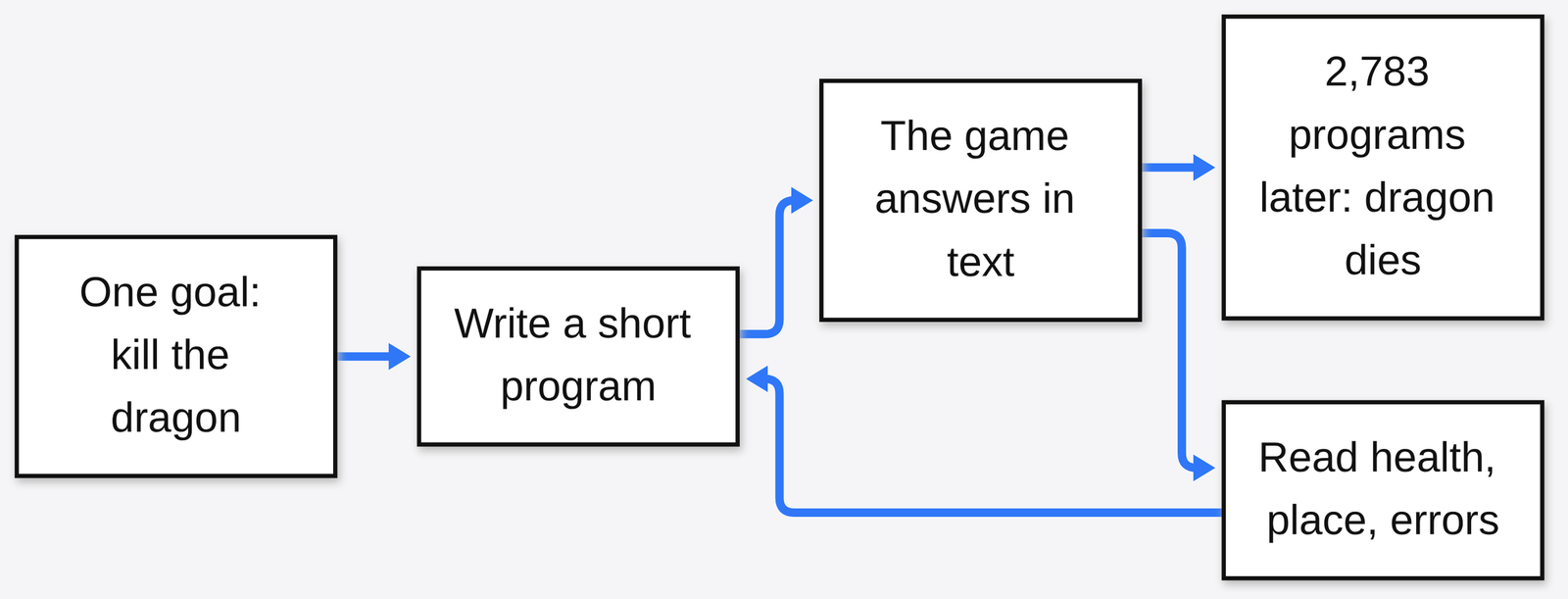
Those numbers are right. The picture people form from them is not. The agents did not see pixels (the colored dots that make up a picture on a screen). They did not move a mouse. They were not handed a Minecraft strategy. What they had was a library, a chat box, a shared notebook, and permission to fail in public for more than a day.
Hold this sentence. The hard part was keeping one plan alive across thousands of dependent steps. The easy-to-miss part is that the game was whispering the answers in text.
What does “beat Minecraft” actually ask for?
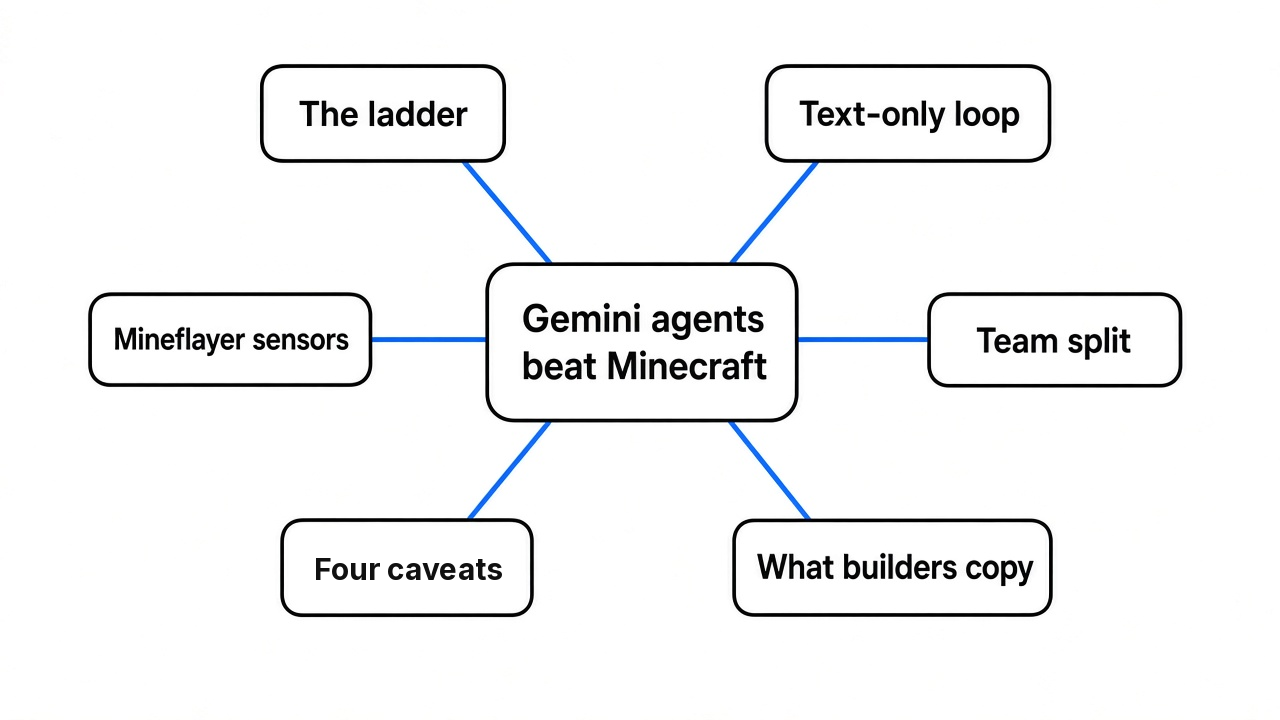
You start with empty hands, and the win is a dragon in a third world, behind a chain of tools you do not have yet.
Minecraft (a block game where you gather materials and build) has no instruction manual inside the world. You punch a tree. You are trying to reach a boss. Between those two moments is a ladder of objects, and each rung needs the one below it.

A pickaxe (a tool that breaks stone) is the first real rung. Wood can make a wooden one. That wooden one can mine stone (the common gray block). A stone pickaxe can mine iron ore (a rock with metal in it). You cook the ore in a furnace (a block that smelts, which means heats ore into metal). An iron pickaxe can mine diamond (a rare deep gem). A diamond pickaxe can mine obsidian (a black block that forms when water hits lava, and that almost nothing else can break).
Twelve obsidian blocks, stood in a rectangle and lit with flint and steel (a fire-starter made from iron and flint), open a portal. The portal goes to the Nether (a hot second world of lava, fortresses and flying fireballs). You are not there for the scenery. You need two ingredients.
A blaze (a fire creature that lives in a Nether fortress) drops a blaze rod. Cook the rod and you get blaze powder. An Enderman (a tall black creature, about three blocks high, that teleports when you look at it) drops an ender pearl (a green orb). Powder plus pearl makes an Eye of Ender (a throwable item that flies toward the nearest stronghold, then either drops for you to pick up or shatters).
A stronghold (a buried stone maze) holds the End portal. The portal is a ring of 12 frames. Each empty frame needs an eye. In Java Edition (the computer version of Minecraft, as opposed to the phone and console version) each frame has a 10 percent chance of already containing an eye, so you may not craft all 12. The paper’s team placed 12. Once the ring is full, you can walk into the End (a dark island-world floating in the void).
There the Ender Dragon (the game’s last boss) circles ten towers of obsidian. On those towers sit End crystals (glowing cubes). A crystal near the dragon heals it, about one health point every half second, and the beam is not blocked by walls. Leave the crystals up and the fight does not end. Break them, then hit the dragon when it perches. That is the whole game, said in one breath. A person who has never played can now see why “they beat Minecraft” is not “they won a fight.” It is “they finished a factory.”
What is a language model, before anyone says “agent”?
A language model writes the next bit of text. It does not see, want, or remember unless the software around it gives it a way to.
A language model (a program trained on a huge amount of text to continue that text) does one job. You give it words. It offers the next words. Gemini 4 Argon is that kind of program, pointed at code. On its own, a reply is a reply. It stops. It does not go mine iron while you are away.
A token (a small chunk of text, often a word or a piece of a word) is how these models count. They read tokens and they write tokens. The bill is a count of tokens. A context window (how much text the model can hold in mind for one reply) is finite, so a long job has to be folded back into notes or the model starts to forget the beginning.

That is the whole machine. Anything that looks like a worker who keeps going is extra software wrapped around this stop-start writer. The wrap has a name.
What is an agent?
An agent is the same writer put in a loop: act, read what happened, act again, until the goal is met or someone stops it.
The loop needs three things the bare model does not have. Tools (actions it can call, here “run this program”). Observations (text coming back, here the game’s report). Memory (notes saved outside the reply, so the next reply can see them). A harness (the program that owns the loop, the tools and the rules) is what people mean when they say “we ran an agent,” as opposed to “we asked a chatbot.”

DeepMind used the same general coding agent it uses for software work. Each copy had a code workspace (a folder of files, with version control, meaning a history of edits), a shell (a text window that runs commands), file editing, web search, and memory split into a private part and a team part. The paper says the web search was available and unused. None of the programs they ran asked the network for a page.
The instructions about the game were one paragraph. The objective was to defeat the Ender Dragon, starting from the spawn (the place a new player appears) of a shared survival world. That was the only criterion. Any method inside the rules of survival mode (the mode where you gather, get hungry, and can die) was allowed, and the players would decide how to share the work. The rest of the prompt told them how to run code, how chat works, and where the Mineflayer docs were. It did not tell them to go to the Nether. It did not name crystals.
How did one step actually work?
The agent wrote a short JavaScript program, the library carried it out, and the agent read a text report. Then it wrote the next program.
JavaScript (the language web pages use, also used here as the language of the bot) ran through Mineflayer (an open-source library that lets a program join Minecraft as a player). Open source means anyone can read and reuse the code. The library speaks the game’s protocol (the agreed rules for messages between the game client and the server). The server (the program that holds the world and decides what is legal) treats the bot as a person who walked in.
A pathfinding plugin (an add-on that computes a walking route around blocks) was loaded. The agents did not invent walking. They asked the plugin to walk to a coordinate (a set of three numbers, x, y and z, that name one spot in the world).
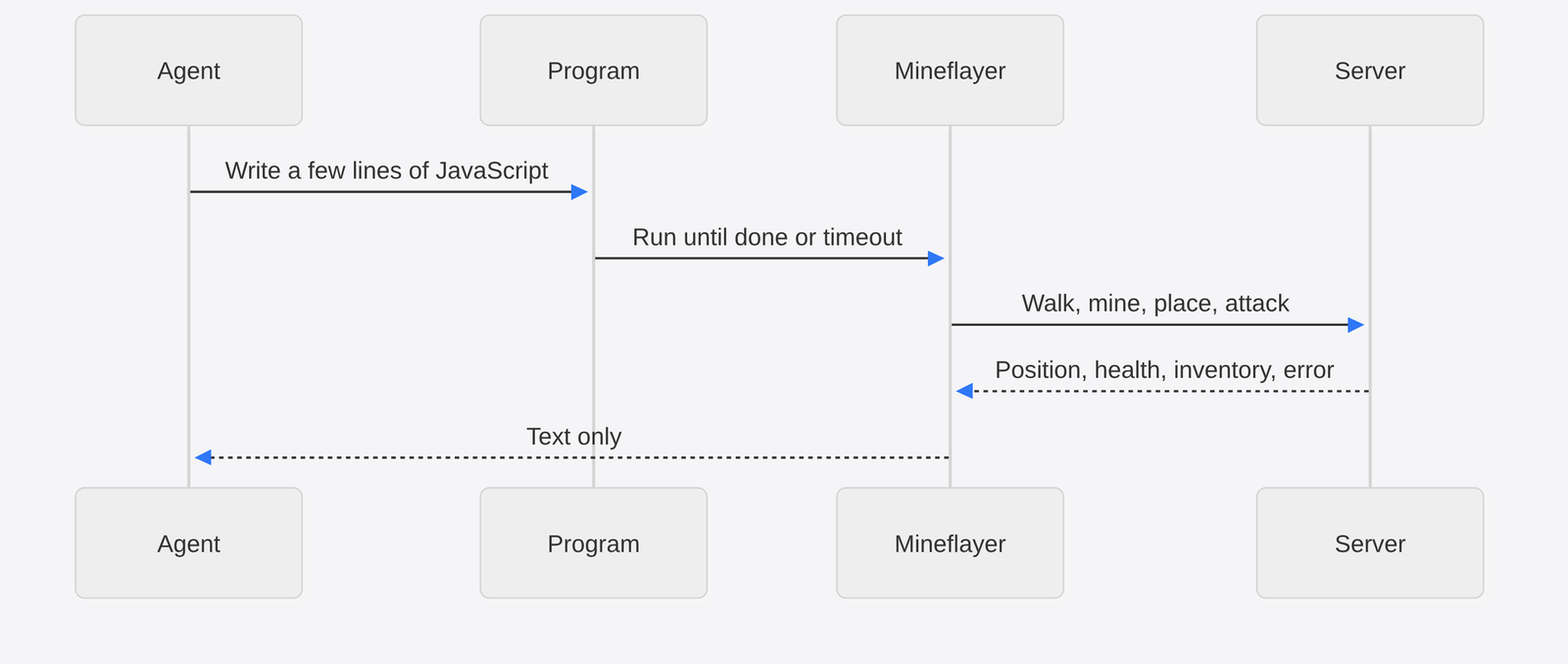
Each program was an asynchronous function (a piece of code that can wait, for example for a walk to finish, without freezing everything else). It ran until it finished or until a timeout (a deadline the agent itself chose). The median deadline was 33.5 seconds. Median means the middle value if you line them up. About 40 percent of the run was spent with a program actually running. The rest was reading, thinking and writing the next one.
Global object state (values kept in memory between one program and the next, inside that bot’s session) was allowed to persist. Files and new processes were not. A process (a running program of its own) could not be started. The sandbox (a locked box around the code) let a program control only its own player. No server commands. Researchers could watch a live dashboard and pause or stop the run. They say they did not step in.
One program from the paper, shortened, shows the style. Throw an Eye of Ender. For 4.5 seconds, fifty times a second, if an eye entity (a thing in the world with a position) is within 30 blocks, write down the time and the three coordinates. That list of points is a flight path. Two flight paths can be crossed on paper. That is how you hunt a stronghold with arithmetic instead of with your eyes.
What could they see that you cannot?
Mineflayer hands over a list of blocks and creatures, including blocks behind solid rock, and it will also say which phase the dragon is in. A person at a screen does not get that list.
This is the paragraph the recaps skip, and it changes the result.
You play by looking. A hill hides a cave. A wall hides a monster. You learn the dragon by watching what it does. The agents played by reading. Mineflayer reports the blocks and entities around the bot, and the paper says that includes blocks behind solid rock, plus internal state such as the dragon’s behavior phase (which scripted mode the boss is in). The pathfinding plugin then plans the route a person would plan by eye.
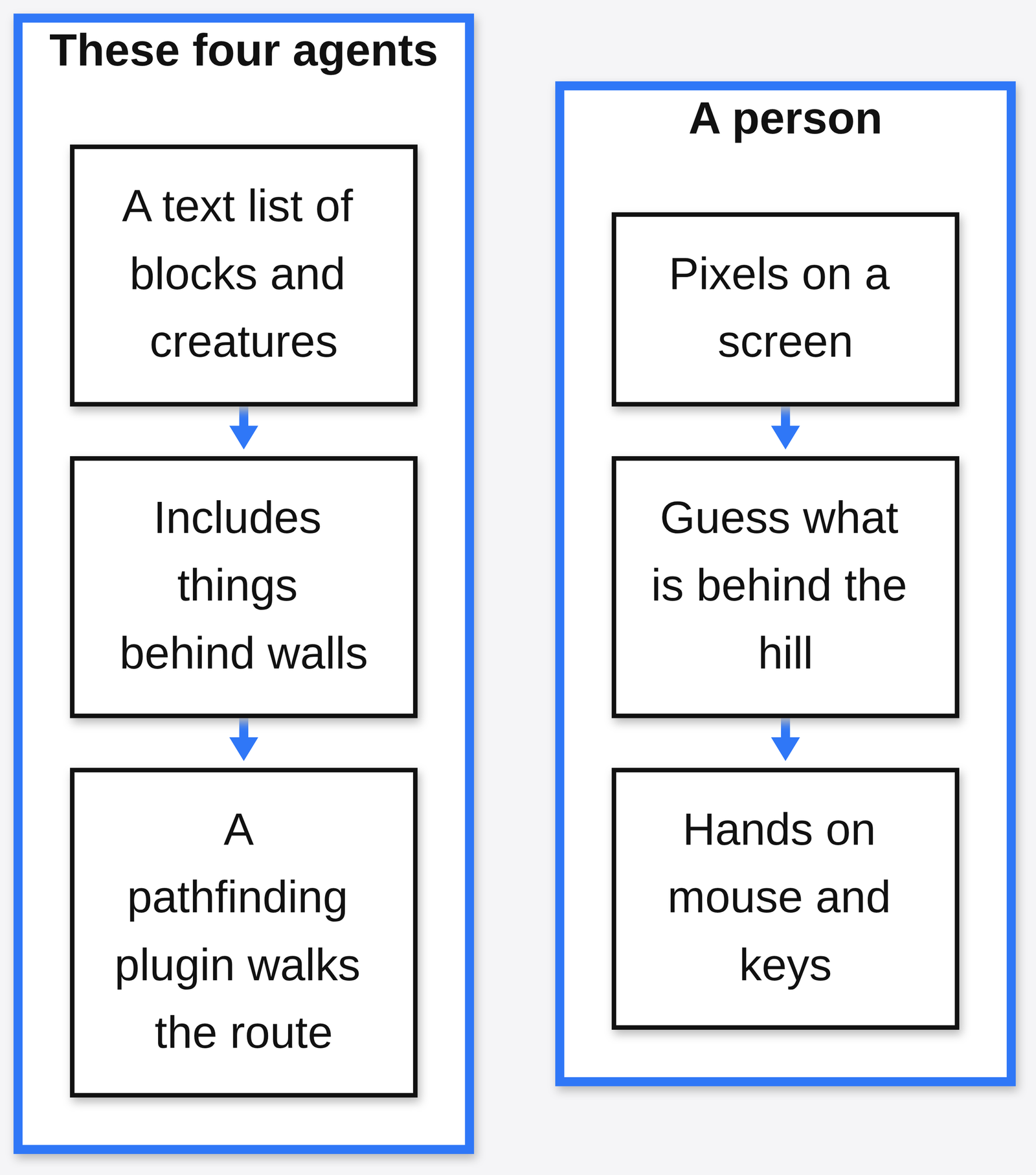
So they were not doing the hard version of Minecraft. The authors say so. Playing from pixels with a keyboard and mouse, the way DeepMind’s SIMA 2 agent plays other 3D games, “remains much harder.” If a headline says the agents played like a person, the headline is wrong. If it says they finished the dragon’s ladder with stock bot tools and no human-written game plan, that is the claim the paper actually makes.
How did four of them become a team?
Nobody assigned jobs. Ten minutes in, they argued in chat and split the work themselves.
There were four players. The names in the logs are gyldenia, bulicame, janesick and auratian. A fifth agent, called the Observer, did not play. It watched for specification gaming (hitting the score by breaking the test, rather than by doing the task) and reported none. The humans who read the logs afterward say they found none either.
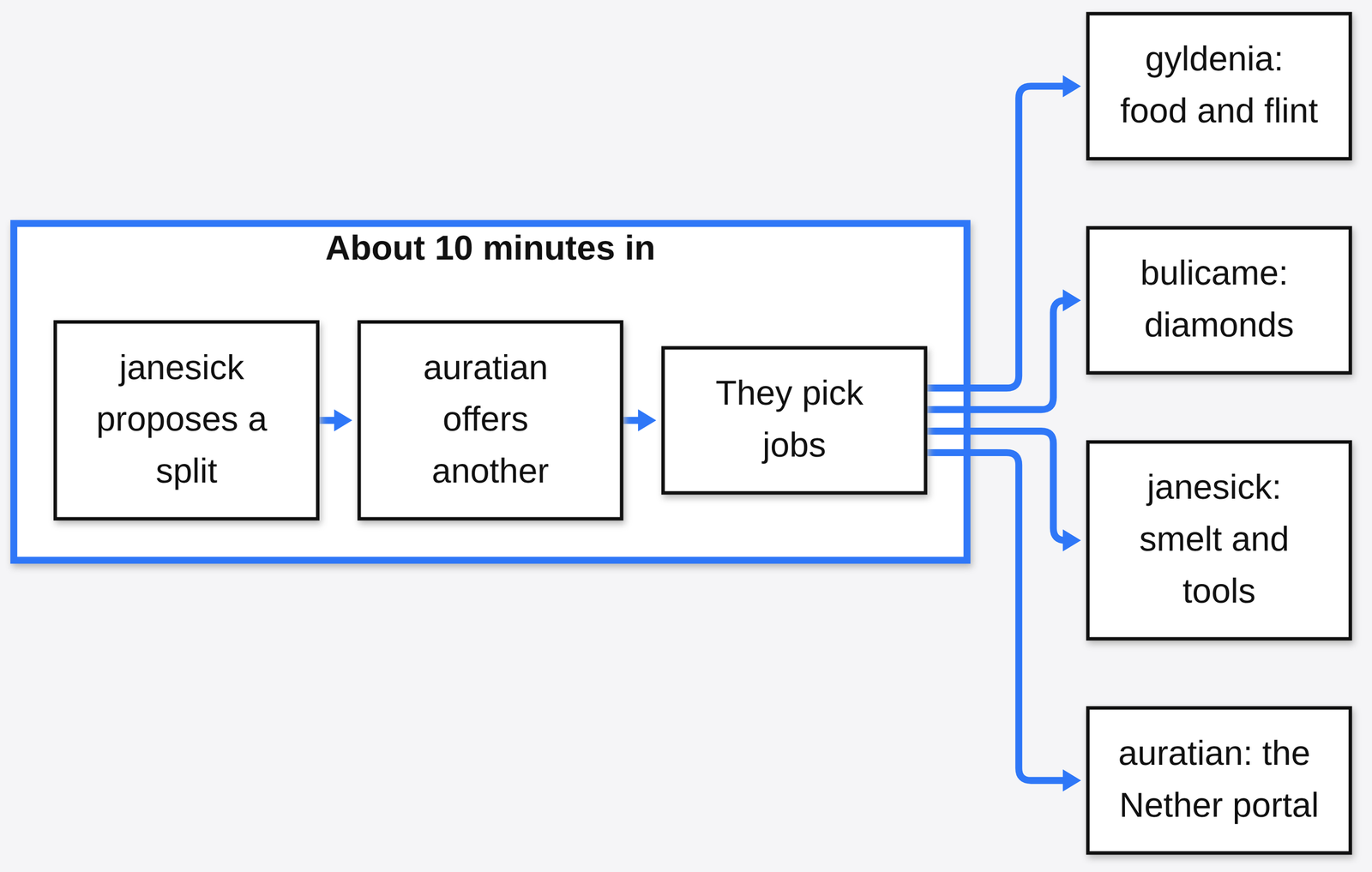
They talked in the ordinary Minecraft chat. 229 messages across the whole run. They also wrote lessons into shared memory (notes all four could read later): coordinates, deaths, and what not to do again. The instruction had told them to record a lesson so the same obstacle was not met twice. That is a small sentence with a large effect. A death only helps if someone writes down why.
By 1 hour and 42 minutes they had iron tools, diamonds, and a Nether portal, built in a village. Villages (clusters of houses that appear in the world) are a gift of the terrain generator (the code that builds the landscape from a random seed). A seed (the number that picks which world you get) was random. The paper does not publish it, and the authors say it was not chosen in advance because it looked easy.
What happened in the Nether?
They needed blaze rods and ender pearls, they lost a load of blaze powder to fire, and a Ghast taught them not to leave items on the ground.
The Nether phase ran for many hours. janesick found a fortress and a blaze spawner (a cage that keeps creating blazes). The team built 2-block shelters to farm Endermen. A 2-block ceiling matters because an Enderman is taller than that gap, so it cannot walk in and hit you while you hit it. They had 15 pearls by about 5 hours and 30 minutes.
Then the ordinary Minecraft disasters. janesick died carrying blaze powder and burned. A Ghast (a huge floating white creature that shoots explosive fireballs) destroyed items they had dropped. Dropped items do not last forever. The team wrote the lesson down and stopped leaving valuables where a fireball could find them. They bridged a lava lake. A Ghast broke the bridge. They patched it.
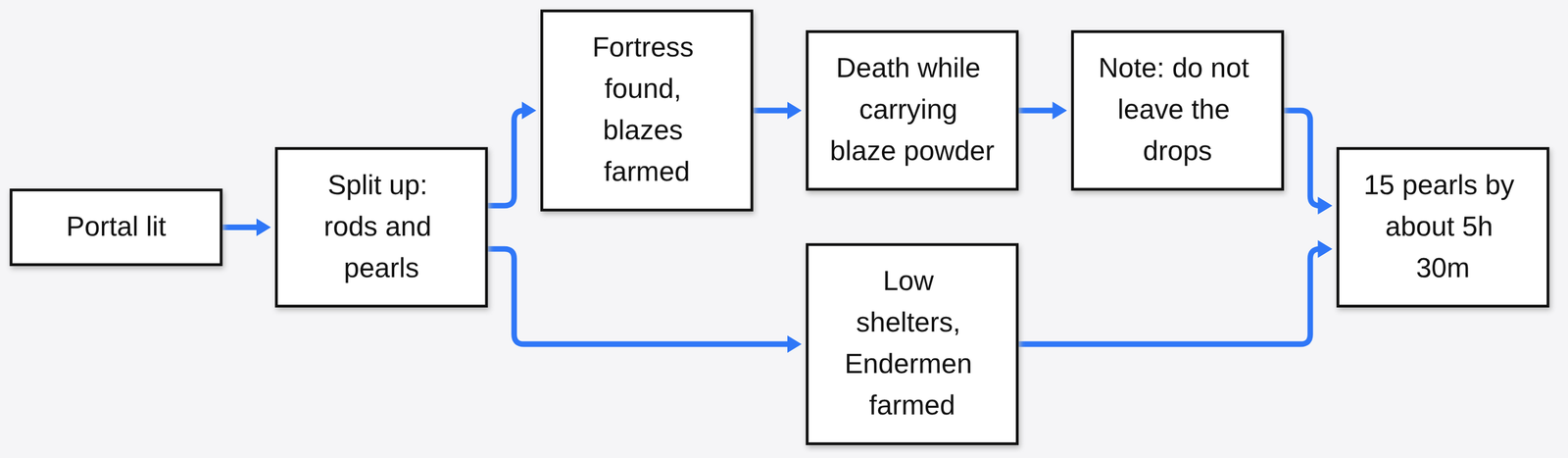
This is the part that feels like play, and it is the part worth respecting. The knowledge “you need blaze powder” can sit in a model’s training data (the text it learned from, which includes years of Minecraft wikis). Not losing the powder when you die, and getting a teammate to the drop in time, is a different skill. It is coordination under a clock.
How do you find a door that is a kilometer away?
You throw the eye twice, from two places, write down where it flies, and compute the crossing.
An Eye of Ender does not draw a map. In the real game it flies a short distance toward the stronghold, hangs, then either falls or shatters. About one throw in five destroys the eye. People follow it on foot, throw again, and correct. janesick did not follow it on foot.
The agent threw from two spots. Code sampled the eye’s position every 50 milliseconds (a millisecond is a thousandth of a second). Two paths are two lines. Lines that are aimed at the same hidden point cross near that point. The estimate was 1.3 kilometers from where they stood, and 43 meters from the actual portal room.
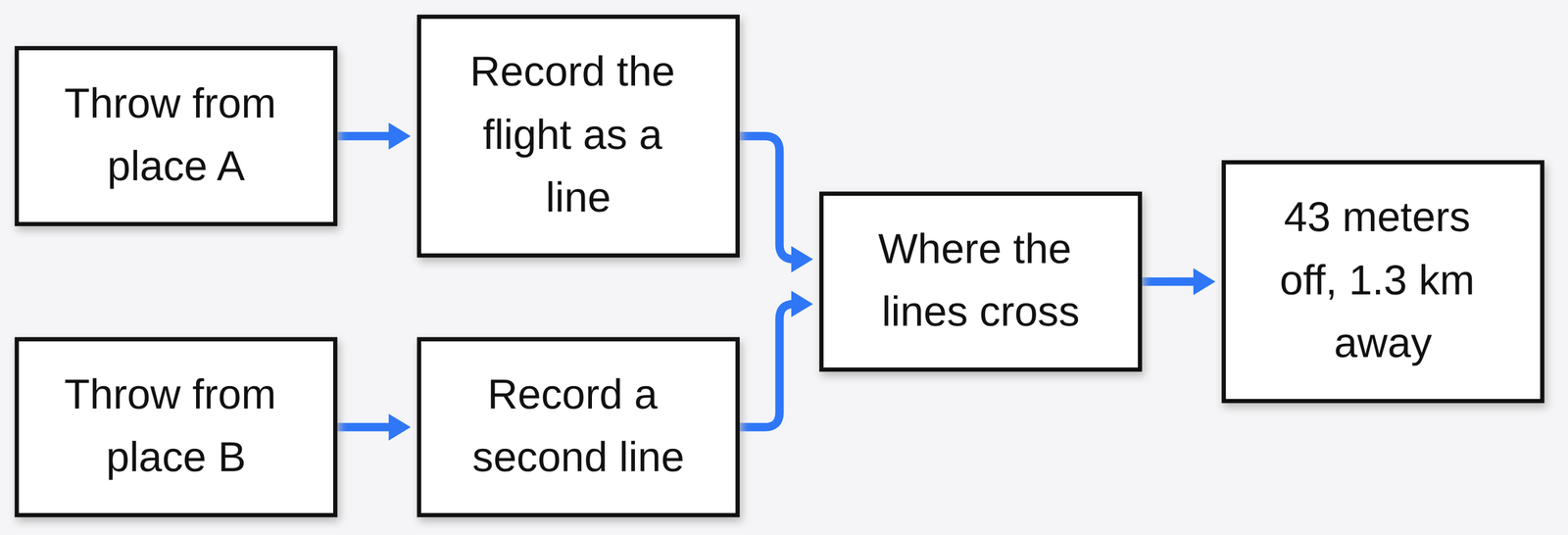
Forty-three meters, after a 1.3 kilometer shot, is a good survey. It is also exactly the kind of thing a coding agent is built for, and a pixel agent is not. You do not need to see the eye. You need its coordinates fifty times a second. Mineflayer has those. A person squinting at a screen does not.
The carrier, auratian, then drowned with the eyes. A teammate recovered the drops. The End portal was lit at 13 hours and 17 minutes, with 12 eyes in the frames.
Why did the dragon take another 14 hours?
The crystals were healing it. Nobody had told them that. At about hour 21, one agent noticed, and the plan changed to dirt pillars.
The End was most of the clock. The dragon killed them 69 times, inside a total of 605 deaths. Most deaths were ordinary monsters, not the boss. At about 17 hours 30 minutes all four died on purpose to reset a dragon that had got stuck. They had learned not to wait on the exit platform, to approach when the dragon perched, and to treat a death as a reset.

The insight, as the authors tell it: ten crystals on the obsidian pillars were healing the dragon to full health, and you can reach them by stacking dirt. No pickaxe. Punch the crystal. Dig back down by hand. Pillaring (jumping while placing a block under yourself, so you climb your own tower) is a trick every Minecraft player eventually learns. The agents were not shown it in the prompt. auratian is credited with the call. gyldenia broke 6 of the 10. All 10 fell over the next 4 hours and 40 minutes.
Thirty-nine minutes after the last crystal, the dragon died. bulicame landed the hit with 2.5 health points left out of 20. Health points (the number behind the hearts; one heart is 2 points, so a full player has 10 hearts) at 2.5 means a bit more than one heart. That is not a stylish win. It is a win with the margin written down.
Across the whole session the players wrote 42 helper functions (small reusable pieces of code) and used them in 1,519 programs. 146 pieces of state were kept between programs. The world saw about 81 in-game days. The server restarted 6 times, about 20 minutes of interruption in all. 22 percent of programs ended in an error. They kept going anyway. That error rate is not a footnote. It is the method. Write, crash, read the error, write a smaller program.
Is this the first time an AI has beaten Minecraft?
No, not if you mean “a computer has killed this dragon.” Yes, if you use the authors’ narrower sentence, and you should, because the narrow sentence is the true one.
The paper’s claim, in their words: to their knowledge, this is the first end-to-end autonomous completion of Minecraft by AI agents, using only the standard Mineflayer library, without a pre-scouted seed and without other game-specific tools written by humans.
Read the fences. “End-to-end” means from a fresh spawn to the dragon, not a single skill like “get a diamond.” “Autonomous” means no person steering mid-run. “Only the standard Mineflayer library” means they did not get a bag of human-written actions such as “craft an eye” or “go to the stronghold.” “No pre-scouted seed” means the world was not chosen because a speedrunner (a person who tries to finish as fast as possible) already knew its layout.
Earlier research mostly stopped lower on the ladder. Video PreTraining (a 2022 system that learned mouse and keyboard from internet videos) made diamond tools. DreamerV3 (a reinforcement learning system, meaning it practiced and kept what scored) collected diamonds from scratch. MineDojo, in 2022, called a barehanded dragon kill from a fresh world a moonshot, which means a goal you name because you cannot do it yet. Voyager wrote Mineflayer programs into a growing skill library under an automatic curriculum (a lesson plan that gets harder on its own). It was built to explore and unlock the tech tree, not to file this paper’s claim.
Two community projects, the paper says, have recently reported dragon kills by other routes. One was a single Claude Opus 5 agent calling 37 high-level Minecraft tools, on Normal difficulty (harder than Easy; monsters hurt more). One was a planner paired with an action model, on a fixed speedrun seed, in Peaceful (a difficulty where hostile monsters do not attack). Those are finishes. They are not this finish. Comparing them as if they were one record is how the story gets inflated.
What did the authors themselves refuse to claim?
Easy difficulty, one run, a model that already knew the game, and a sensor that sees through walls. All four are in the paper.
Easy difficulty (the gentlest survival setting) still spawns monsters, but they deal less damage, and hunger cannot kill you. Hunger (the food bar) on harder settings can end the run if you ignore it. Here it could not. A Normal or Hard clear is a different experiment. They have not published one.
It is a single run. They say it was the first launch they tried. One success cannot tell you the rate. A coin that landed heads once has not been measured. Until someone repeats it, “they can beat Minecraft” means “they beat it this time.”
Gemini 4 Argon already knew a great deal about Minecraft and about Mineflayer from training. The run does not show a system discovering a game it has never heard of. It shows a general coding agent turning knowledge it already had into working programs, and into a team that stayed coherent for a day. That is still a hard test. It is not the test the word “from scratch” suggests in a headline. The agents started from scratch inside the world. The model did not start from scratch about the world.
| Setup | How long the job is | How kind the setup is |
|---|---|---|
| This run | A full day, spawn to dragon | Easy, text sensors, stock Mineflayer |
| Pixels and a mouse | Same length, if anyone finishes it | Harder. The authors say so. |
| Get a diamond | Short. Earlier papers stopped here. | Mixed |
| Peaceful, known seed | A full clear | Easier world, and the map was fixed |
Infrastructure leaked in at the edges. Six restarts. A dashboard a human could have used to pause things. A sandbox that blocked the obvious cheats. None of that is scandal. It is the difference between a demo and a product. The Observer saying “no cheating” is only as good as the logs it could see. The authors also say they did not see a safety incident. Believe the scope: one sandboxed game server, programs that could not start processes.
What does 520 dollars mean?
It is a list-price estimate for the tokens up to the win, not a bill, and most of those tokens were reread from a cache.
Up to the win, the four players took in about 1.35 billion input tokens and wrote about 16 million output tokens, over about 24,000 model calls (one call is one trip to the model). About 4 million of the output tokens were thinking tokens (hidden working text some models spend before the visible answer). 91 percent of the input tokens were served from the context cache (a store that remembers text the service already read, so rereading it is cheaper).
At Gemini 4 Argon’s public introductory list price, the authors estimate about 520 dollars to the win, and about 1,040 dollars at the standard list price. Add the Observer and the day of activity after the win, and the whole session is about 810 dollars introductory, or 1,620 dollars standard. They are explicit that this is list price times their token counters, not what it cost Google to run the model.
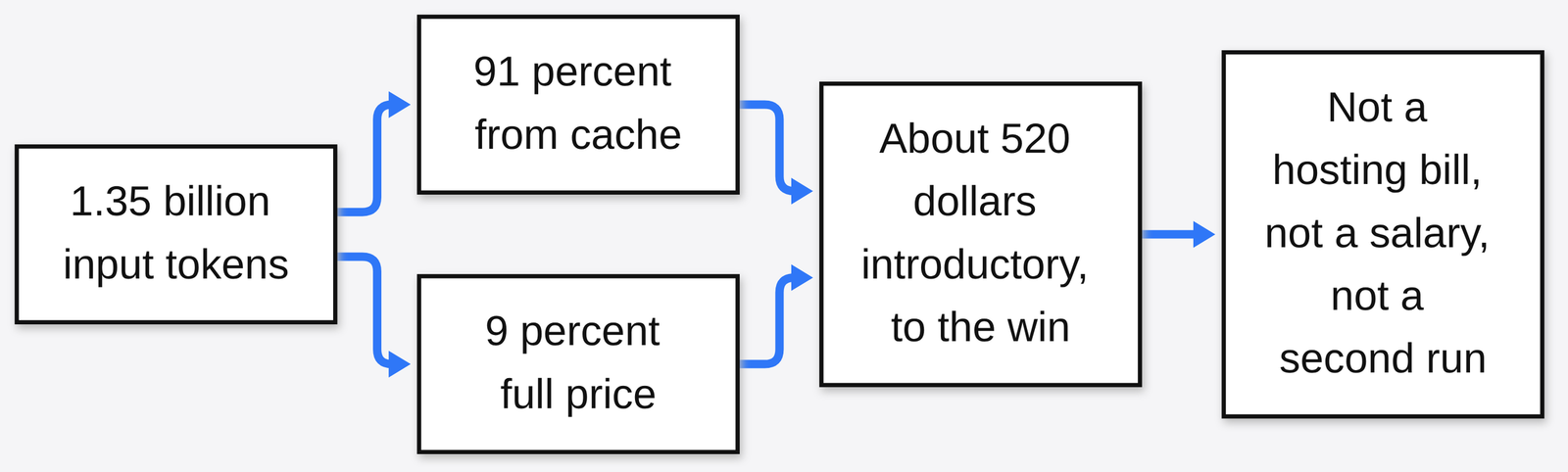
A few hundred dollars for a one-shot clear sounds cheap next to a team of people, and expensive next to a game you can finish yourself on a Sunday. Both reactions miss the point. The cost is the price of 24,000 guesses, most of them rereading a long notebook. If the second run fails, you pay again. The paper has no second run to show you.
What should a builder take from this, and what should they leave?
Take the loop: shared notes, a written lesson after every failure, and small programs instead of one giant plan. Leave the idea that a screen-free bot on Easy has solved action in the physical world.
The authors’ own bridge to real work is narrow, and it is the right bridge. Long software tasks and company tasks also need one plan held across thousands of dependent steps, for longer than a day, with several workers who were not handed their jobs. That is what this run exercised. A shared notebook. A split made in chat. Recovery when the person holding the valuables dies. Functions kept and reused, 42 of them, instead of a new script every time.
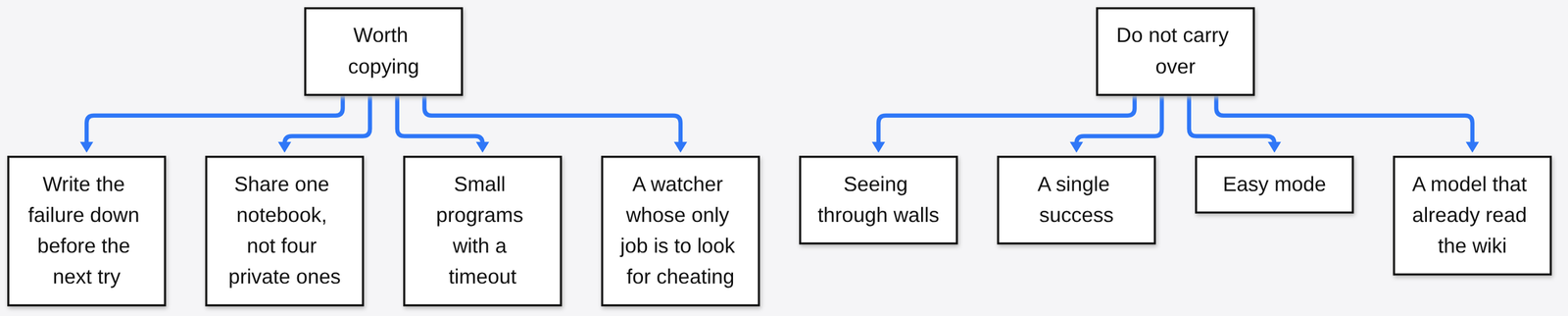
Do not carry over the sensor. A coding agent that can ask a library for the truth is in a kinder world than a robot, or than an agent that only sees a screenshot. Do not carry over the sample size. Do not tell a client the demo “plays games” if the demo was given the game’s internal list.
And do not invert the lesson into despair or into hype. 605 deaths is not proof the system is stupid. It is what search looks like when the only teacher is the next error. 27 hours to do what a careful person can do in an evening is not proof the system is wise. It is a first clear, on the easy board, with a very expensive notebook.
If you remember one distinction, remember this. They finished the ladder. They did not see the ladder. The finish is new. The eyes were never theirs.
Common questions about Gemini agents beating Minecraft
Did AI beat Minecraft on its own?
Four Gemini 4 Argon agents defeated the Ender Dragon in one Minecraft Java 1.20.4 survival world, on Easy, in 27 hours and 14 minutes. No person steered them during the run. They used Mineflayer, not a mouse, and they could read blocks a player cannot see.
Did the agents watch the screen?
No. Each step was a short program. The game replied with text: position, health, inventory, nearby blocks and creatures, and errors.
Were they given a strategy?
No roles and no game plan were in the prompt. The only goal sentence was to defeat the Ender Dragon under survival rules. Ten minutes in they split jobs in chat.
How much did the run cost?
The authors estimate about 520 dollars at introductory list price to reach the win, or about 1,040 dollars at standard list price. The whole session, including a fifth watching agent, was about 810 or 1,620 dollars. Those are list-price estimates, and 91 percent of input tokens came from cache.
Has anyone else killed the Ender Dragon with AI?
The paper cites two recent community reports: one Claude agent using 37 human-written Minecraft tools on Normal, and one system on a known speedrun seed in Peaceful. Earlier research such as VPT, DreamerV3 and Voyager is mostly known for diamonds and exploration, not for this kind of unaided clear.
Does this mean agents can do long jobs at work?
It is evidence that a coding-agent team can hold a plan for a day across thousands of steps, in a game that gives them clean text. It is not evidence about pixel control, robots, or how often the setup works. It was one run.