
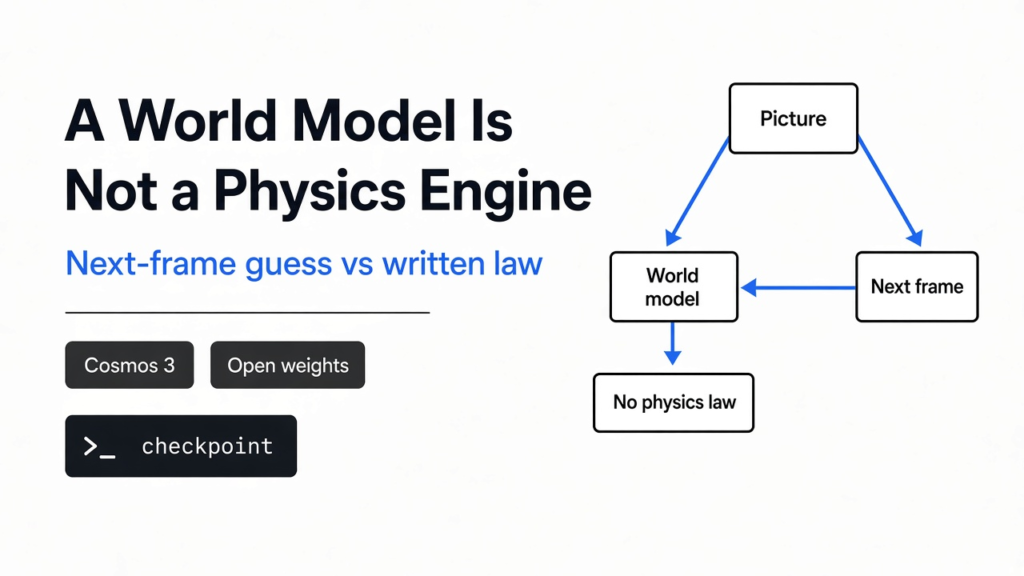

A headline that says an AI can simulate the real world is easy to hear as “the computer learned physics.” It did not, not in the sense a person means by that sentence. A model, here, is a huge file of stored numbers plus a rule for guessing the next piece of an input. A parameter (one of those stored numbers) is not a fact about gravity. A weight is the same number, said as something sitting in the file. A checkpoint (a saved copy of those numbers) can be very good at the next picture and still have no idea what a kilogram is. Related reading on another label that oversells the hardware: Maia 300 is not a faster GPU.
What “World” Means Before the Hype
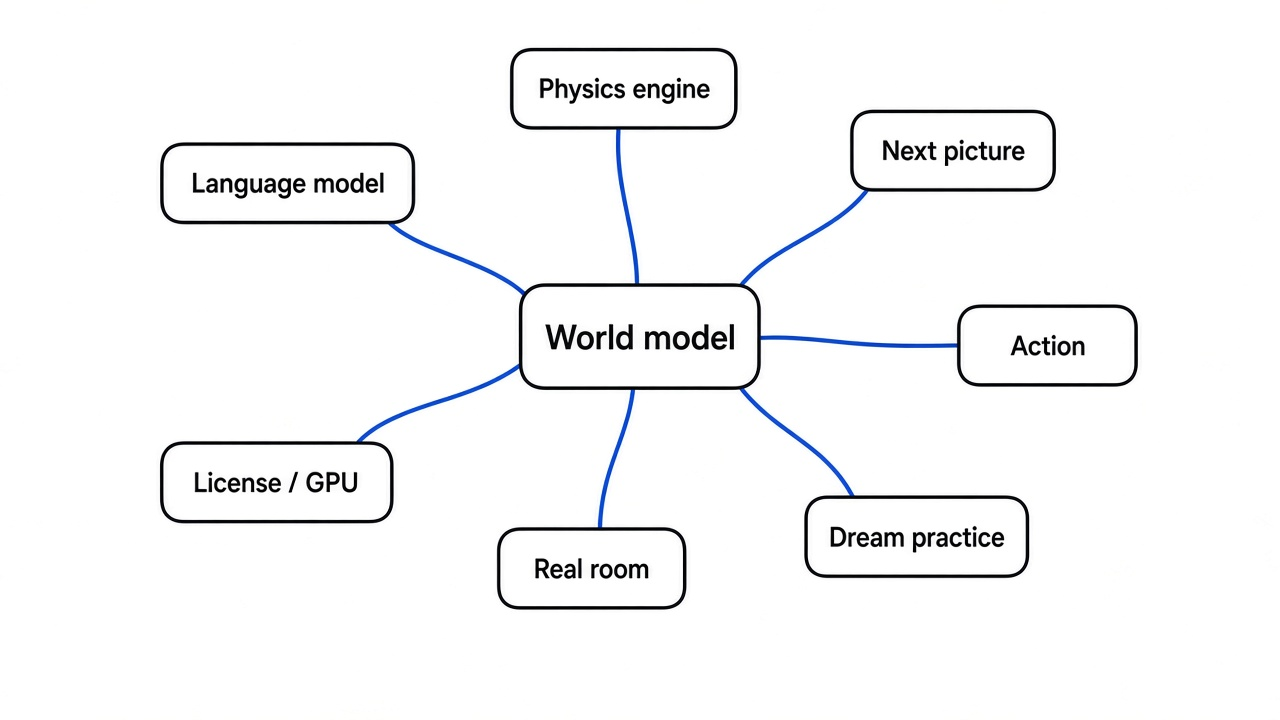
Three machines. People use one English word for all three.
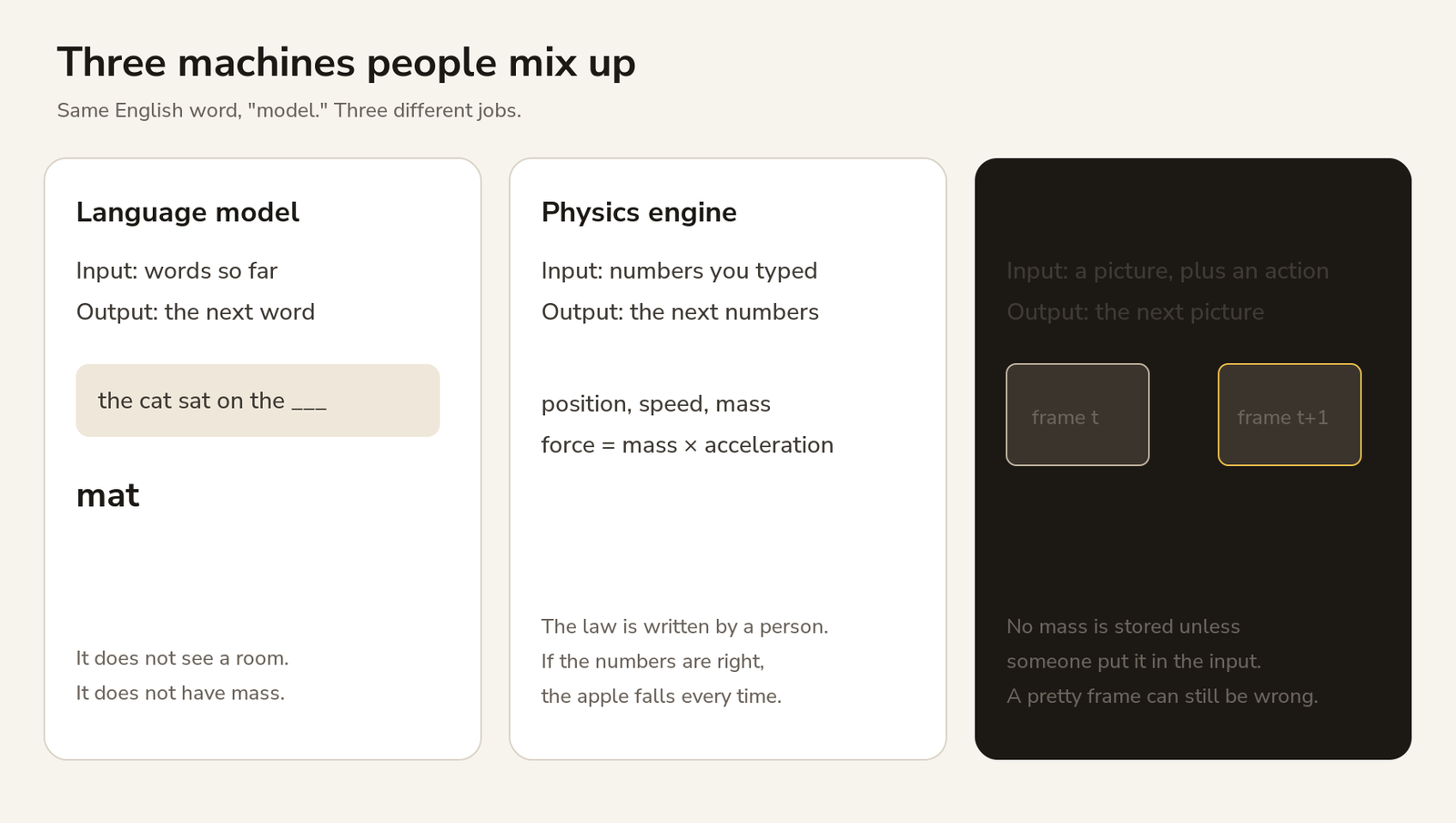
Start with a language model, because that is the machine most people have used. A token (a chunk of text, often a piece of a word) goes in. The model guesses the next token. “The cat sat on the” becomes “mat.” It never saw a cat. It saw tokens that people used when they wrote about cats. Chat is that guess, repeated.
A physics engine is the opposite kind of honesty. You type the situation as numbers: where the ball is, how fast it is moving, how heavy it is. A person already wrote the law. The famous one is Newton’s second law. Force equals mass times acceleration. If your numbers are right, the apple falls. If your numbers are wrong, it falls wrong on the first frame, and you can point at the number that caused it. A game engine (the program inside a video game that moves objects, light, and collisions) is this kind of machine with a lot of extra paint.
A world model is the third machine. You hand it a picture of the situation now, and usually an action (what the car or the arm does next). It guesses the picture a moment later. Oliver Cameron, who runs a lab called Odyssey, is quoted in write-ups of the 8 November WIRED piece as saying you give it a visual state and it predicts the next visual state. That line was not re-checked against the WIRED body (paywalled). The sentence is still the right definition, and it is old. It is the definition David Ha and Jürgen Schmidhuber used in 2018.
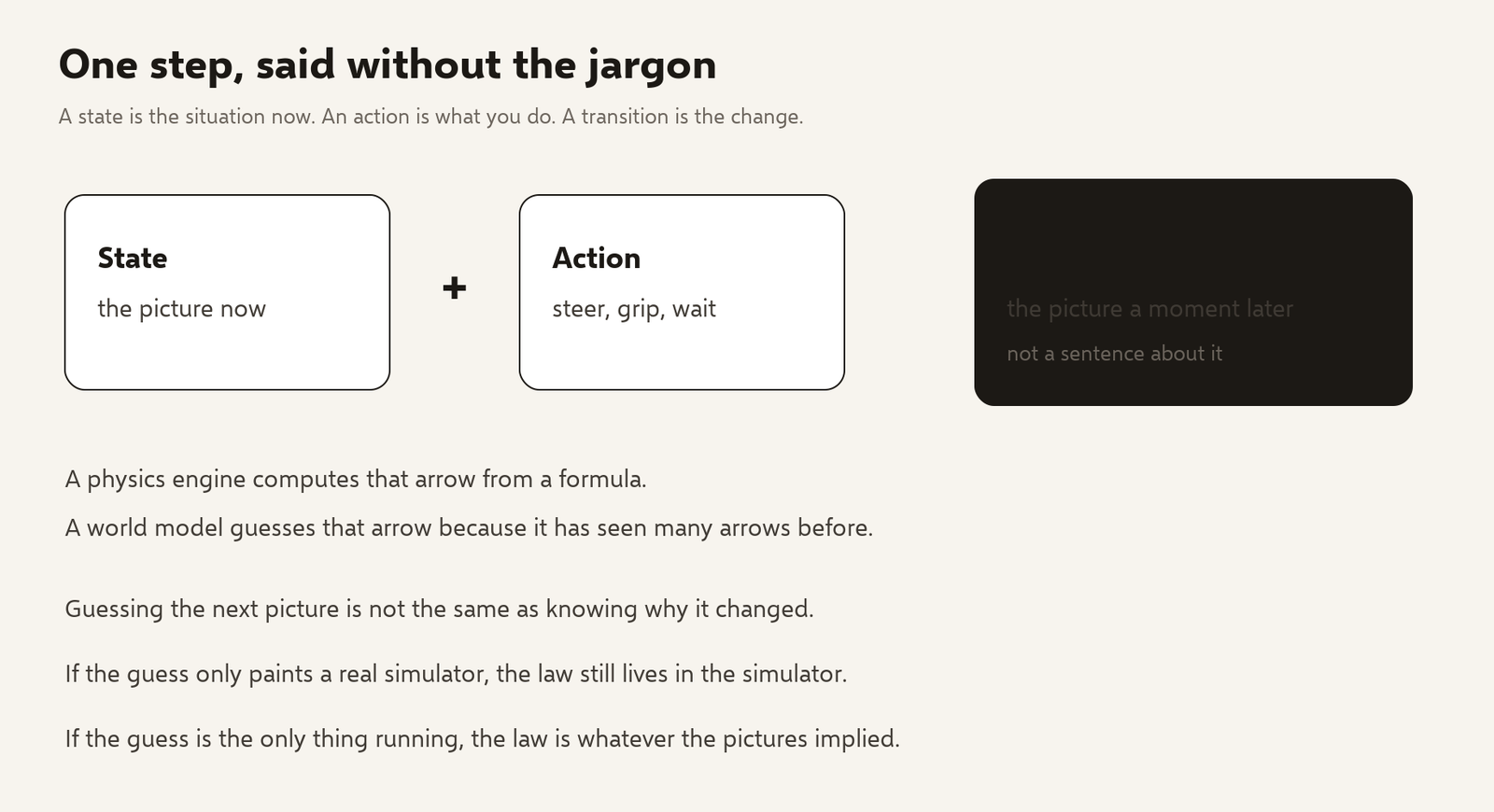
Three more words, then the arrow is usable.
A state (the situation now) can be a photograph, a grid of distance points, or a short list of numbers. An observation (what the sensor actually reported) is the state you got, not the state you wish you had. A transition (the change from this moment to the next) is the thing both machines are trying to produce. The physics engine computes the transition from a formula. The world model guesses the transition because it has watched a lot of transitions.
That guess can be more useful than the formula. A formula does not know what a wet cardboard box looks like after a forklift clips it. A guess can also be a liar. Nothing inside the file has to conserve energy (the rule that the energy you start with is the energy you still have, after you account for heat and sound). If the training videos mostly showed boxes that did not fall, the model will prefer a future where the box does not fall.
Where the Name “World Model” Came From
2018. Not this week. The week only made the name loud.
Ha and Schmidhuber’s paper is “Recurrent World Models Facilitate Policy Evolution,” NeurIPS 2018. The public site is worldmodels.github.io. This page follows the public site, not a reimplementation. Their question was: can an agent (a program that picks actions) learn inside its own dream, then try the real room?
They split the agent into three pieces so the dream could be small enough to practice in.
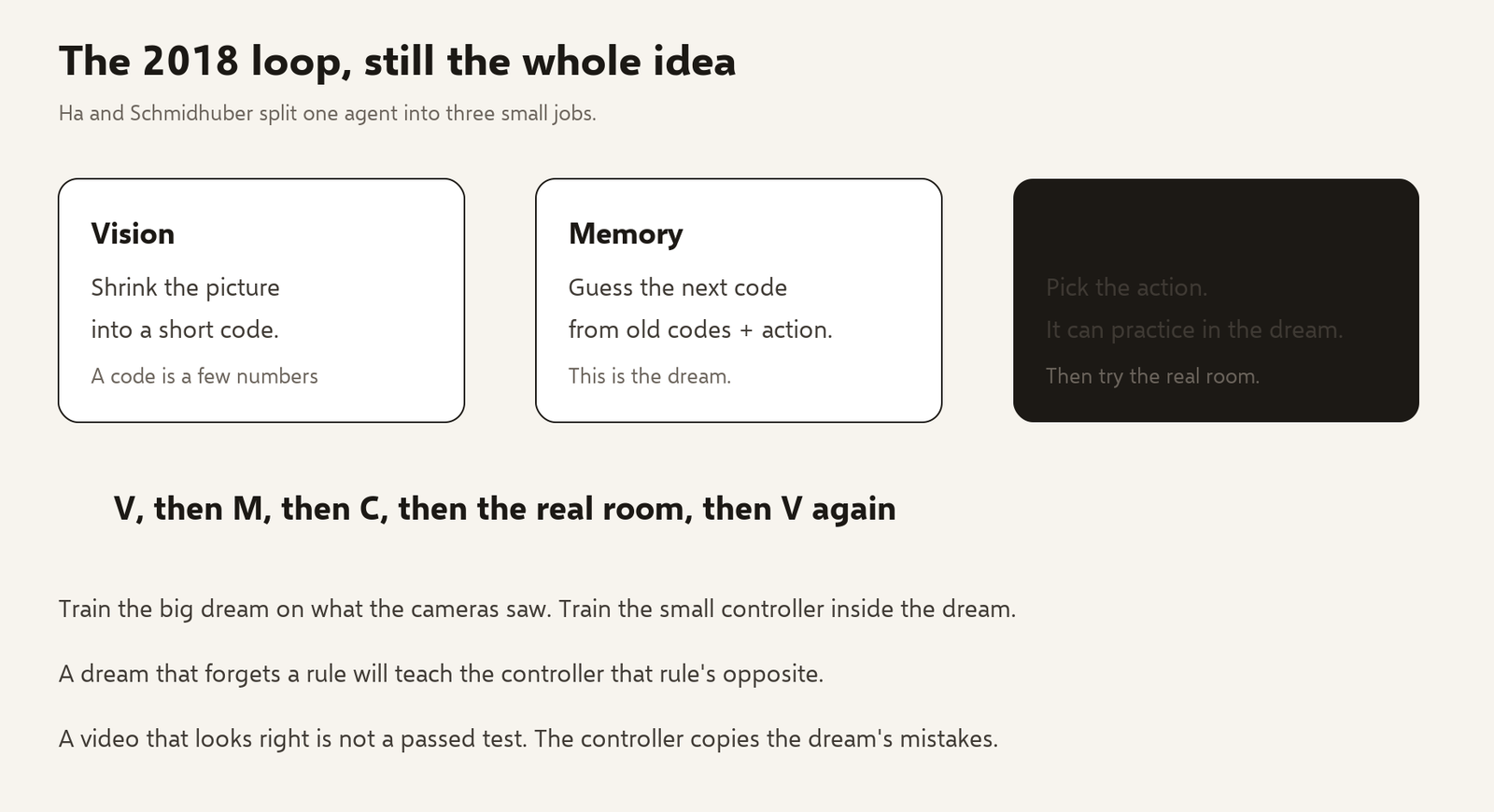
Vision (V) compresses what the camera sees into a short code. A code, here, is a handful of numbers that stand in for the picture, the way a thumbnail stands in for a photo. Memory (M) guesses the next code from the codes it has already seen and from the action. Controller (C) is small on purpose. It only sees those codes, and it picks the action. They trained C inside the dream M produced, then moved that controller back into the real game.
The lesson that still matters in 2026 is the split, not the Doom demo. The dream is not the pilot. The pilot learns whatever mistakes the dream repeats. If the dream never fires a fireball, the pilot never practices dodging one. Ha and Schmidhuber showed that on their site with a temperature knob that made fireballs rare. A modern video model has the same hole, with better paint.
What NVIDIA Shipped on 5 November
Four checkpoints. Four jobs. One shared size. No scoreboard.
The post is NVIDIA’s 5 November 2026 note on Hugging Face. The family is Cosmos 3. The four new files are built on Cosmos3-Nano. NVIDIA calls them world-simulation checkpoints. The framework docs, which I also read, list the base Cosmos3-Nano checkpoint at 15.75 billion parameters, and the 5 November post describes each of these four as 16 billion trainable parameters. I am not going to sand those into one number. Report the one attached to the file you downloaded.
A trainable parameter is a number the training process was allowed to change. The file you run is the result of that changing, frozen again.
The base Cosmos 3 line, from NVIDIA’s earlier 2026 release notes and the cosmos GitHub, is an omnimodal model (one model that can take and give more than one kind of signal: text, picture, video, sound, action) on a Mixture-of-Transformers (a design that keeps separate stacks for different kinds of signal instead of forcing every signal through one identical stack). You do not need that sentence to use the four files. You need the job each file was cut out to do.
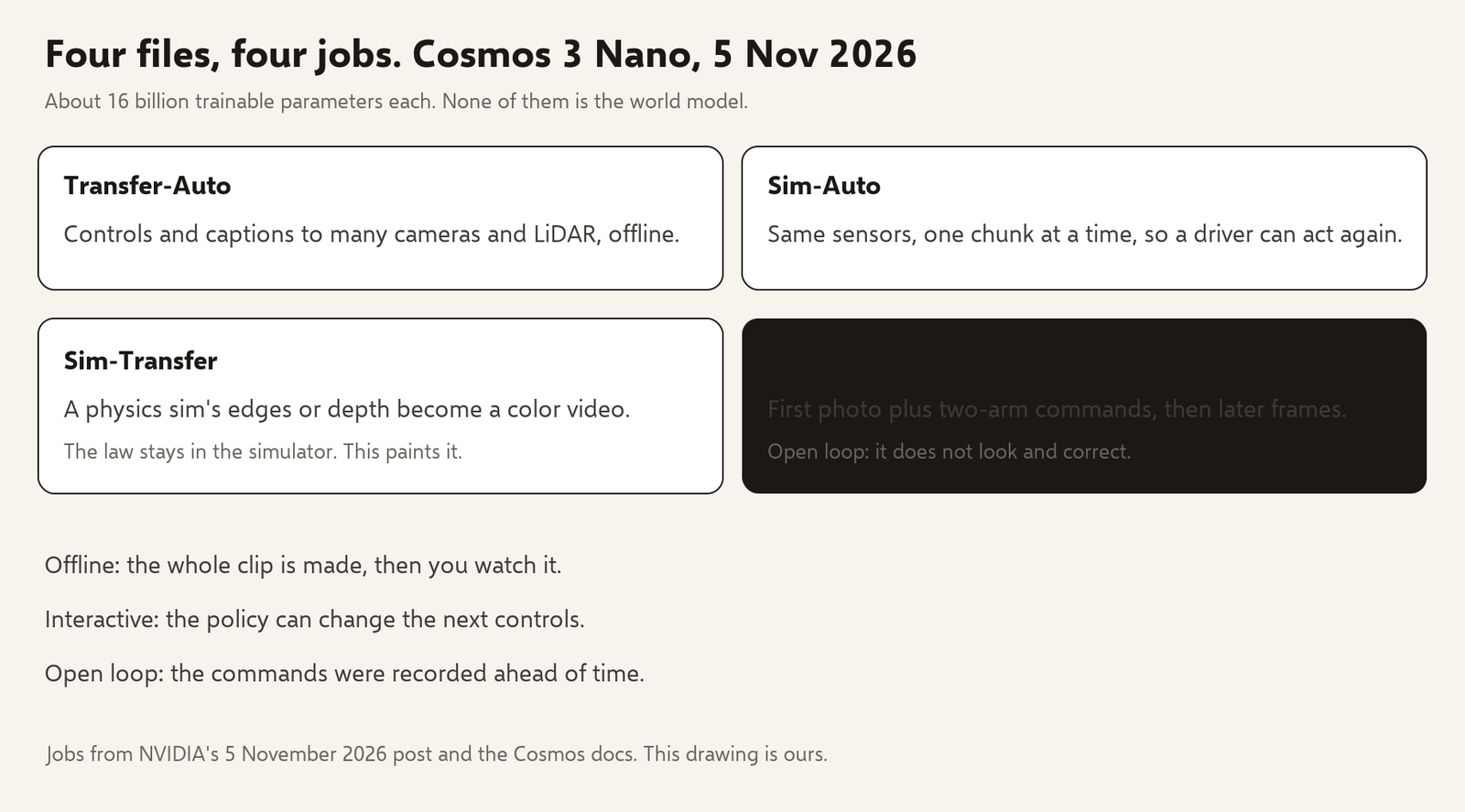
| Checkpoint | You hand it | It hands back | What it is for | What it is not |
|---|---|---|---|---|
| Cosmos3-Nano-Transfer-Auto | Per-camera controls called a World Scenario Map, plus captions. Optional first color frames. Optional map controls for distance. | Synchronized video from up to 11 cameras, including fisheye lenses, and a matching LiDAR cloud. | Making a pile of fake sensor recordings from a scenario, offline. | Not a driver. Nothing is steering in response to the frames it just invented. |
| Cosmos3-Nano-Sim-Auto | The same kind of controls, plus the frames it already generated, plus updated driving controls. | The next short chunk of cameras and LiDAR, in a few denoising steps. NVIDIA says it was distilled from Transfer-Auto and uses a fixed four-step sampler. | A loop a driving policy can step through: act, see, act again. | Not a promise the tenth second still matches the road. Errors compound. |
| Cosmos3-Nano-Sim-Transfer | A text prompt, plus one control video from a physics simulator: edges, blur, depth, or segmentation. | A color video that follows those controls. | Paint. The simulator keeps the contacts and the motion. This file makes them look photographed. | Not the source of the physics. Turn the simulator off and this file has nothing lawful left to follow. |
| Cosmos3-Nano-Sim-Bimanual | One starting image, plus recorded robot and camera actions. NVIDIA describes 59 control values padded out to 64, for YAM and AgiBot arms. | Later video of how the scene moves under those actions. The docs call it an open-loop rollout. | Watching a two-arm plan without owning the arms yet. | Not a closed loop. If the predicted hand misses, the next command does not notice. |
The words in that table are doing quiet work. Spell them once.
LiDAR (light detection and ranging) is not a color photo. A laser pulse measures how long the light took to bounce back. The result is a cloud of points, each with a distance. A camera can be fooled by a picture of a tunnel painted on a wall. A LiDAR return of that wall is a wall, if the sensor is working. Generating both together matters because a driving stack often refuses to trust either one alone.
A fisheye (a very wide lens) bends straight lines so one camera can see around the car. Eleven of those, pointed in a known pattern, are a rig (the metal and the calibration that keep the cameras agreed about where “forward” is). Transfer-Auto is trying to invent that whole rig’s recording from a scenario, not a single cinematic shot.
A World Scenario Map, in NVIDIA’s words, is the control that carries scene structure and traffic motion. I am not going to invent a file format beyond that. Read their notebook before you build one. A caption is still just text about appearance: the weather, the time of day, what the street should look like.
Denoising (removing noise in steps until a picture appears) is how many video generators work. They start from snow, on purpose, and clean it. A four-step sampler means Sim-Auto is only allowed four of those cleanups, so it can answer fast enough to stream. Distilled means Sim-Auto was taught to imitate the slower Transfer-Auto rather than being the only model trained from scratch. Fast is the point. Fast is also how a small error gets less time to be corrected.
Depth (how far each pixel is), segmentation (which pixels belong to which object), and edges (where the outline is) are the cheap maps a physics simulator already knows, because it built the scene. Sim-Transfer is the admission that those maps are not a photograph. The photograph is a coat of paint. That is the honest checkpoint. It does not pretend to be the law.
Open loop means the actions were written down before the video was made. Closed loop (look, then change the next action) is what a real arm does when the cup slips. Sim-Bimanual, as documented, is the first of those. NVIDIA’s data note is the practical one: keep time aligned, because T transitions need T+1 observations. One more picture than the number of moves. Drop that picture and the file is learning the wrong delay.
Why the Tenth Frame Is a Worse Witness Than the Second
The model eats its own homework.
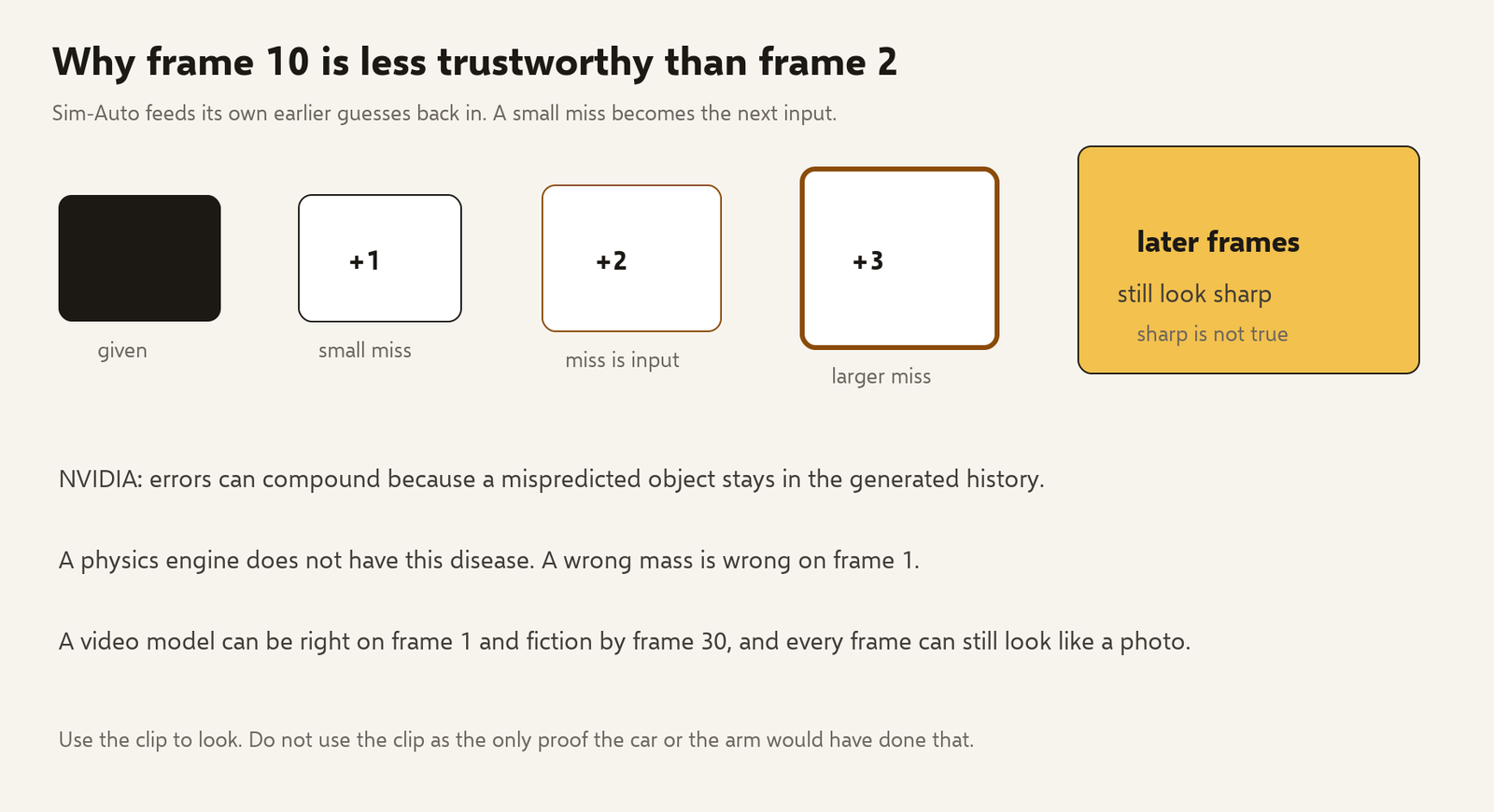
NVIDIA says the quiet part on the same page: errors can compound, because an object the model mis-predicted stays inside the generated history. History, here, is not the road. It is the frames the model already emitted, fed back as if a camera had taken them.
A physics engine does not have this disease. A wrong mass is wrong immediately, and it is the same kind of wrong on frame 200. You can plot it. A next-frame model can be excellent for a second and fiction by the end of the clip, while every frame still has the grain of a photograph. People trust grain. Grain is not evidence.
This is also why “simulate the world” is a sales sentence. Simulation, in the old sense, meant a model whose errors you could name. A rollout (the clip you get by asking for the next frame, then the next, then the next) can be a simulation. It is one only after you have measured where it stops being one. NVIDIA’s own last line on that post is the line I would print on the box: the work ahead is to measure where the models faithfully support policy learning and evaluation, understand their limits, and improve where they fall short. That page has no benchmark table in the published note. No score is also information.
What the License Allows, and What a Missing GPU Changes
Open weights are a file you may take. They are not a laptop demo. They are not legal advice. If you are watching local VRAM while you try a checkpoint, see gputaskman vs nvidia-smi. For another open-weights packaging question, see Mistral Large 4: not a download yet.
The weights and the Cosmos framework code are under the OpenMDW License Agreement, version 1.1. The license text, summarized from openmdw.ai and from the license notes attached to the Cosmos records, says you may use, change, and ship the model materials, including in a commercial product, if you keep the agreement and the notices of origin with any copy you distribute. It says the outputs (the videos and clouds the model writes) carry no extra duty from this license. It also says the grant dies if you sue claiming the materials infringe your patent or copyright, unless you are answering a suit brought against you first. The materials are “as is.” You still have to clear other people’s rights in any data you train on. This is not legal advice. Read the agreement before you ship.
Open weights (the numbers are public) are not the same as open data (the videos the numbers were trained on are public). I am not claiming NVIDIA published the training set for these four files.
Hardware, said as narrowly as the post says it: the published vLLM-Omni setup (a program for serving the model) was tested on one GB200. A GB200 is NVIDIA’s Grace-Blackwell board, a data-center part, not a card you clip into a bedroom PC. NVIDIA says that test is not a minimum-memory specification. It is also not an invitation to try this on a laptop and conclude the model is broken. Budget a data-center GPU, Linux, Docker, and their container toolkit, then read the notebook for the one checkpoint you picked.
The notebooks they linked from that post, if you want the shortest path:
- Transfer-Auto and Sim-Auto, in the cosmos-framework cookbooks
- Sim-Transfer and Sim-Bimanual, through vLLM-Omni
- The collection lives at huggingface.co/collections/nvidia/cosmos3
What This Week’s Noise Is — and Is Not
Money and a magazine are context. They are not a second set of weights.
On 28 September 2026 AMD announced a definitive agreement to buy World Labs, Fei-Fei Li’s lab, for about $8.2 billion in stock. AMD’s newsroom and Reuters both say the close was expected by the end of 2026, subject to approvals, and that Li would become executive vice president and chief scientist after the close, reporting to Lisa Su. World Labs, in AMD’s words, builds models that generate, reconstruct, and simulate interactive 3D scenes from text, image, and video. The Verge, the same week, noted that the lab’s first commercial product was Marble, in 2025: a prompt in, an interactive 3D world out.
I looked again on 8 November for a closing announcement. The pages that came back were still the September agreement. I am not saying the deal is unclosed. I am saying No public “we have closed” notice was on the page, so this draft does not treat Li as AMD’s chief scientist yet.
Marble and Cosmos answer different questions. Marble, as described, hands you a place you can move around in. Cosmos’s 5 November files hand you the next sensor reading. Both get called world models. If you are buying one of them to do the other one’s job, you will be disappointed and the press release will not tell you why.
The 8 November WIRED story, “World Models Will Soon Be Inescapable,” is the piece that made the word unavoidable today. The public deck says these models simulate real-world physics to teach robots and autonomous cars. Secondary write-ups name Niantic Spatial, Wayve, Odyssey, Tencent, and Google, and they pass along a 2027 guess for home robots and driverless cars. Those secondary quotes are not treated as first-hand interviews here, and 2027 is not adopted as a date. A year in a magazine is not a measurement.
What I will take from that pile is the labor point, because it falls straight out of the definition. If the model learns transitions from recorded video, somebody has to record the video. Unusual rooms, rare crashes, and hands doing ordinary chores are not in the public internet in the way novels are. The scarce object is no longer text. It is a calibrated sensor pointed at something true.
What to Try With a Checkpoint This Week
Name the job. Then download one file. Then try to break the second frame, not admire the first.
- If you need a lot of fake multi-camera and LiDAR recordings from a scenario you already wrote down, start with Transfer-Auto. You are making data, not a driver.
- If a driving policy has to act, see the result, and act again, start with Sim-Auto. Decide in advance how many seconds you will trust before a human, or a physics engine, has to check.
- If you already have a simulator that knows contacts, and you only hate the way it looks, start with Sim-Transfer. Do not throw the simulator away. It is the part that can be wrong for a reason.
- If the body is two arms and you have a recording of the commands, start with Sim-Bimanual. Remember it will not correct itself when the hand misses.
- If you wanted a chatbot that “understands physics,” you wanted none of these. A language model can talk about force. These files do not talk. They paint the next sensor frame.
The test worth running is boring, which is how you know it is a test. Freeze the action. Ask for the next frame twice. See whether a parked car stays parked, whether a still cup stays still, whether the LiDAR cloud and the color frame still agree about where the curb is. Then take one step. Then ten. Write down the first frame where a solid object melts, or a distance jumps. That frame number is the model’s range. A company that will not tell you the frame number is selling you grain.
Ha and Schmidhuber already had the right last step. Practice in the dream. Then make the controller touch the real room. A cached offline world is not an air gap either — see A cached web is not an air gap. The dream does not get a vote after that.
Common questions about world models
Is a world model a physics engine?
No. A physics engine runs a written law on numbers you supply. A world model guesses the next picture from this picture and an action. The guess can look physical and still have no kilogram inside it.
Did NVIDIA ship a world model on 5 November 2026?
NVIDIA published Cosmos interactive world-simulation materials and open weights under OpenMDW 1.1. That is a family of checkpoints and jobs, not a single physics engine download. Check the Cosmos model table for which file matches which job.
Can you trust the tenth generated frame?
Each miss can become the next input. Sharpness can survive longer than truth, which is why later frames are a worse witness than early ones for whether the scene still obeys the world you meant.
What should you try first with a checkpoint?
Pick the job before the file. Confirm the license and the GPU you actually have. Practice in the dream if the docs say so, then test the controller in the real room — the dream does not get a vote after that.