
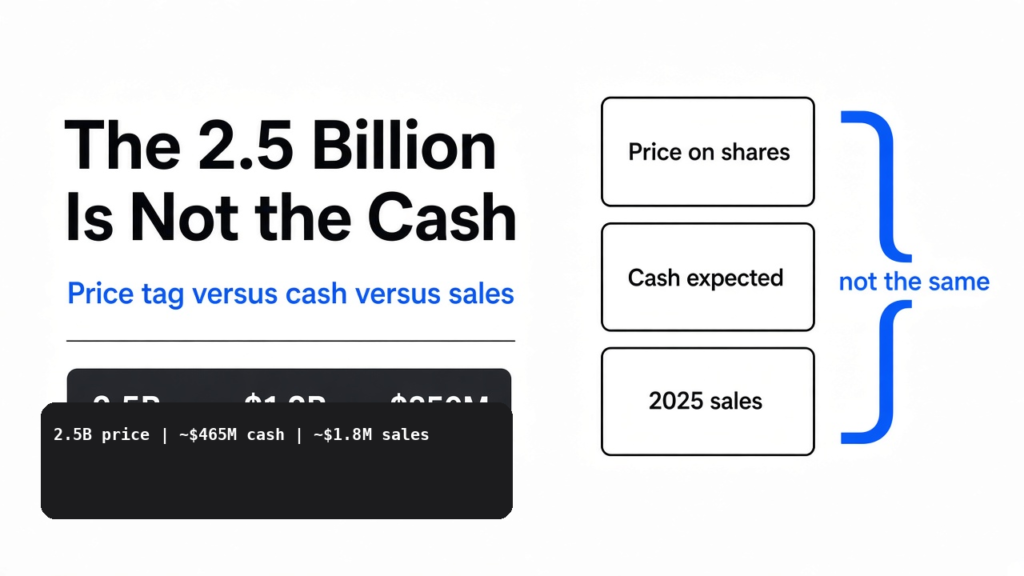

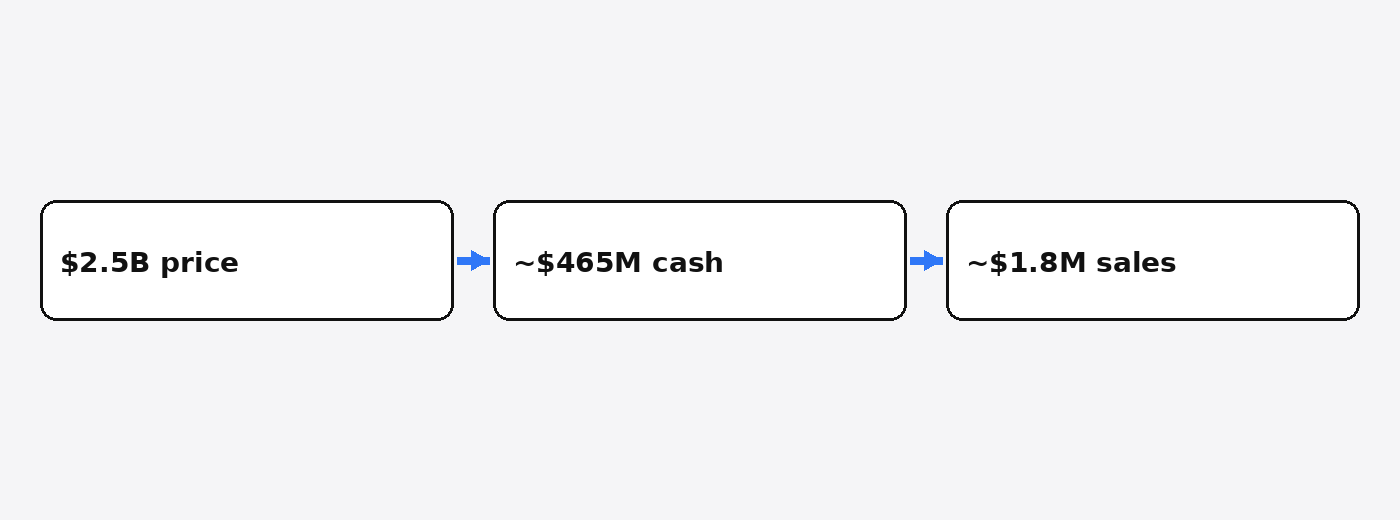
Agility Robotics SPAC math is three different numbers: a $2.5 billion share price, about $465 million of expected cash, and about $1.8 million of 2025 sales.
Shareholders said yes on 2 November 2026. That yes did not put \\$2.5 billion in a bank account. The \\$2.5 billion is the price tag the deal puts on shares that already exist. The cash Agility Robotics says it expects is about \\$465 million, before the lawyers and bankers are paid, and even that pile is three smaller piles taped together. Last year’s sales, as reported from the merger paperwork, were about \\$1.8 million. If you remember one line, remember that those three numbers are not the same kind of thing.
A share (a slice of ownership you can sell to someone else) is not cash. A price on a slice is not cash either. Cash is the money that can pay wages and buy parts. The rest of this page is the same idea, walked slowly, because the headline glues the three numbers into one.
what happened on 2 november
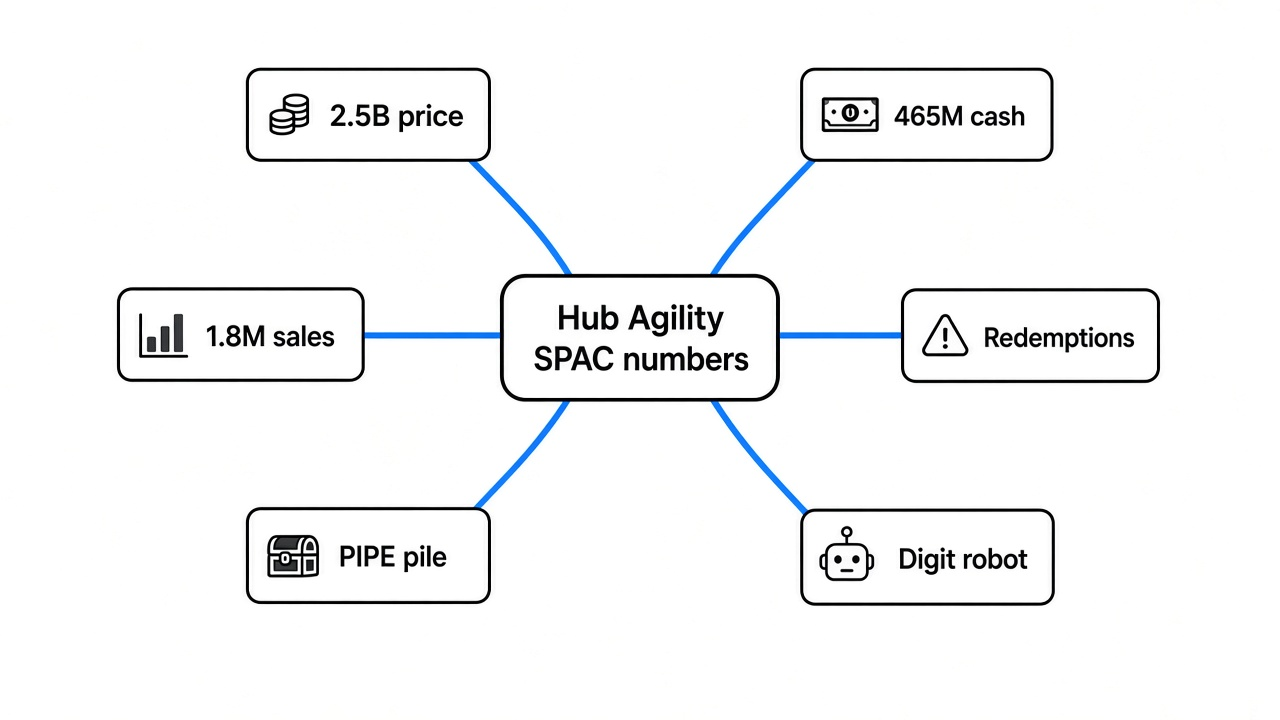
Churchill Capital Corp XI held a special meeting. Churchill is the SPAC (a company that sold shares to the public first, parked the money, and went looking for a real business to buy). Agility is the real business: it builds Digit, a humanoid (a robot with two legs, two arms, and a body meant to fit a workplace built for a person). Agility’s own release says more than 84 percent of votes cast were in favor. The companies expect the deal to close on 4 November 2026, and they expect the stock to trade on Nasdaq as AGLT, and the warrants as AGLTW, on 5 November. Expected means the closing conditions still have to be met. This page was written on 3 November, so the close had not happened yet.
| What the sentence sounds like | What it actually is | The number | Where it comes from |
|---|---|---|---|
| The company is worth \\$2.5 billion | Pre-money equity value (the price put on the old Agility shares, before new cash is added) | \\$2.5 billion | Deal terms, repeated by The Robot Report on 2 November 2026 |
| Agility is raising \\$2.5 billion | Gross capital (money from the deal and related sales of new shares, before expenses) | about \\$465 million | Agility release, 2 November 2026 |
| The robot business already sells at that scale | Net sales for 2025 | about \\$1.8 million | The Robot Report, 7 September 2026, citing the S-4 (the long merger filing) |
| Customers have already paid \\$300 million | Committed multi-year orders for Digit 5, subject to milestones | more than \\$300 million | Company figure, repeated in the same coverage; not current revenue |
a share is a claim, not a box of money
Start smaller than a robot. Suppose a bakery has no cash and one oven. You and a friend each own half. A stranger offers \\$100 for your half. The bakery is not holding \\$200. The stranger is offering \\$100 for your claim on whatever the bakery later earns. If the bakery earns nothing, the claim can be worth nothing. The \\$100 was a price. It was never cash inside the shop.
Pre-money (before the new money) is that kind of price, applied to every old share at once. Agility’s old owners are not being paid the \\$2.5 billion in cash. The Robot Report says they roll their equity (they swap their old Agility shares for shares of the combined company and stay owners). A roll is a trade of paper for paper. It is not a paycheck.
what a spac is, from an empty box
A normal listing is backwards from a SPAC. A normal company works for years, then sells shares so strangers can own a piece. A SPAC sells the shares first. The buyers hand over cash. That cash sits in a trust (a locked account the company cannot freely spend). The SPAC then has a deadline to find a company. If it finds one, and shareholders agree, the trust money and the company combine. If too many shareholders hate the company, they can leave, and they take their slice of the trust with them.
Redeem (hand the share back and take the trust cash instead of joining the merger) is a separate choice from voting yes. You can imagine a club: people vote to let a new member in, and some of the same people still walk out with their deposit. Both can be true on the same night. That is what this vote was.
Summaries of the 2 November 2026 Form 8-K, including StockTitan’s filing summary and Venture Atlas, say holders redeemed 25,451,804 Class A shares, about 61.5 percent of that class at the deadline, for about \\$261.8 million, or about \\$10.29 a share. That is why the cash shrank. In June the companies talked about more than \\$620 million of gross proceeds if redemptions were light. After the deadline, Agility’s 2 November release put the expected gross capital at about \\$465 million, before transaction expenses.
the \\$465 million is three piles
Agility’s release splits the expected gross capital into three piles. None of them is the \\$2.5 billion.
| Pile | About how much | What it is |
|---|---|---|
| Trust, after people left | \\$164 million | What remained of the public cash once redemptions were taken out |
| PIPE at \\$10 a share | \\$201 million | A private sale of new shares to named investors. Foxconn is leading it. PIPE means private investment in public equity (big investors buy new shares beside the public deal, at an agreed price, instead of only in the open market) |
| Already received | \\$100 million | Equity funding Agility says it already got after the deal was announced |
Gross (before expenses) means the headline sum still has to pay the deal’s own costs. Net cash into the business is smaller than \\$465 million. I do not have a final net figure, because the close had not happened on the day I wrote this, and the release does not subtract the bill.
Loop back to the bakery. The \\$2.5 billion is the stranger’s price for the old claim. The \\$465 million is new flour money, and only if each pile arrives as planned. The \\$1.8 million is what the bakery sold last year. A person who adds them, or who picks the biggest one and calls it “the raise,” is mixing a price, a funding plan, and a sales receipt.
what the robot is actually doing
Digit is not a general worker. The job Agility talks about is narrow on purpose: move a tote (a standard plastic box a warehouse already uses) through a building whose aisles, shelves, and doors were sized for a person. The Robot Report, writing on 2 November, says Digit robots are described as operating in nine customer environments, with logistics and manufacturing as the main markets. The earlier S-4 language, as reported in September, was more careful: deployed or committed for deployment across nine customer facilities, with more than 65,000 hours of operation. “Committed” includes a site that is planned, not only a robot that worked a shift this morning. The hours figure is tied, in write-ups of the filing, to about May 2026, not to this week.
Named relationships, as reported by The Robot Report from the companies: GXO Logistics has worked with Agility since 2023, signed a multi-year RaaS agreement in 2024 for a site in Flowery Branch, Georgia, and in October 2026 expanded toward facilities in Statesville, North Carolina, and Lebanon, Tennessee. AGCO signed a commercial agreement to pilot Digit at a plant in Hesston, Kansas, beginning in 2027. RaaS (robots as a service) means the customer pays over time and the vendor keeps owning the machine, closer to a rental than to buying a forklift outright.
Digit 5 is the next machine, not the one filling those hours. The Robot Report says it was unveiled with redesigned legs and new batteries, early access is aimed at the first half of 2027, and general availability is aimed at the end of 2027. Some earlier deployments are described as starting on the current Digit and moving to Digit 5 when it exists as a product. A picture of a robot next to a box is a demonstration (a controlled showing). A product is a machine you can order, receive, and run without the vendor’s film crew.
why a warehouse wants a body at all
A warehouse is a stack of choices made for human bodies. Shelves are about as tall as an arm. Aisles fit a walking person, not a car. A tote has handles a hand can close on. A conveyor starts at waist height. If you replace the person with a robot arm bolted to the floor, you often have to rebuild the shelf, the aisle, or the tote. A humanoid is an attempt to skip that rebuild: keep the building, swap the body.
That trade is the whole product. Legs are not there because legs are elegant. Legs are there because stairs, thresholds, and gaps were already built. If the building can be changed, a wheeled robot or a fixed arm is usually the simpler machine. Simpler means fewer ways to fall, and fewer motors to feed.
why standing is a physics problem
Gravity pulls every bit of the robot toward the floor. Those pulls add up at one balance point, the center of mass (the single spot where the whole weight can be treated as hanging). If that spot stays above the feet, the floor’s push can cancel the weight and the robot stays up. If the spot wanders past the edge of the feet, the floor cannot help, and the robot rotates into a fall. You already know this. Stand on a bus. When the bus brakes, your balance point slides forward of your shoes unless you step. The step is not style. The step moves the feet back under the weight.
An actuator (a motor plus gearing that turns an electrical command into a shove at a joint) has to make that step before the fall finishes. A person does it with muscles and an inner ear, many times a second, without thinking. A robot has to measure tilt, decide, and move the motor while also holding a tote that shifts the balance point every time the arm moves. Add a payload and the balance point moves. That is why a backflip in a lab and a full shift in an aisle are different sports. The backflip can be one rehearsed motion. The aisle is a new shove every few seconds, from a box that is heavier than the last one, on a floor that is not the lab floor.
Engineers name one version of this test the zero moment point (the spot on the ground where the tipping forces balance, so the foot is not being asked to twist the robot over). You do not need the name to use the test. If the weight’s shadow leaves the shoe, something has to step, catch, or fall. Batteries make the same problem worse, because a battery heavy enough for a shift is weight you must also balance, and a motor that steps hard is a motor that empties the battery.
why the hand is harder than the walk
Walking, hard as it is, repeats. A hand meets a new shape every time. A tote is rigid, which is why this product starts there. A shirt, a cable, or a part that can roll away is a different problem. The fingers have to push hard enough to hold and gently enough not to crush. They also have to feel slip. A camera sees the outside. Slip happens at the skin, which the camera does not touch.
So “it can walk” does not answer “it can do the job.” The job is the loop: see, reach, hold, place, and still be standing, then do it again until the shift ends. Agility’s commercial claim is that loop for totes, in a few real buildings, for tens of thousands of hours, not that the machine can do any physical task a person can do.
orders are reservations, sales are paid meals
A restaurant can have a book full of Saturday reservations and an empty till on Monday. The reservation is a promise with conditions. The meal is revenue (money recorded because the work was delivered and the customer was charged). Agility says it has more than \\$300 million in committed multi-year orders for Digit 5. Write-ups of the S-4 describe that book as one customer, on the order of 1,000 robots over about three years, and still subject to milestones, features, and specifications. One customer means one cancellation, or one missed milestone, moves the whole number. The Robot Report’s point on 2 November is the right one: that figure is interest, and it is not current revenue.
The sales receipt is the small number. The Robot Report, on 7 September 2026, said the S-4 showed about \\$1.8 million of net sales in 2025 and about a \\$140 million operating loss (costs of running the company, above those sales). It also said operating spending was about \\$111 million, up from about \\$71 million in 2024, and that cash burn in 2025 was about \\$100 million. Two later write-ups of the same filing, Humanoids Daily and Ontic Post, put 2025 net sales at \\$1,782,000 and related-party sales at about \\$1.13 million. A related party (a buyer that also has a tie to the company, such as an owner) is not a fully outside customer. If those write-ups are right, most of an already tiny sales line was not an arm’s-length purchase. I am citing their reading of the filing, not a table I pulled from EDGAR myself.
The same filing, as quoted by outlets that reviewed it, says that without the merger Agility’s management concluded there was substantial doubt it could continue as a going concern (the plain-language test: can it pay its bills for the next year with the cash it already has). That is why the \\$465 million matters more than the \\$2.5 billion. The price tag does not pay payroll. The cash might, if it arrives and if it lasts longer than the spending.
| 2025, as reported from the S-4 | What people confuse it with | |
|---|---|---|
| Net sales | about \\$1.8 million | The \\$2.5 billion price |
| Operating loss | about \\$140 million | A profit hiding somewhere in the orders |
| Digit 5 orders | more than \\$300 million, multi-year, conditional, described as one customer | Money already earned |
| Hours | more than 65,000, across nine facilities deployed or committed | Proof the 2027 machine is already generally available |
The Robot Report also reported an illustrative RaaS price Agility has used: about \\$8,500 a month. Illustrative means a worked example, not a contract I have read. At that rate, 1,000 robots on rent for a year would be 1,000 times \\$8,500 times 12, which is \\$102 million a year, before you ask who pays, who cancels, or how many machines are actually up. That illustration is the gap. It is not a forecast. It is the distance between a rate on a slide and a year of invoices.
the other headline this week is older money
On 2 November, Reuters reported a different robot story that is easy to misread as “China just wrote a \\$13 billion check.” It did not. Reuters, citing the research firm ITjuzi, said Chinese embodied-AI companies raised 93.5 billion yuan, which Reuters gave as \\$13 billion, across 322 deals in the first half of 2026. That was five times the amount in the same half of 2025. First half means January through June. The news on 2 November was the race, not a new round closing that morning.
Embodied AI (software whose job is a body in a room: see, choose, and move, rather than only reply with text) is the word Reuters uses for the bet. The hardware can already dance and flip. The money is moving toward the brain, because a body that cannot learn a new task is a costume. Reuters quotes a Shanghai consultant, Dermot McGrath, that robot makers have concluded the margin will not come from the hardware but from the brain, as competition pushes hardware prices down. Margin (what is left of the selling price after the cost of the thing) is the point of that sentence. If every factory can build a pair of legs, the legs become cheap, and the scarce piece is the software that makes the legs useful on a new task without a fresh engineering project.
Reuters names three American software efforts in that race: Physical Intelligence, Skild AI, and Generalist. It says Generalist’s GEN-1.5 completed around 60 percent of simple tasks after a demonstration lasting 3 to 12 seconds. A demonstration here means a person shows the task once, briefly, and the model tries to copy it. Sixty percent of simple tasks is not a warehouse shift. It is a measurement of a research system, and it is useful because it is modest. Reuters also says specialist Chinese startups including X Square, Galaxea, and Spirit AI have each reached valuations of roughly \\$3 billion, according to company disclosures. A valuation (someone’s price for the shares) has the same trap as Agility’s \\$2.5 billion. It is not revenue, and it is not cash in the operating account.
Put the two stories on one table and the week is less confusing. The United States just voted a humanoid company toward the public market, at a \\$2.5 billion pre-money price, with about \\$1.8 million of 2025 sales and a cash plan near \\$465 million after most public holders took their money back. China, in the first half of the year, put about 93.5 billion yuan into the wider embodied-AI category, much of it still private and much of it, by Reuters’ telling, aimed at software. One is a single listing. The other is a pile of venture checks. They are not a scoreboard with one winner on 3 November.
what not to conclude
Do not buy, sell, or short anything because of this page. I am explaining the words in the headline.
Do not read “approved” as “closed.” The release says the close is expected on 4 November 2026, subject to conditions. A vote is permission. A close is the moment the shares and the cash actually move.
Do not read Digit 5’s order book as 2026 revenue. The machine’s general availability is aimed at the end of 2027. Early access is aimed at the first half of 2027. Milestones can slip, and one customer is a concentration, not a market.
Do not read a Beijing stage, or a warehouse photo, as a census of robots doing useful work. Count invoices, hours on a named site, and tasks that repeat when nobody is filming.
the loop, in one page
A company is a claim on future cash. A SPAC is an empty listed shell holding a locked pile of other people’s cash until it finds a company. Shareholders can approve the find and still take their cash home. That is the 84 percent yes beside the roughly 61 percent redemption. What remains, plus a private share sale, plus money already taken in, is the about \\$465 million. The \\$2.5 billion never joins that pile. It is the label on the old shares.
The machine those shares refer to is a body trying to do a person’s chore without rebuilding the building. Staying upright means keeping the weight over the feet while the hands move the weight. The hands are a second problem, because each object pushes back differently. The evidence so far is hours and a few named logistics sites, not a general worker, and not a 2025 sales line anywhere near the price on the shares.
The same week, the other large number in robot news was a first-half funding total for embodied AI in China. It is real, it is large, and it is not cash that arrived on 2 November. Treat every large number as a question: price, cash, sales, order, or valuation. If the sentence does not say which, it is not yet a fact you can use.
Common questions about the Agility SPAC number
Is the $2.5 billion cash Agility can spend?
No. It is the pre-money price on old shares. The expected gross capital in the 2 November 2026 release is about $465 million before expenses.
Did the shareholder vote put money in the bank?
The vote approved the combination. Cash still depends on closing conditions and the three piles (trust remainder, PIPE, already received).
What did we verify for this page?
We checked the arithmetic on the published vote counts (yes votes over votes cast land near 84 percent) and lined the three headline numbers against Agility’s 2 November release and Robot Report coverage of the S-4. We did not trade the stock.